01Facts
The complainant, Daljit Singh, sought a bank loan to construct on a 54 sq. yd. plot owned by his mother. The bank required 30 years' revenue records and a Patwari's inspection report.
¶ 2The complainant approached the petitioner, Mandeep Singh, a Patwari, who directed him to co-accused Gurpreet Singh Soni, a karinda. Soni allegedly demanded Rs. 7,000, and Rs. 1,000 was paid.
¶ 2The petitioner allegedly told the complainant over the telephone that the fard was with him, already signed, and to collect it from Soni. The complainant recorded this conversation on CD.
¶ 2Rs. 5,000 in trap currency was then handed over.
¶ 2The FIR was registered on 01.11.2022 under Sections 7 and 7-A of the Prevention of Corruption Act, 1988 and Section 120-B IPC.
¶ 1The trap led to Soni's arrest, and the recovery was made from Soni alone.
¶ 3, 4, 10The petitioner contends that he never demanded a bribe and that the complainant has a prior conviction. On 07.12.2023, in FIR No. 2 of 2017 under the PC Act, the complainant was convicted under Sections 7 and 13(1)(d) r/w 13(2) and sentenced to five years' rigorous imprisonment and a fine of Rs. 10,000. His appeal (CRA-S-622-2024) was admitted, and the sentence was suspended.
¶ 5Charges were framed on 16.12.2025 on the challan dated 17.09.2025, which the petitioner challenges.
¶ 1, 3The FSL report found that the voices in the telephonic conversations matched.
¶ 10The State opposed the petition, arguing that the complainant's prior conviction does not decide the present case and that facts can be determined only at trial.
¶ 702Issues
i.1. Whether the FIR and consequential proceedings, including the challan and the order framing charges against the petitioner, should be quashed at this stage, given the absence of direct evidence of demand or acceptance by him and the complainant's prior conviction in a similar case.
¶ 4, 5, 6, 8ii.2. Whether the order framing charges is sustainable, having regard to whether it is speaking and whether the investigation material and relevant circumstances were adequately considered.
¶ 6, 11iii.3. Whether, at the charge-framing stage, the trial court must examine the entire investigation report and assess the specific circumstances identified by the Court, including the complainant's prior conviction and the call records and voice evidence.
¶ 903Law Applied
The Court proceeded under Section 528 BNSS, 2023, the successor to the inherent-jurisdiction provision, to examine quashing.
¶ 1At the framing-of-charges stage, the trial court must examine the entire investigation report to decide whether the material, even if it raises only strong suspicion, is sufficient to proceed to trial.
¶ 9A charge order must be reasoned and must consider the material collected during investigation.
¶ 9, 11The offences considered were Sections 7 and 7-A of the PC Act, 1988 and Section 120-B IPC.
¶ 1The Court referred to Section 173 CrPC for the investigation report but did not cite any precedent.
¶ 6, no citationProvisions in the judgment · 5 · Linked ones open on LawLens
Bharatiya Nagarik Suraksha Sanhita, 2023 Section 528
Prevention of Corruption Act, 1988 Section 7Section 8Section 13
Code of Criminal Procedure, 1973 Section 173
04Reasoning
The Court declined to quash the FIR, holding that the merits could not be decided at this stage without expressing a final opinion.
¶ 9The Court identified circumstances that raise prima facie suspicion against the petitioner. The fard was allegedly signed before the balance payment was made. The petitioner was found seated beside the co-accused, which the prosecution treats as a strong circumstance.
¶ 10The call transcripts between the petitioner and the complainant, and the FSL voice-matching finding, required examination for any common intention.
¶ 10The Court flagged, for examination, whether the investigating agency knew of the complainant's prior prosecution and conviction, and whether that case involved similar allegations.
¶ 9(i)–(ii)The Court framed further questions about the absence of direct demand, recovery from the petitioner, and call records establishing any agreement.
¶ 9(iii)–(iv)The Court found the charge order "cryptic and non-speaking" because it did not consider the investigation material and relevant circumstances adequately, and set it aside while leaving the merits open.
¶ 11The reasoning reflects a distinction between quashing an FIR, which requires the absence of any offence, and a defective charge order, which can be corrected by a reasoned fresh decision.
¶ 9, 11The Court did not decide whether the complainant's conviction affects the present prosecution and left that issue to the trial court.
¶ 9(i)–(ii)05Holding
Quashing of the FIR is not warranted at this stage, since the merits require trial.
¶ 9–10The order framing charges is cryptic, non-speaking, and fails to consider the investigation material.
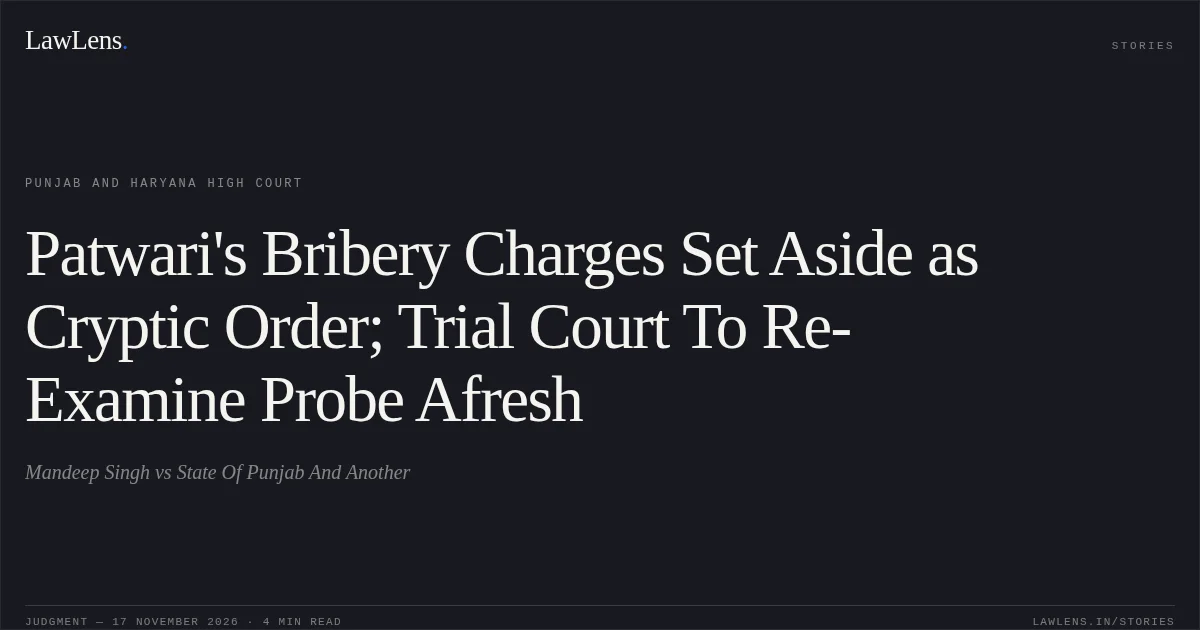
¶ 11The petition is partly allowed. The impugned order of charge and the charge-sheet are set aside. The trial court is directed to re-examine the entire investigation report afresh, consider all issues raised by the petitioner and the other material on record, and pass a fresh reasoned order on whether the allegations and evidence are sufficient to frame charges against the petitioner.
¶ 11, 12The petition is disposed of.
¶ 13Original Court PDF
Mandeep SinghvsState Of Punjab And Another
Click to open original judgment
Original judgment, available to read, download and summarize on LawLens.in