01Facts
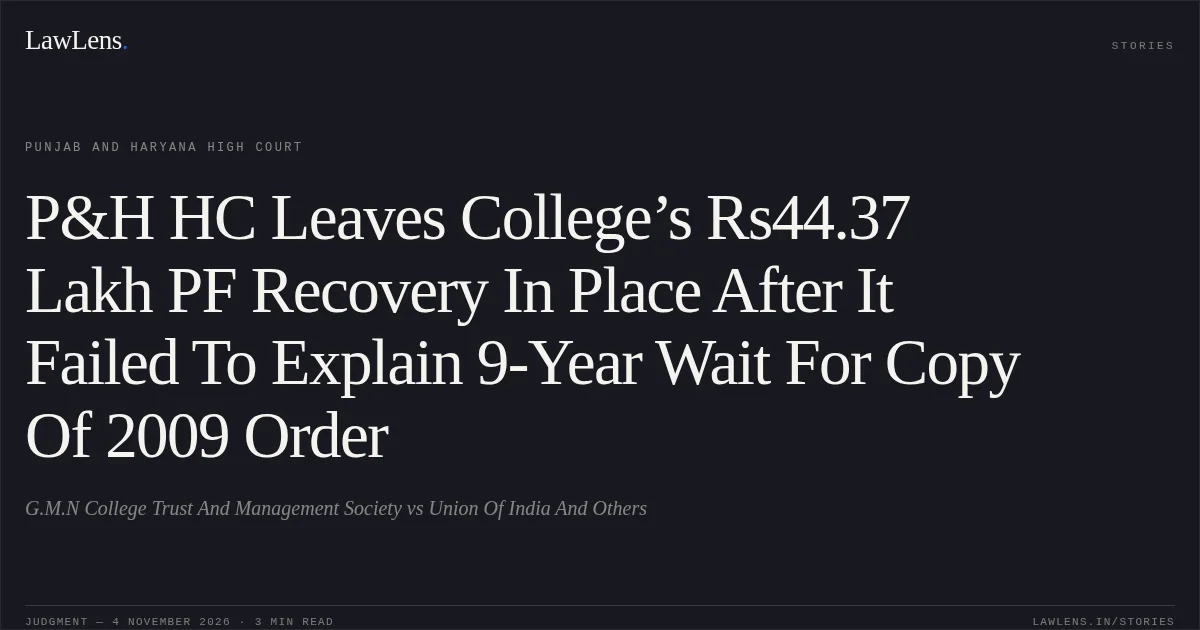
An assessment order dated 25 April 1994 determined provident fund dues of ₹44,36,532 against the petitioner for August 1982 to October 1991.
¶ 2The petitioner challenged the assessment in a writ petition, which was disposed of on 5 March 2009 with liberty to pursue a statutory appeal within two months of receiving the certified order and with recovery stayed pending determination of the claim.
¶ 2, 9The petitioner claimed it received the certified copy on 1 January 2018 and filed an appeal on 12 January 2018, accompanied by an application to condone delay.
¶ 3The Tribunal dismissed the application and appeal on 17 March 2020, holding that it could not condone delay beyond the maximum period prescribed by Rule 7(2).
¶ 3–4The petitioner then sought to quash the Tribunal’s order and a recovery order dated 30 November 2017, or alternatively to have its appeal entertained.
¶ 102Issues
i.Whether the Tribunal could condone delay in filing an appeal under Section 7-I of the Employees’ Provident Funds and Miscellaneous Provisions Act, 1952 beyond the maximum period under Rule 7(2) of the 1997 Rules
¶ 8ii.Whether the Tribunal’s refusal to condone delay, and the consequential recovery proceedings, warranted interference under Articles 226 and 227 of the Constitution
¶ 14–1803Law Applied
Section 7-I of the Employees’ Provident Funds and Miscellaneous Provisions Act, 1952 provides for a statutory appeal, while Rule 7(2) of the Employees’ Provident Fund Appellate Tribunal (Procedure) Rules, 1997 prescribes 60 days for filing an appeal, extendable by a further 60 days for sufficient cause; the Tribunal has no jurisdiction to condone delay beyond that maximum period.
¶ 4, 10Section 5 of the Limitation Act, 1963 cannot be invoked to enlarge a statutory limitation period where the statute restricts the power of condonation.
¶ 4, 10The Court relied on Assistant Commissioner (CT), LTU, Kakinada v. M/s. Glaxo Smith Kline Consumer Health Care Limited, 2020 AIR (SC) 2819, and Chhattisgarh State Electricity Board v. Central Electricity Regulatory Commission, (2010) 5 SCC 23, as well as the Division Bench decision in Indira Gandhi National College, Ladwa v. Union of India and Others, LPA-2392-2026, decided 30 October 2026, on the limits of statutory condonation.
¶ 9–10The protection against recovery granted in the earlier writ proceedings was tied to pursuit and determination of the claim before the competent forum, not an indefinite bar on recovery.
¶ 15–16Provisions in the judgment · 1 · Linked ones open on LawLens
Limitation Act, 1963 Section 5
04Reasoning
Although the petitioner claimed to have appealed promptly after receiving the certified copy, it gave no satisfactory explanation for waiting nearly nine years after the disposal of its own writ petition before obtaining that copy.
¶ 11–12The Tribunal therefore had grounds to reject the condonation application; in any event, it lacked jurisdiction to extend the statutory period beyond 120 days.
¶ 10, 13The earlier protection against recovery did not permit the petitioner to resist recovery indefinitely after its appeal was dismissed as time-barred.
¶ 15–16Nor could the petitioner use the present proceedings to reopen the merits of the 1994 assessment, which remained in force; its 2017 representation did not extend limitation or make that assessment unenforceable.
¶ 15–1705Holding
The Court held that no jurisdictional error or patent illegality justified interference with the Tribunal’s order, and that the petitioner had shown no ground to quash the recovery order or obtain a refund.
¶ 14, 18The writ petition was dismissed.
¶ 19Original Court PDF
G.M.N College Trust And Management SocietyvsUnion Of India And Others
Click to open original judgment
Original judgment, available to read, download and summarize on LawLens.in