01Facts
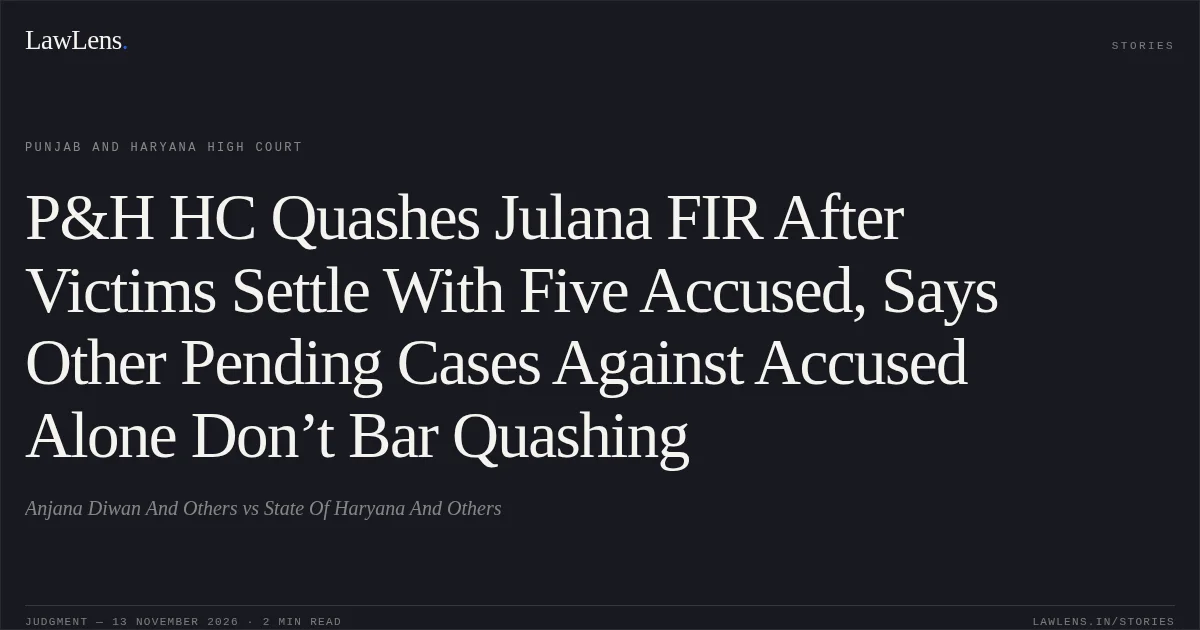
The petitioners sought quashing of FIR No. 108 dated 24 April 2024, registered at Police Station Julana, District Jind, under Sections 148, 149, 323, 324, 427 and 506 of the Indian Penal Code, 1860, and the consequential proceedings, on the basis of a compromise.
p. 1The complainant and other victims, as well as all five accused, appeared before the Judicial Magistrate First Class, Jind, and made statements confirming that the settlement was voluntary and free from coercion. The Magistrate reported that the compromise was genuine; no accused had been declared a proclaimed person or offender.
pp. 1–3The report also disclosed criminal cases pending against some accused. The State did not dispute the compromise.
pp. 3–502Issues
i.Whether the High Court should exercise its inherent jurisdiction under Section 528 of the Bharatiya Nagarik Suraksha Sanhita, 2023, to quash the FIR and consequential proceedings on the basis of the parties’ compromise.
pp. 1, 5–6ii.Whether the criminal antecedents disclosed in the Magistrate’s report, by themselves, precluded quashing.
p. 503Law Applied
Section 528 of the Bharatiya Nagarik Suraksha Sanhita, 2023, preserves the High Court’s inherent power to prevent abuse of the process of court and secure the ends of justice.
p. 1Relying on Kulwinder Singh v. State of Punjab, 2007 (3) RCR (Criminal) 1052, and Gian Singh v. State of Punjab, (2012) 10 SCC 303, the Court applied the principle that criminal proceedings may be quashed on the basis of a genuine settlement where the dispute is private in nature and quashing would not adversely affect public interest or have wider societal consequences.
p. 5Criminal antecedents are relevant but cannot, standing alone, determine whether proceedings should be quashed.
p. 5Provisions in the judgment · 32 · Linked ones open on LawLens
Indian Penal Code, 1860 18 provisions
Section 34Section 143Section 148Section 149Section 307Section 308Section 323Section 324Section 325Section 341Section 382Section 395Section 398Section 427Section 452Section 500Section 505Section 506Bharatiya Nagarik Suraksha Sanhita, 2023 Section 528
Bharatiya Nyaya Sanhita, 2023 Section 3Section 115Section 126Section 189Section 351
Arms Act, 1959 Section 3Section 5Section 25Section 27
rajasthan excise act, 1950 Section 16Section 19Section 54Section 58
04Reasoning
The Magistrate’s report confirmed that the complainant, victims and accused had voluntarily settled the dispute, and the State raised no objection.
pp. 2–5The Court treated the dispute as personal and inter se, with no wider societal ramifications or adverse effect on public interest.
p. 5Although criminal antecedents had been reported for some accused, the Court held that they were not, by themselves, sufficient to defeat the petition. In these circumstances, it considered continuation of the proceedings futile and an abuse of process.
p. 505Holding
The Court allowed the petition and quashed FIR No. 108 dated 24 April 2024, under Sections 148, 149, 323, 324, 427 and 506 IPC, registered at Police Station Julana, District Jind, together with all consequential proceedings, qua the petitioners.
p. 6Pending miscellaneous applications, if any, were disposed of.
p. 7Original Court PDF
Anjana Diwan And OthersvsState Of Haryana And Others
Click to open original judgment
Original judgment, available to read, download and summarize on LawLens.in