01Facts
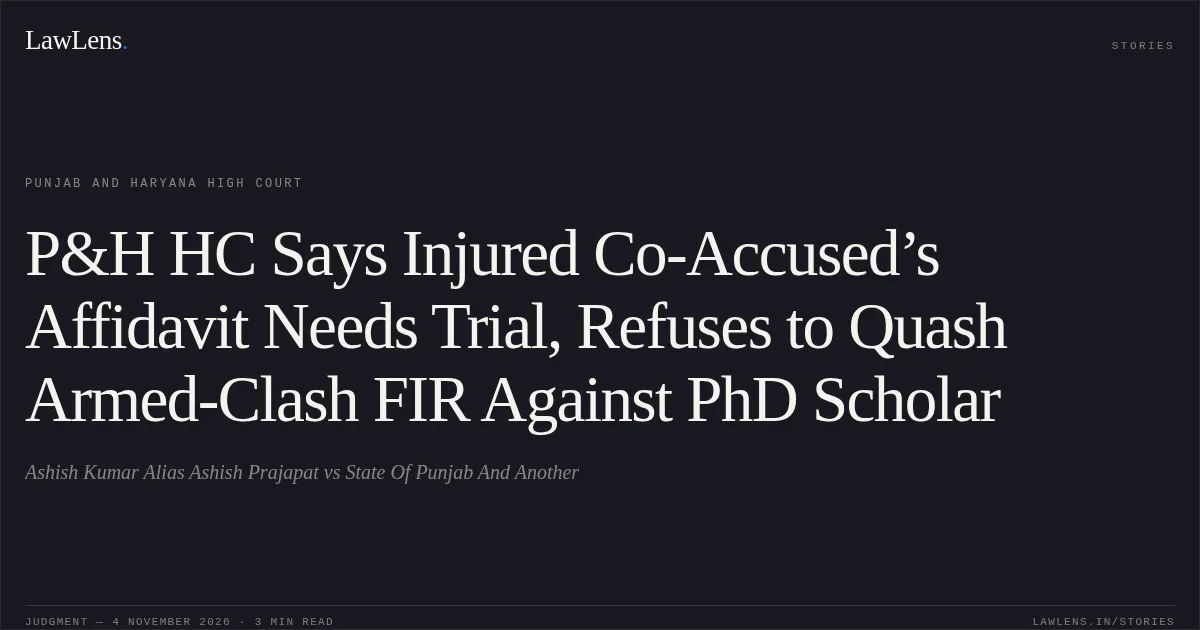
FIR No. 60 dated 4 May 2024 was registered under Sections 160, 307, 148, 149 and 201 IPC and Section 25 of the Arms Act, 1959, following a reported armed fight in which respondent No. 2 sustained a firearm injury.
¶ 1–3The petitioner was named in the FIR and, after an inquiry, was found by the Superintendent of Police to be rightly accused; he was sent up for trial, but charges had not been framed.
¶ 1–3The petitioner sought quashing of the FIR, final report and consequential proceedings, relying on the injured respondent’s affidavit and reply supporting him, a witness statement, CCTV footage, the asserted absence of any overt act or weapon recovery, and the discharge of certain co-accused.
¶ 4–5The State opposed the petition, arguing that the allegations and the petitioner’s role should be assessed at trial.
¶ 602Issues
i.1. Whether the material relied on by the petitioner justified quashing the FIR and consequential proceedings under Section 528 BNSS.
¶ 8–10ii.2. Whether the respondent’s affidavit, witness statement, CCTV footage and asserted parity with co-accused established that the petitioner was merely a bystander and not a member of the unlawful assembly.
¶ 11–14iii.3. Whether the remaining pleas, including the absence of weapon recovery and the alleged failure to make out offences under the Arms Act and Section 201 IPC, should be considered at the quashing stage or before the trial court at the framing-of-charge stage.
¶ 1703Law Applied
Section 528 of the Bharatiya Nagarik Suraksha Sanhita, 2023, corresponding to Section 482 CrPC, empowers the High Court to prevent abuse of process and secure the ends of justice, but is not ordinarily used to assess disputed facts that require trial.
¶ 8Under State of Haryana v. Bhajan Lal, 1992 Supp (1) SCC 335, illustrative categories for quashing include cases where the allegations, taken at face value, disclose no offence, are inherently improbable, or the proceedings are maliciously instituted.
¶ 8–9Under Rajiv Thapar v. Madan Lal Kapoor, (2013) 3 SCC 330, defence material may support quashing only if it is sterling and impeccable, rules out the prosecution’s assertions, is unrefuted or cannot justifiably be refuted, and shows that continuing the trial would amount to an abuse of process.
¶ 9Further, State of Madhya Pradesh v. Laxmi Narayan, (2019) 5 SCC 688, recognises that offences under Section 307 IPC and the Arms Act are generally serious offences against society; the court may examine the evidence and circumstances rather than rely solely on the section invoked.
¶ 15Provisions in the judgment · 10 · Linked ones open on LawLens
Bharatiya Nagarik Suraksha Sanhita, 2023 Section 528
Indian Penal Code, 1860 Section 160Section 307Section 148Section 149Section 201
Arms Act, 1959 Section 25
Code of Criminal Procedure, 1973 Section 482Section 156Section 155
04Reasoning
The Court held that the petitioner’s material did not satisfy even the first Rajiv Thapar step: he was named in the FIR, and the police inquiry supported his prosecution.
¶ 10The injured respondent’s affidavit was not conclusive because he was himself an accused, had not joined the investigation, and the affidavit did not explain the occurrence or the petitioner’s presence; its weight could be tested at trial.
¶ 11The witness statement placed the petitioner at the scene among those watching the fight, while the bail order did not determine his innocence and the CCTV footage’s evidentiary effect was for trial.
¶ 12The Court also rejected parity because the inquiry had distinguished the petitioner from co-accused declared innocent, and held that whether he shared the unlawful assembly’s common object was a factual question.
¶ 13–14The serious firearm injury and circumstances of the incident further distinguished the case from the settlement-based decision relied on by the petitioner.
¶ 15His remaining pleas could be raised before the trial court at the framing-of-charge stage.
¶ 1705Holding
The Court dismissed the petition and refused to quash the FIR, final report or consequential proceedings against the petitioner.
¶ 19It permitted him to raise all available pleas before the trial court at the framing-of-charge stage, to be decided on their merits and uninfluenced by the High Court’s observations.
¶ 20The injured respondent was also permitted to join the investigation; if he did so, the investigating agency was directed to record his statement and take further action in accordance with law.
¶ 18Original Court PDF
Ashish Kumar Alias Ashish PrajapatvsState Of Punjab And Another
Click to open original judgment
Original judgment, available to read, download and summarize on LawLens.in