01Facts
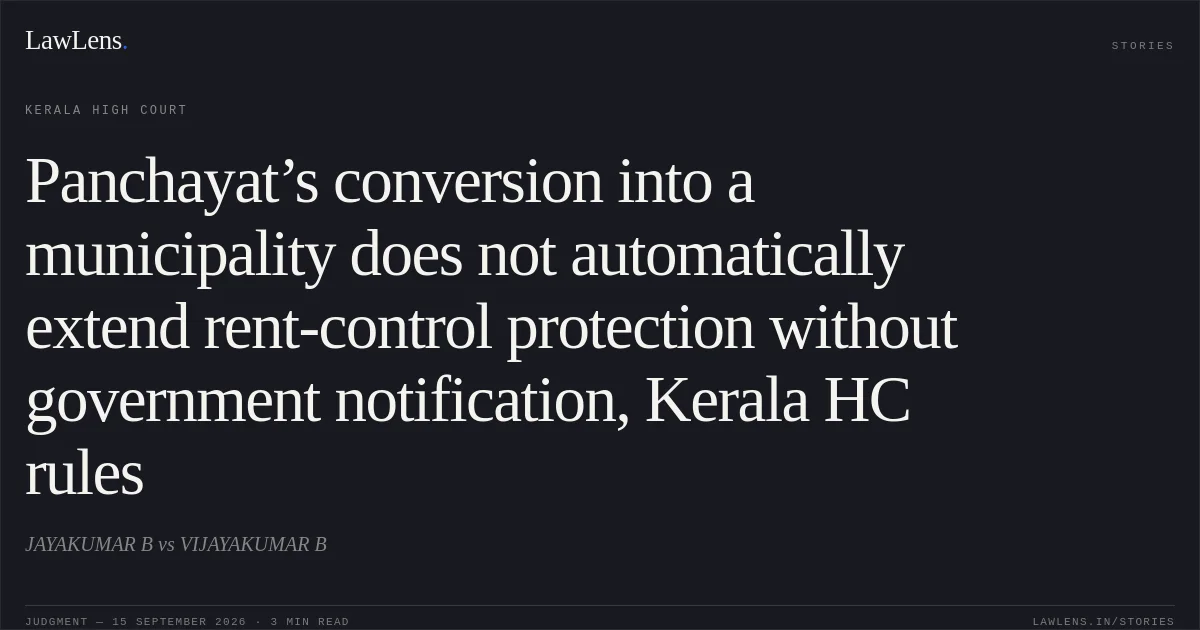
The petitioner, Jayakumar B, claimed to be the landlord and the respondent, Vijayakumar B, the tenant of the premises.
The petitioner issued a statutory notice dated 10 June 2026 and thereafter presented a Rent Control Petition under Section 11(2) of the Kerala Buildings (Lease and Rent Control) Act before the Rent Control Court, Neyyattinkara.
p. 8The proceedings raised the question whether the Rent Control legislation applied to an area that had formerly been within a Panchayat but was subsequently included within municipal limits.
The petitioner challenged the order/judgment in the interlocutory proceedings before the High Court under Article 227 of the Constitution.
p. 102Issues
i.1. Whether the Kerala Buildings (Lease and Rent Control) Act automatically becomes applicable to an area merely because a Panchayat is subsequently converted into, or included within, a Municipality, without a further notification under Section 1(3) of the Act?
¶ 4 · Vadavathi Rajeevan, quoted at pp. 5–6ii.2. Whether the observations in Kuruvilla Abraham v. John required the landlord to proceed only under the Rent Control legislation after the premises became part of a Municipality?
¶ 4–6iii.3. Whether the petitioner was entitled to admission or interference in the present original petition?
¶ 803Law Applied
The Court applied Section 1(3) of the Kerala Buildings (Lease and Rent Control) Act, 1965, holding, in accordance with the Full Bench decision in Vadavathi Rajeevan v. K. Vanaja, that the Schedule to the Act does not automatically vary merely because a Panchayat becomes a Municipality or because municipal limits are extended; a further notification by the State Government is required.
¶ 2–5The Court relied on the reasoning in Gopeswar Mullick v. Biraj Mohini Dassi, ILR 27 Calcutta 202, that an extension of municipal boundaries for municipal purposes does not, by itself, alter the scope of a statutory expression used in a rent or tenancy law.
¶ 2–3It distinguished Kuruvilla Abraham v. John, 1995 KHC 32, holding that the earlier decision did not determine the specific question of automatic extension of Rent Control legislation and that its relevant observation concerned the jurisdictional consequence of the notification in that case.
¶ 4–6The Court also reiterated that a judgment must be read in the context of the issue actually decided and is authority only for what it decides, relying on State of M.P. v. Ramesh Chandra Bajpai, 2009 (13) SCC 635, and Indusind Media and Communications Ltd. v. Commissioner of Customs, 2019 (17) SCC 108.
¶ 7Provisions in the judgment · 2
Bengal Tenancy Act Section 1Section 11
04Reasoning
The Court treated the later Full Bench ruling in Vadavathi Rajeevan as conclusively governing the question.
It reasoned that the mere conversion of a Panchayat into a Municipality, or the inclusion of the concerned area within municipal limits, does not automatically extend the operation of the Rent Control Act in the absence of a notification under Section 1(3).
¶ 2–5The Court adopted the contextual approach reflected in Gopeswar Mullick: municipal boundary extension for municipal administration does not necessarily modify the operation of another statute whose applicability depends on a separately defined area or notification.
¶ 2–3It further rejected the petitioner’s reliance on Kuruvilla Abraham, explaining that the earlier decision had not adjudicated the precise issue referred to and that its observation regarding the Munsiff’s jurisdiction could not be treated as a ruling that Rent Control protection automatically followed every municipal inclusion.
¶ 4–7Since the petitioner’s argument did not overcome the binding effect of Vadavathi Rajeevan, the Court found no ground to admit or interfere in the proceeding.
¶ 805Holding
The High Court held that the Rent Control legislation does not automatically become applicable to an area merely because a Panchayat is converted into, or incorporated within, a Municipality.
¶ 4–6A further notification under Section 1(3) of the Kerala Buildings (Lease and Rent Control) Act is necessary.
¶ 4–6The Court declined to admit the original petition and dismissed it, while clarifying that the dismissal would not prevent the petitioner from pursuing any other remedy available in law.
¶ 8Original Court PDF
JAYAKUMAR BvsVIJAYAKUMAR B
Click to open original judgment
Original judgment, available to read, download and summarize on LawLens.in