Facts
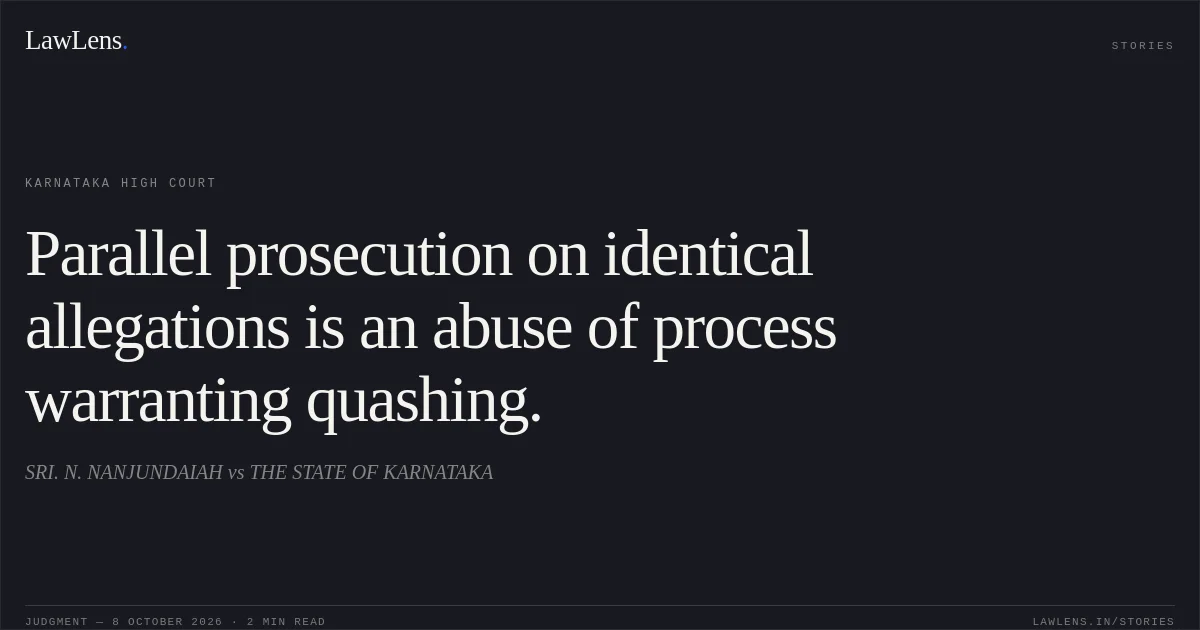
Respondents 2 and 3 filed a private complaint, PCR No. 19389/2021, alleging offences under Sections 120B, 166A, 415, 419, 420, 477 and 477A IPC.
Source reference: para. 1, 6The Magistrate referred it for police investigation under Section 156(3) CrPC, following which Basaveshwaranagar Police registered Crime No. 270/2021.
Source reference: para. 1, 6The petitioner, arrayed as accused No. 2, sought to quash the complaint and the resulting proceedings under Section 482 CrPC.
Source reference: para. 1, 6He relied on earlier decisions quashing similar complaints; the High Court noted that the present complaint’s allegations were identical to those in the earlier proceedings.
Source reference: para. 3, 6Issues
Whether the proceedings arising from PCR No. 19389/2021 should be quashed because similar proceedings concerning the same alleged offences were already pending before the Special Court.
Source reference: para. 6–8Whether the Magistrate’s referral of the complaint for investigation under Section 156(3) CrPC, by an allegedly unreasoned order, provided a further ground to quash the proceedings.
Source reference: para. 7Law Applied
Section 482 CrPC empowers the High Court to quash criminal proceedings where their continuation would amount to an abuse of the process of law.
Source reference: para. 7The Court adopted the coordinate bench’s reasoning that a person should not be subjected to parallel proceedings for the same offences where related proceedings are already pending.
Source reference: para. 7It also relied on the principle, attributed to Om Prakash (the full citation is not provided in the judgment), that a Magistrate’s referral under Section 156(3) CrPC must reflect application of mind and provide reasons; a cryptic, non-speaking and unreasoned referral is unsustainable.
Source reference: para. 7Reasoning
The Court found that the allegations in the present complaint were identical to those in similar complaints previously quashed by a coordinate bench.
Source reference: para. 6–8It also relied on that bench’s finding that proceedings concerning the alleged offences, alongside offences under the KPIDFE Act, were already pending before the Special Court, where the petitioner was an accused and respondent No. 2 was a witness.
Source reference: para. 6–8The coordinate bench had further held that the Magistrate’s unreasoned Section 156(3) referral was defective.
Source reference: para. 6–8The High Court held that these grounds applied equally to the present case and that continuing the proceedings would be an abuse of process.
Source reference: para. 6–8Holding
The petition was allowed.
The High Court quashed, as against the petitioner, the entire proceedings in Crime No. 270/2021 arising from PCR No. 19389/2021, registered for offences under Sections 120B, 166A, 415, 419, 420, 477 and 477A IPC.
Source reference: para. 9Acts & Sections Cited
6 provisions across 2 statutes referred to in this judgment. Each provision opens on LawLens.
Code of Criminal Procedure, 19732
Indian Penal Code, 18604
Original Court PDF
SRI. N. NANJUNDAIAHvsTHE STATE OF KARNATAKA
Click to open original judgment
Original judgment, available to read, download and summarize on LawLens.in