01Facts
The petitioners, former employees who had been appointed as Assistant Teachers in local bodies later taken over by the State, retired in 1994.
¶ 2 · pp. 5–7Other similarly placed employees had obtained relief from the Karnataka State Administrative Tribunal (KSAT) in 1996 concerning pensionary benefits, and a separate group’s claim was partly allowed in 2002; the State’s challenge to that latter order was dismissed in 2004.
¶ 2 · pp. 5–7The petitioners approached the KSAT in 2016, seeking similar benefits and relying, among other things, on a 2014 Government Order.
¶ 2 · pp. 5–7The Tribunal dismissed their applications because of delay, and they challenged that decision in this writ petition.
¶ 2 · pp. 5–702Issues
i.Whether the KSAT was justified in dismissing the petitioners’ applications on the ground of delay and laches, despite their claim to parity with employees who had earlier obtained relief.
¶ 9, 14ii.Whether the 2014 Government Order provided a sufficient basis to treat the petitioners’ 2016 applications as timely.
¶ 4, 6, 903Law Applied
The Court applied the principles governing delay and laches in the exercise of discretionary and equitable jurisdiction: a claim brought after prolonged, unexplained delay may be rejected, and delay may make a claim stale [*Chennai Metropolitan Water Supply and Sewerage Board v. T. T. Murali Babu*, (2014) 4 SCC 108, para. 16, p. 11].
p. 11The ordinary rule that similarly situated employees should receive equal treatment is subject to recognised exceptions, including delay, laches and acquiescence; late claimants who seek benefits after others succeed may be treated as fence-sitters [*State of Uttar Pradesh v. Arvind Kumar Srivastava*, (2015) 1 SCC 347, as quoted in *Damor Nanabhai Manabhai v. State of Gujarat*, 2025 SCC OnLine SC 3105, para. 9, pp. 12–14].
¶ 9 · pp. 12–14The Court also relied on *New Delhi Municipal Council v. Pan Singh*, (2007) 9 SCC 278, para. 16, which treats delay and laches as relevant to the exercise of equitable jurisdiction.
p. 17Provisions in the judgment · 1 · Linked ones open on LawLens
Code of Civil Procedure, 1908 Section 100
04Reasoning
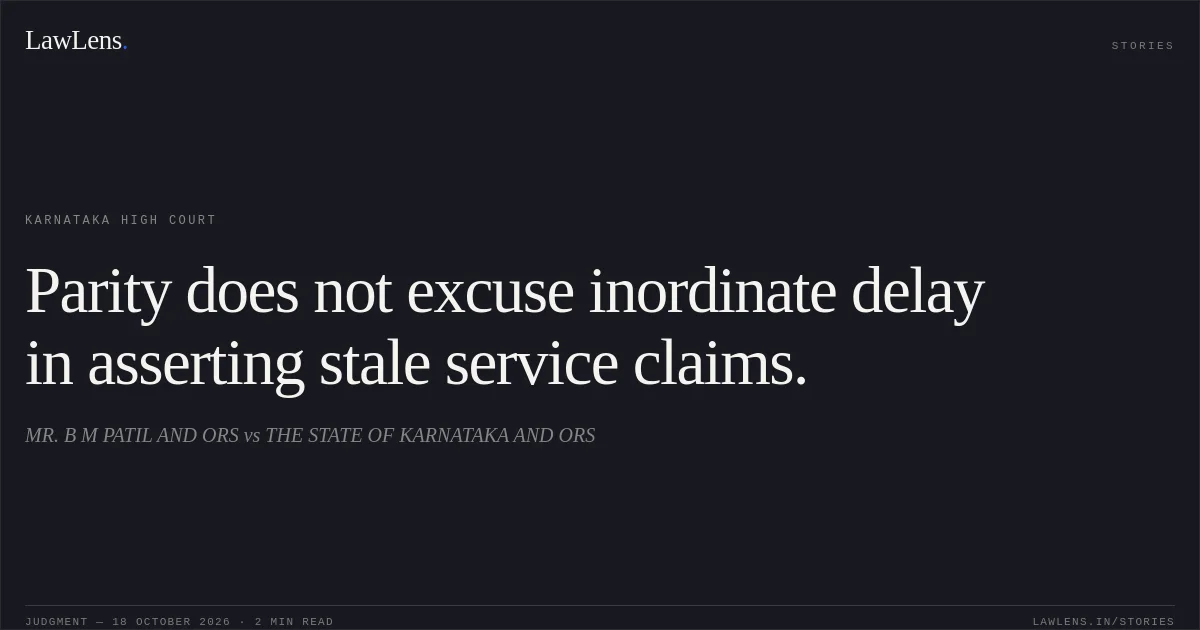
The petitioners retired in 1994 but did not approach the Tribunal within a reasonable time, although the earlier Tribunal order granting relief to similarly placed employees was made in 1996. The Court held that the 2014 Government Order did not revive or extend their stale claims; by then, substantial time had passed, and the petitioners’ applications were filed only in 2016.
¶ 9 · pp. 10–11Their reliance on parity did not overcome the delay, because the principle of equal treatment is subject to the exception for laches. The Tribunal therefore had sufficient grounds to find that the petitioners had not shown sufficient cause to condone the delay, and the High Court found no error in that decision.
¶ 11, 13–14 · pp. 12–1805Holding
The Court answered the first issue in the affirmative and declined to treat the 2014 Government Order as curing the delay.
¶ 14–15 · p. 18It held that the KSAT was justified in dismissing the applications and dismissed the writ petition.
¶ 14–15 · p. 18Original Court PDF
MR. B M PATIL AND ORSvsTHE STATE OF KARNATAKA AND ORS
Click to open original judgment
Original judgment, available to read, download and summarize on LawLens.in