Facts
The original plaintiffs, a son and his mother, executed two registered sale deeds dated 10 March 1975 in favour of the original defendant concerning two properties.
Source reference: p.2Each property was sold for ₹7,000; ₹2,500 was paid, while ₹4,500 per property was retained by the defendant for discharging the plaintiffs’ debts owed to government departments, banks and other institutions.
Source reference: p.2The defendant subsequently executed agreements undertaking to pay the retained amounts and discharge the outstanding loans, but allegedly failed to do so.
Source reference: p.3The plaintiffs filed a suit in 1984 seeking cancellation and declaration that the sale deeds were void and inoperative, a declaration of ownership, and permanent injunction.
Source reference: p.1; p.8The Trial Court dismissed the suit, holding that the sale was concluded and that non-payment of the balance consideration did not invalidate the sale; the First Appellate Court affirmed that decision.
Source reference: p.3–4The High Court, in second appeal, reversed those concurrent findings and decreed the suit in favour of the plaintiffs.
Source reference: p.4–6The legal heirs of the original defendant appealed to the Supreme Court.
Source reference: no citationIssues
Whether registered sale deeds executed upon part payment of the consideration, with the balance promised or retained for discharge of the vendors’ debts, are valid and binding, or become void and inoperative upon non-payment of the balance consideration.
Source reference: p.4–5, para. 6Whether the plaintiffs were entitled to a declaration of ownership, cancellation of the sale deeds and an injunction, instead of pursuing a remedy for recovery of the unpaid balance consideration.
Source reference: p.5, para. 6Whether the High Court was justified in reversing the concurrent findings of the Trial Court and the First Appellate Court in second appeal.
Source reference: p.6–7, paras. 9, 14Law Applied
The Court applied Section 54 of the Transfer of Property Act, 1882, under which a sale is a transfer of ownership for a price paid, promised, or part-paid and part-promised; payment of the entire consideration at the time of execution is not essential to completion of the sale.
Source reference: p.7–8, paras. 10–12Relying on Vidhyadhar v. Manikrao, (1999) 3 SCC 573, the Court held that the decisive consideration is the parties’ intention to transfer ownership and to pay the price either immediately or in future, as gathered from the sale deed, conduct and evidence.
Source reference: p.7–8, para. 10Following Dahiben v. Arvindbhai Kalyanji Bhanusali, (2020) 7 SCC 366, it reiterated that non-payment of the remaining sale consideration does not invalidate a registered sale or justify cancellation; the vendor’s remedy is to recover the balance consideration.
Source reference: p.8, para. 11The Court also applied the principle that a second appellate court cannot interfere merely because it prefers a different legal conclusion where the concurrent findings are not shown to be legally perverse.
Source reference: p.6–7, paras. 9, 14Reasoning
The sale deeds expressly recorded that ₹2,500 had been paid for each property and that the remaining ₹4,500 was retained for discharging the plaintiffs’ liabilities.
Source reference: p.2; p.8, para. 12Thus, the documents demonstrated an intention to complete the transfer while deferring payment of part of the consideration.
Source reference: no citationThe subsequent agreements did not establish a conditional sale or a stipulation that the sale would stand cancelled if the balance was not paid; rather, they reaffirmed the defendant’s obligation to pay the balance and discharge the debts.
Source reference: p.3–4, paras. 4, 12Applying Section 54 and the authorities in Vidhyadhar and Dahiben, the Court held that the registered sale deeds had transferred title and could not be treated as void merely because the defendant failed to perform his monetary obligation.
Source reference: p.7–9, paras. 10–14The plaintiffs’ proper remedy was a claim for recovery of the unpaid consideration, with applicable interest, not cancellation of the sale deeds or a declaration that they remained owners.
Source reference: p.8–9, paras. 13–15The High Court therefore erred in reversing the concurrent judgments on the basis of non-payment of consideration.
Source reference: p.9, para. 14Holding
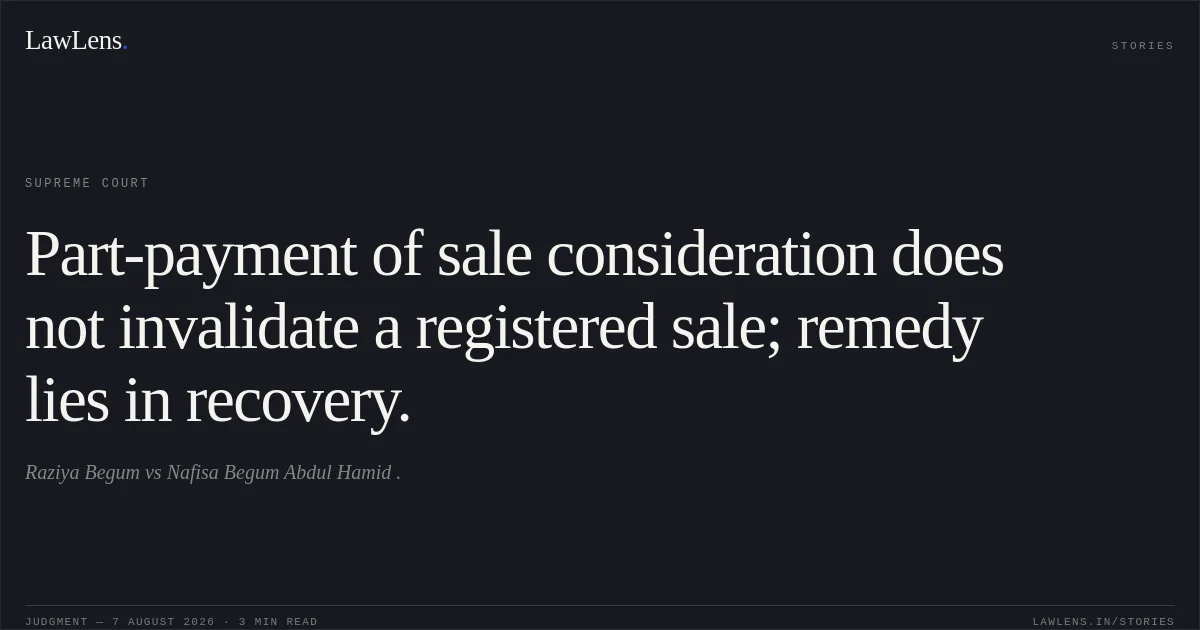
The Supreme Court held that the two sale deeds were valid, operative and binding despite part payment of the consideration.
The plaintiffs were not entitled to cancellation, declaration of ownership or an injunction on the ground of non-payment of the balance consideration; their remedy was recovery of the unpaid amount with interest.
Source reference: p.8–9, paras. 13–15The appeal was allowed, the High Court’s judgment was reversed, and the judgments of the Trial Court and the First Appellate Court were restored.
Source reference: p.10, para. 17The Court declined to disturb the plaintiffs’ possession; the appellants could pay the balance consideration with interest at the rate charged by the plaintiffs’ creditors and seek possession, if otherwise entitled.
Source reference: p.9–10, paras. 15–16Acts & Sections Cited
3 provisions across 3 statutes referred to in this judgment. Each provision opens on LawLens.
Code of Criminal Procedure, 19731
Code of Civil Procedure, 19081
Transfer of Property Act, 18821
Original Court PDF
Raziya BegumvsNafisa Begum Abdul Hamid .
Click to open original judgment
Original judgment, available to read, download and summarize on LawLens.in