Facts
TANGEDCO invited online bids for disposal of scrap materials.
Source reference: p.2, para. 2The petitioner was the successful bidder for Lots 3 and 6 and paid the 5% earnest money deposit (EMD), but did not pay the balance sale amounts within the stipulated period.
Source reference: p.2, para. 2After the petitioner sought additional time, the third respondent granted a 30-day extension; the petitioner still did not pay for Lots 3 and 6, although he paid for Lot 2.
Source reference: p.3, para. 3The petitioner sought a further extension, offering to pay with 22% penal interest, but the respondents issued the challenged order.
Source reference: p.3, para. 3Meanwhile, a subsequent tender was conducted, in which the petitioner participated unsuccessfully; the materials were supplied to the successful bidder.
Source reference: pp.3–5, paras. 3–5The petitioner sought to quash the order and obtain permission to pay the outstanding amounts, or alternatively to prevent forfeiture of the EMD.
Source reference: pp.1, 4, paras. 1, 4Issues
1. Whether the petitioner was entitled to a further extension of time to pay the sale amounts for Lots 3 and 6, with 22% penal interest.
Source reference: pp.4–5, paras. 4, 72. Whether the respondents’ forfeiture of the petitioner’s EMD under Clause 16(c) of the tender conditions could be interfered with.
Source reference: pp.4–5, paras. 4–7Law Applied
The Court treated the grant of an extension as a matter of administrative discretion, not a bidder’s right.
Source reference: p.4, para. 5It also applied Clause 16(c) of the tender conditions, under which the EMD was liable to forfeiture following the petitioner’s failure to complete payment.
Source reference: pp.4–5, paras. 5, 7The petitioner relied on Clause 13 as providing for payment with 22% penal interest, but the Court did not hold that this clause conferred an entitlement to an extension.
Source reference: pp.2, 4, paras. 2, 4Reasoning
The petitioner had already received an extension but failed to pay within the extended period.
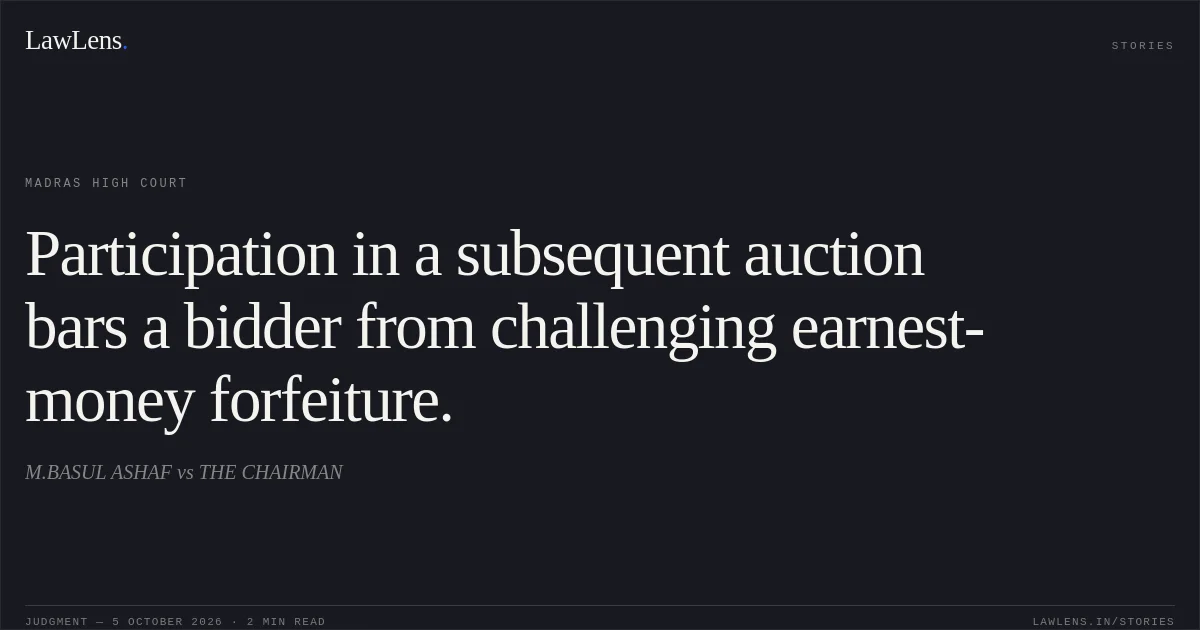
Source reference: pp.4–5, para. 7The Court considered his subsequent participation in the re-tender significant: he had not insisted that further time be granted or that the re-tender be halted, and he participated in that process before challenging the refusal of a further extension.
Source reference: pp.4–5, para. 7Since the subsequent tender had been completed in favour of a third party and the materials were no longer available, the Court declined to entertain the extension claim.
Source reference: p.5, paras. 5, 7In light of the petitioner’s default and Clause 16(c), it found no basis to interfere with the EMD forfeiture.
Source reference: p.5, paras. 5, 7Holding
The Court dismissed the writ petition, finding no merit in the challenge to the refusal of further time or the forfeiture of the EMD.
It made no order as to costs and closed the connected miscellaneous petitions.
Source reference: p.6, para. 8Original Court PDF
M.BASUL ASHAFvsTHE CHAIRMAN
Click to open original judgment
Original judgment, available to read, download and summarize on LawLens.in