Facts
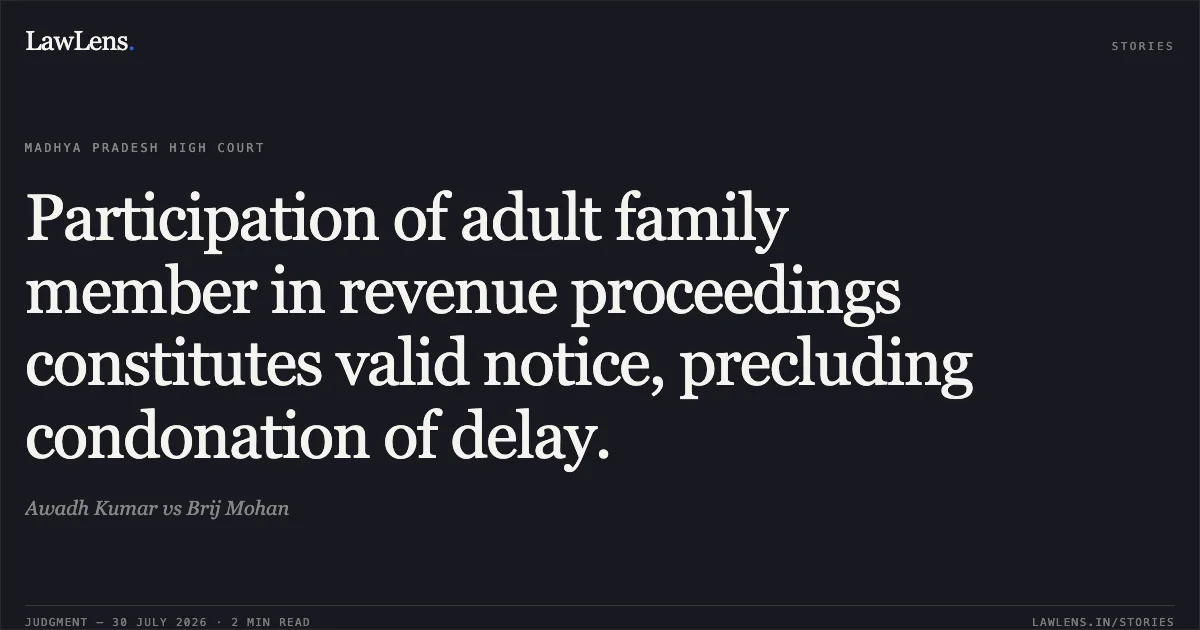
The petitioner challenged a partition (Batankan) order dated 30.11.2013 and subsequent appellate/revisional orders confirming it.
Source reference: p.1Respondent No. 3 applied for Batankan of Survey Nos. 45/3 and 73/3. The petitioner, owner of adjoining Survey No. 45/1/2, alleged he received no notice and that a portion of his self-acquired land was wrongly included in Survey No. 45/3 due to clerical and mapping errors.
Source reference: p.1-2The revenue authorities rejected the petitioner’s appeal primarily because his father, Imratlal, had signed the Fard Batankan and appeared in proceedings on 30.10.2013.
Source reference: p.3-4The petitioner argued that as the land was self-acquired, his father's participation could not legally bind him or trigger the limitation period, which led to a delay in filing the appeal on 16.06.2015.
Source reference: p.3Issues
1. Whether the concurrent findings of the revenue authorities regarding the bar of limitation and the sufficiency of notice through the petitioner's father warrant interference under Article 226.
Source reference: p.4-52. Whether the High Court should adjudicate disputed questions of revenue mapping and area measurement when an alternative statutory remedy exists.
Source reference: p.5-6Law Applied
The court applied the principle of valid service under Order V Rule 15 of the Code of Civil Procedure, which recognizes service upon an adult family member as due service.
Source reference: p.3Findings of fact cannot be re-appreciated unless they are patently illegal, arbitrary, or perverse.
Source reference: p.5Rule of "exhaustion of alternative remedy," specifically citing Section 115 of the Madhya Pradesh Land Revenue Code, which provides a dedicated statutory mechanism for the correction of revenue entries and maps.
Source reference: p.5Reasoning
The Court refused to disturb the factual findings that the petitioner’s father participated in and signed the Batankan proceedings. It reasoned that such concurrent findings of fact regarding notice and limitation are binding in writ jurisdiction unless proven perverse, which the petitioner failed to do.
Source reference: p.4-5The Court rejected the argument that the self-acquired nature of the property precluded the father from representing the family interest for the purposes of service of notice.
Source reference: p.5Regarding the mapping errors and area discrepancies (where Survey No. 45/3 allegedly grew from 0.366 to 0.6480 hectare), the Court determined that these involve disputed questions of measurement. Consequently, the Court held that the petitioner must invoke the specific statutory remedy under Section 115 of the MP Land Revenue Code rather than seeking extraordinary relief under Article 226.
Source reference: p.5Holding
The Court dismissed the writ petition, upholding the impugned orders.
The Court granted liberty to the petitioner to approach the competent authority under Section 115 of the MP Land Revenue Code for correction of revenue records and maps and directed both parties to maintain status quo regarding the nature, possession, and boundaries of the land for fifteen days.
Source reference: p.6Acts & Sections Cited
2 provisions across 2 statutes referred to in this judgment. Each provision opens on LawLens.
Limitation Act, 19631
MP Land Revenue Code 19591
Original Court PDF
Awadh KumarvsBrij Mohan
Click to open original judgment
Original judgment, available to read, download and summarize on LawLens.in