Facts
The petitioner was charged under Sections 494 and 498A of the IPC in C.C.No.1170/2025 following a complaint by his wife (R2).
Source reference: p.2After the investigation was transferred to the CBCID, the petitioner, who was working in Libya, failed to cooperate, leading to the issuance of a Blue Corner Notice and Lookout Circular.
Source reference: p.4-5He was eventually deported and arrested at Mumbai Airport on 25.03.2025.
Source reference: p.3While out on bail with conditions to sign before the police twice a month, the petitioner filed Crl.M.P.No.2566/2025 seeking permission to resume his employment in Libya to avoid termination.
Source reference: p.3, 8The Judicial Magistrate No.4, Salem, dismissed the application on 19.01.2026, noting it was a replication of an earlier dismissed and unchallenged application (Crl.MP.No.3863/2025).
Source reference: p.3, 6Issues
1. Whether the refusal to grant permission to travel abroad for employment constitutes an unjustified violation of the petitioner's fundamental rights under Articles 19(1)(g) and 21 of the Constitution.
Source reference: p.42. Whether the trial court was justified in dismissing the second application for travel permission in the absence of a change in circumstances and considering the petitioner’s past conduct.
Source reference: p.7-9Law Applied
The court applied the principle that while the right to travel abroad is a fundamental right under Article 21, it is subject to a balance between individual liberty and the effective enforcement of the criminal justice system.
Source reference: p.7It considered Section 6(2)(f) of the Passport Act, 1967, regarding restrictions on travel for persons facing criminal proceedings.
Source reference: p.4The court relied on Mahesh Kumar Agarwal v. Union of India (2025 SCC OnLine SC 2887) regarding the return of passports to accused persons on undertakings.
Source reference: p.7The court reaffirmed that revisional jurisdiction is limited to cases of palpable perversity or lack of evidentiary support.
Source reference: p.10Reasoning
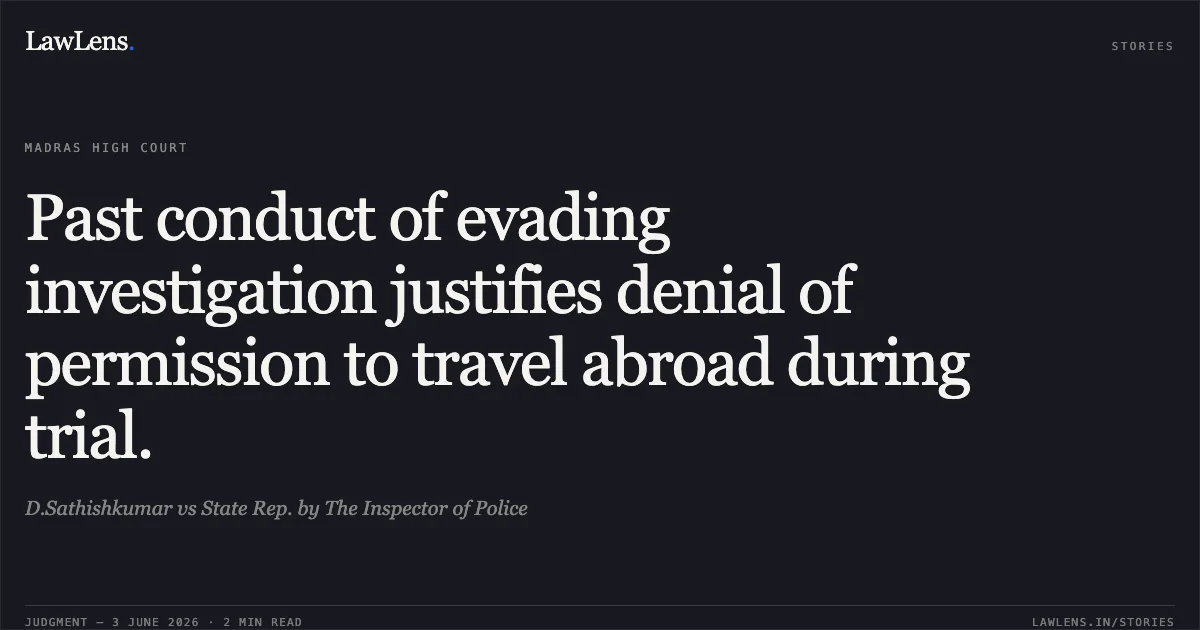
The court reasoned that although the right to travel is valuable, the petitioner’s past conduct—specifically evading investigation for three years until secured via international notices—indicated a high risk of him absconding or delaying the trial.
Source reference: p.8-9The court noted that the petitioner failed to challenge the previous dismissal of a similar prayer (Crl.MP.No.3863/2025), and thus no "change in circumstances" justified a different outcome.
Source reference: p.6-7The court found the petitioner's application to be "omnibus" and procedurally flawed, as it sought to bypass existing bail conditions (signing twice a month) and pre-emptively dictate trial procedures (virtual appearances) without a formal application for those specific reliefs.
Source reference: p.8-9The High Court concluded that the Magistrate’s decision was supported by material facts and lacked perversity.
Source reference: p.10Holding
The court held that the petitioner’s history of non-cooperation justified the restriction on travel to ensure his presence during the trial, and the second application was a mere replication of a final, unchallenged order.
The High Court dismissed the Criminal Revision Case, upholding the order of the Judicial Magistrate.
Source reference: p.10Acts & Sections Cited
3 provisions across 3 statutes referred to in this judgment. Each provision opens on LawLens.
Bharatiya Nagarik Suraksha Sanhita, 20231
Indian Penal Code, 18601
Passports Act, 19671
Original Court PDF
D.SathishkumarvsState Rep. by The Inspector of Police
Click to open original judgment
Original judgment, available to read, download and summarize on LawLens.in