01Facts
The respondent, Makhanlal Gupta, was posted as Assistant Engineer, Tirhut Canal Division No. I, Muzaffarpur. A Flying Squad test of bricks used in canal lining found a compressive strength of 86.00 kg/cm² against a required 100 kg/cm², and less cement in plaster.
¶ 2A show cause notice was issued on 06.06.2013, and the respondent replied on 11.07.2013, contending that the bricks had been broken during forcible extraction.
¶ 2A charge memorandum (Prapatra-"Ka") was issued on 04.12.2014, and the respondent replied on 07.01.2015. He relied on the Flying Squad's own figures, which showed four bricks at 95.88, 94.18, 75.34 and 78.48 kg/cm², and on satisfactory water absorption.
¶ 2The Enquiry Officer's report dated 25.01.2016 held the charges not proved. It found that the bricks were damaged by digging them out, that comparison with fresh bricks was unjustifiable, that 14% water absorption indicated good burnt quality, and that the Flying Squad itself regarded the strength as near the prescribed standard.
¶ 3–4The disciplinary authority disagreed, issued a second show cause notice on 10.06.2016 relying on IS 5454 (minimum 85 kg/cm²), and imposed a punishment of stoppage of two increments with cumulative effect on 19.04.2017.
¶ 6A review petition was dismissed on 06/10.09.2018.
¶ 6, 12The Single Judge allowed the writ petition on 01.09.2022, quashed both orders, and granted consequential benefits.
¶ 1, 12The respondent retired during the pendency of the proceedings.
¶ 10The State appealed.
02Issues
i.1. Whether the Single Judge was justified in quashing the punishment order dated 19.04.2017 and the order dismissing the review petition.
¶ 13ii.2. Whether, upon quashing those orders, the matter ought to have been remanded to the disciplinary authority to resume proceedings from the defective stage.
¶ 13, 1503Law Applied
The Court relied on Articles 226 and 227 of the Constitution, under which the High Court does not re-appreciate evidence in disciplinary matters but may interfere where the finding is based on no evidence, is perverse, or is arbitrary.
¶ 8, 14–15It applied the grounds laid down in Union of India v. P. Gunasekaran, (2015) 2 SCC 610, particularly ground (i), that a finding of fact based on no evidence is reviewable.
¶ 8, 15Counsel also relied on Kuldeep Singh v. Commissioner of Police, (1999) 2 SCC 10 (a no-evidence finding is perverse and amenable to judicial scrutiny), Roop Singh Negi v. Punjab National Bank, (2009) 2 SCC 570, and State of U.P. v. Saroj Kumar Sinha, (2010) 2 SCC 772; the judgment does not separately analyse these authorities.
¶ 8On remand, the Court relied on the principle, cited from Allahabad Bank v. Krishna Narayan Tewari, (2017) 2 SCC 308, that the High Court has discretion to decline remand where there is long delay or supervening circumstances.
¶ 10The Court relied on the rule that the standard of proof in disciplinary proceedings is preponderance of probability, which presupposes some evidence.
¶ 16The Court also referred to the sampling procedure under the Indian Standard Methods for Sampling of Clay Building Bricks, which contains no provision for sampling used bricks.
¶ 5, 1504Reasoning
The Court found that the department led no evidence. The Flying Squad members were not examined, and no cogent material established guilt.
¶ 14The only evidence was the Flying Squad report, which itself described the bricks as near the prescribed standard, and the Enquiry Officer's reasoned finding that the bricks had been damaged during extraction, rendering comparison with fresh bricks unjustifiable.
¶ 4, 14Because the sampling of used bricks is not provided for in the ISM, the Court held that the test results could not reliably support the charge.
¶ 14–15The disciplinary authority's reliance on the 85 kg/cm² benchmark, without evidence, produced a perverse finding, so the punishment was unsupported by valid reasons.
¶ 14On remand, the Court reasoned that the department had every opportunity to lead evidence and failed to do so. Remanding would therefore reward the department's laxity and cure its failure.
¶ 15The Court also observed that the proceedings appeared vexatious, since no evidence could have been gathered even with due diligence.
¶ 15Given the passage of more than a decade and the respondent's retirement, fresh evidence could not realistically be led.
¶ 10, 1705Holding
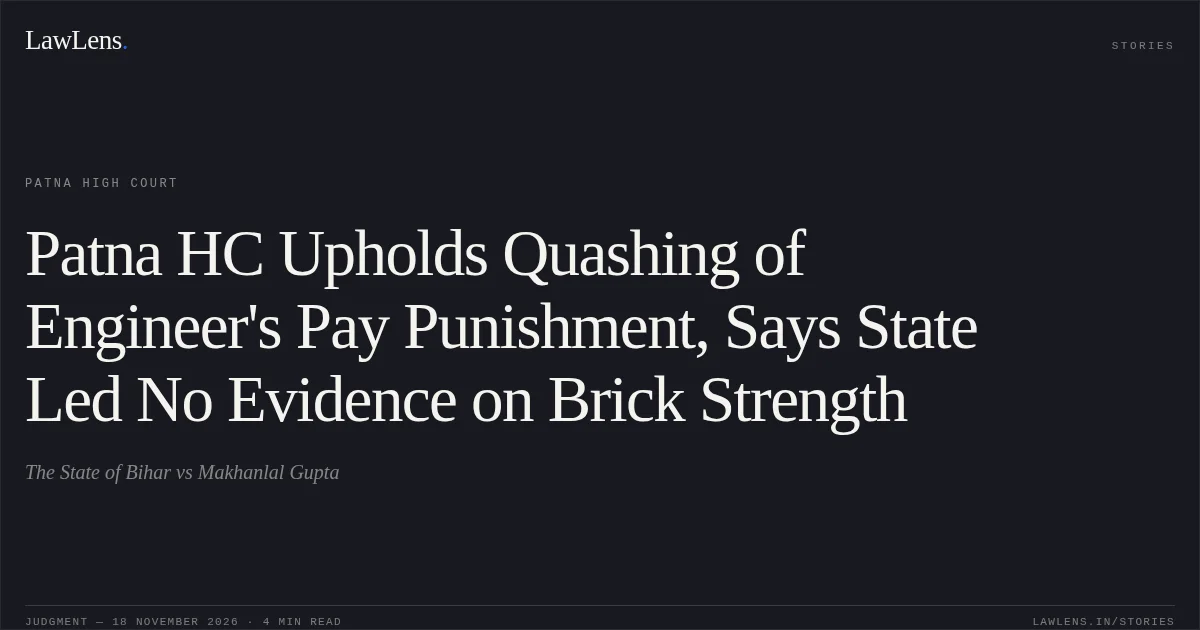
The Court answered both issues in the negative. The Single Judge was justified in quashing the punishment order dated 19.04.2017 and the review order, because the finding rested on no evidence and was perverse.
¶ 14, 18Remand to the disciplinary authority was not warranted, because the department failed to lead evidence and fresh evidence could not be led after more than a decade.
¶ 15, 17The Letters Patent Appeal was dismissed in full, with costs, as vexatious.
¶ 18The Single Judge's direction granting consequential benefits to the respondent stands.
¶ 1, 18Original Court PDF
The State of BiharvsMakhanlal Gupta
Click to open original judgment
Original judgment, available to read, download and summarize on LawLens.in