Facts
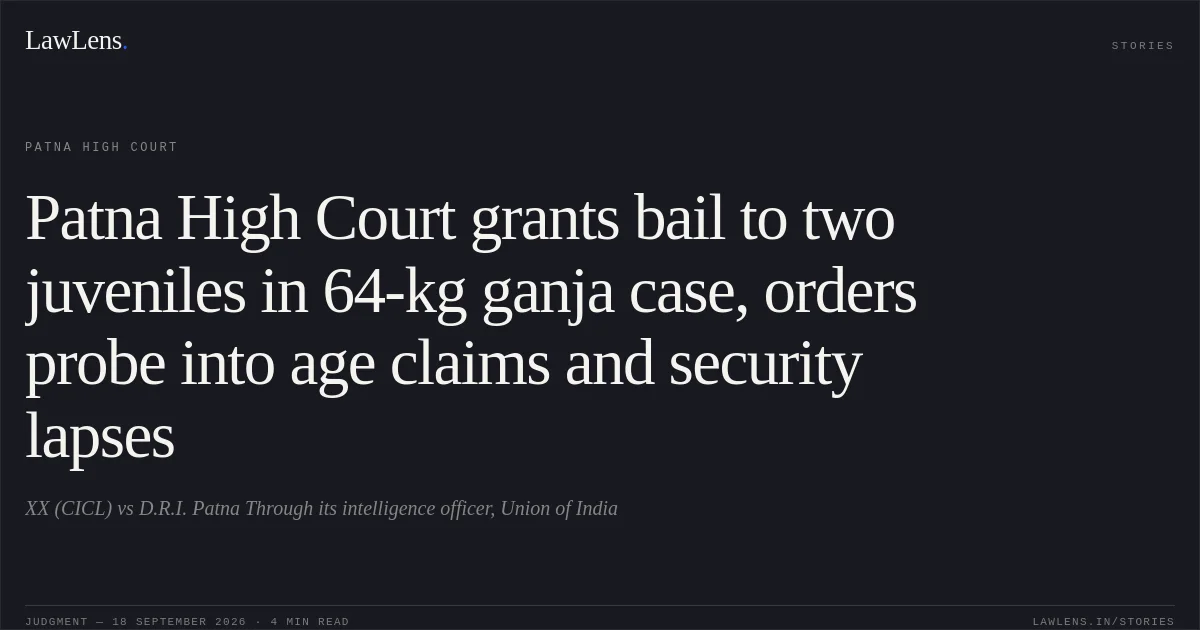
The petitioners, XX and X1, were apprehended by the Directorate of Revenue Intelligence (DRI), Patna, while allegedly travelling in a Mahindra TUV vehicle from Guwahati to Patna.
Source reference: para. 3The DRI recovered approximately 65.940 kg gross and 63.760 kg net weight of ganja in 109 packets concealed in a cavity of the vehicle.
Source reference: para. 3A case was registered under Sections 8(c), 20(b)(ii)(c), 25 and 29 of the NDPS Act.
Source reference: para. 3The petitioners were taken into custody on 8 April 2024.
Source reference: para. 4Although the DRI initially recorded their ages as 25 and 21 years respectively, the Juvenile Justice Board subsequently assessed XX to be 15 years and 9 months and X1 to be 16 years on the date of occurrence, and declared both to be Children in Conflict with Law (CICL).
Source reference: para. 4Their applications for bail were rejected by the Juvenile Justice Board and their statutory appeals were dismissed by the appellate court.
Source reference: paras. 5–7They consequently invoked the revisional jurisdiction of the High Court.
Source reference: paras. 5–7Issues
Whether the Juvenile Justice Board and the appellate court were justified in refusing bail to the petitioners under Section 12 of the Juvenile Justice (Care and Protection of Children) Act, 2015?
Source reference: paras. 8–11Whether the alleged recovery of commercial quantity of ganja and the seriousness of the NDPS offences could, by themselves, justify denial of bail to CICL persons?
Source reference: para. 14Whether the petitioners’ release was shown, on the basis of cogent material, to expose them to criminal elements, moral/physical/psychological danger, or defeat the ends of justice?
Source reference: paras. 11–14Law Applied
The Court primarily applied Section 12 of the Juvenile Justice (Care and Protection of Children) Act, 2015, under which a child alleged to be in conflict with law is ordinarily entitled to bail, unless release would bring the child into association with known criminals, expose the child to moral, physical or psychological danger, or defeat the ends of justice.
Source reference: para. 11The Court also relied on the principles under Section 3 of the JJ Act, particularly the best-interest principle under Section 3(iv), the principle that institutionalisation must be a measure of last resort under Section 3(xii), and the principle of repatriation and restoration under Section 3(xiii).
Source reference: para. 12The Court held that the gravity of the alleged NDPS offence or recovery of commercial quantity is not, by itself, a sufficient ground to refuse bail to a CICL where the statutory exceptions under Section 12 are not established by cogent material.
Source reference: para. 14Reasoning
The Court found that the courts below had denied bail on the basis of general apprehensions that the petitioners might associate with anti-social elements, face moral, physical or psychological danger, or cause the ends of justice to be defeated.
Source reference: paras. 8, 13–14However, no specific or cogent material supported those conclusions.
Source reference: paras. 8, 13–14Applying Section 12 of the JJ Act, the Court held that the statutory presumption in favour of release of a CICL could not be displaced merely because the allegation involved commercial quantity of ganja under the NDPS Act.
Source reference: paras. 12–14The Court emphasised that the JJ Act is child-friendly and seeks reformation, rehabilitation and restoration, while institutionalisation is a last resort.
Source reference: paras. 12–14Since the petitioners had been declared CICL and the statutory grounds for denying bail were not established, the concurrent orders refusing bail were held to be legally unsustainable.
Source reference: para. 14The Court also noted discrepancies concerning the petitioners’ ages, lack of identification and vehicle documents, their alleged travel from Assam to Bihar, and their claim of having received no formal education.
Source reference: para. 18It therefore directed the Senior Superintendent of Police, Patna, to conduct an inquiry into their juvenility, educational background and the alleged security lapses.
Source reference: paras. 18–20Holding
The High Court allowed both revision petitions and set aside the appellate orders dated 17 February 2026 and 17 September 2025, as well as the Juvenile Justice Board orders dated 19 August 2025 and 19 June 2025 rejecting bail.
The petitioners were directed to be released on bail on furnishing bonds of ₹10,000 each with two sureties of the like amount, subject to the conditions that one bailor be a parent, the other be a relative without criminal antecedents who undertakes proper care and supervision, and that the petitioners appear before the Board on every date fixed in the case.
Source reference: para. 16The SSP, Patna, was directed to complete an inquiry within three months regarding the petitioners’ claimed juvenility, education and the security lapses.
Source reference: paras. 19–20If fraudulent conduct or concealment concerning age was found, the State and DRI were given liberty to seek cancellation of bail and review of the orders declaring the petitioners CICL.
Source reference: paras. 19–20Acts & Sections Cited
6 provisions across 2 statutes referred to in this judgment. Each provision opens on LawLens.
Narcotic Drugs and Psychotropic Substances Act, 19854
Juvenile Justice (Care and Protection of Children) Act, 2015.2
Original Court PDF
XX (CICL)vsD.R.I. Patna Through its intelligence officer, Union of India
Click to open original judgment
Original judgment, available to read, download and summarize on LawLens.in