Facts
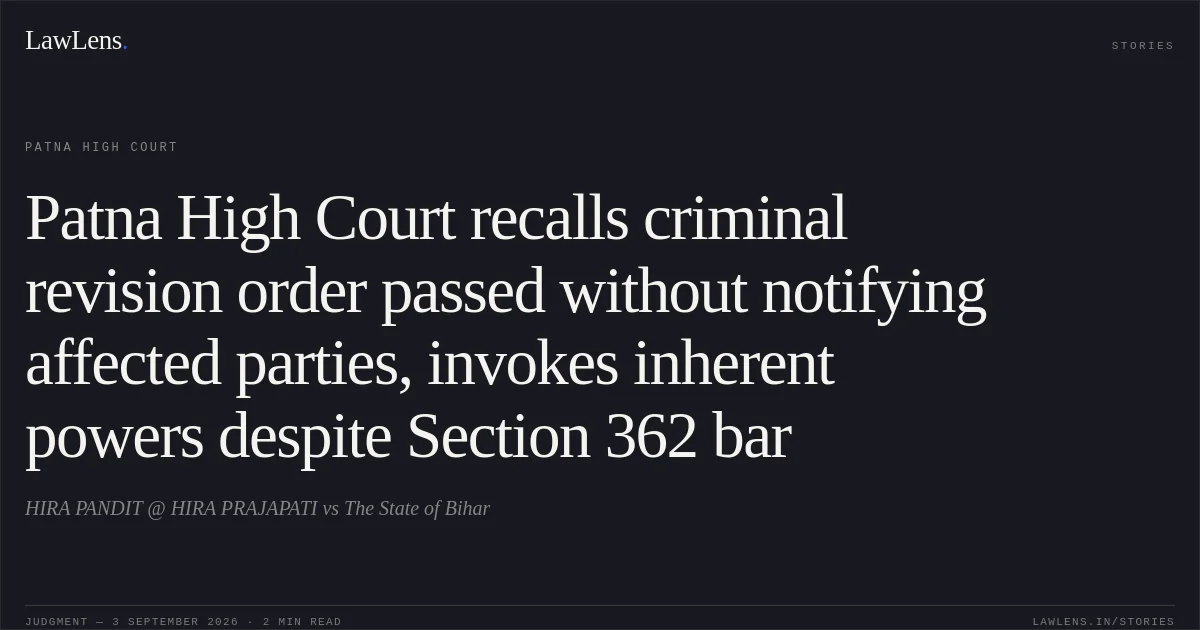
The petitioner sought recall of the order dated 17 February 2024 passed in Criminal Revision No. 206 of 2023.
Source reference: p. 1, para. 1The revision had been disposed of without notice being served on private Opposite Party Nos. 5–7, who were thereby denied an opportunity to present their case.
Source reference: p. 1, para. 2The private opposite parties opposed recall, contending that Section 362 of the Code of Criminal Procedure barred the Court from recalling, modifying, or setting aside a judgment after it had been signed and pronounced.
Source reference: p. 1, para. 3During the proceedings, the private opposite parties entered appearance.
Source reference: p. 4, para. 12Issues
Whether the High Court could recall an order passed in a criminal revision without serving notice on the affected private opposite parties.
Source reference: p. 2, paras. 4–5Whether the inherent jurisdiction under Section 482 Cr.P.C. could be invoked notwithstanding the bar under Section 362 Cr.P.C., where the final order had allegedly been passed in abuse of the process of the Court.
Source reference: p. 2, paras. 5–8Law Applied
The Court considered Section 362 Cr.P.C., which ordinarily prohibits a criminal court from altering or reviewing a judgment after it has been signed and pronounced, subject to correction of clerical or arithmetical errors.
Source reference: p. 1, para. 3It also applied Section 482 Cr.P.C., preserving the High Court’s inherent power to pass orders necessary to prevent abuse of the process of the Court and to secure the ends of justice.
Source reference: p. 2, paras. 5, 8The Court relied on Brajesh Kumar v. State of Bihar & Ors., SLP (Crl.) No. 4811 of 2025, and Rambali Sahni v. State of Bihar, 2026 LivLaw (SC) 61, in which final revisional orders passed without notice to affected opposite parties were set aside.
Source reference: p. 2, para. 6Reasoning
Although the Court acknowledged the general restriction imposed by Section 362 Cr.P.C., it held that an order passed in a revision without notice to the affected private opposite parties was inherently defective and amounted to an abuse of the process of the Court.
Source reference: p. 2, paras. 4–5The denial of notice and hearing violated the basic requirement of procedural fairness.
Source reference: no citationIn such exceptional circumstances, Section 482 Cr.P.C. could be used not as a power of review on merits, but to undo an order that had been passed without jurisdictionally adequate procedural safeguards and to secure substantial justice.
Source reference: p. 2, paras. 7–9Requiring the affected parties to approach the Supreme Court would cause unnecessary harassment and would not serve the interests of justice.
Source reference: p. 3, para. 9Holding
The High Court allowed the criminal miscellaneous application and recalled the order dated 17 February 2024 passed in Criminal Revision No. 206 of 2023.
Since the private opposite parties had already entered appearance in the recall proceedings, service of notice upon them was waived.
Source reference: p. 4, para. 12They were permitted to contest Criminal Revision No. 206 of 2023, which was to be considered after affording them an opportunity of hearing.
Source reference: p. 4, para. 12Acts & Sections Cited
2 provisions across 1 statute referred to in this judgment. Each provision opens on LawLens.
Code of Criminal Procedure, 19732
Original Court PDF
HIRA PANDIT @ HIRA PRAJAPATIvsThe State of Bihar
Click to open original judgment
Original judgment, available to read, download and summarize on LawLens.in