Facts
The petitioner, a Grade III Bench Clerk, was appointed as an Examiner on 11 September 2013 and later promoted.
Source reference: pp. 1–2Her pay was fixed by the competent authorities under the applicable rules.
Source reference: pp. 1–2Following an internal audit objection, the third respondent issued proceedings dated 24 July 2026 requiring recovery of excess pay.
Source reference: pp. 1–2The petitioner challenged those proceedings under Article 226 of the Constitution
Source reference: pp. 1–2The Court noted that the respondents had not established any misrepresentation by the petitioner and that the alleged error was attributable to the establishment
Source reference: p. 2Issues
Whether the respondents could revise the petitioner’s pay fixation following the audit objection
Source reference: pp. 2, 4Whether recovery of the excess salary from the petitioner was permissible, given the absence of misrepresentation and the hardship caused by recovery after a lapse of time
Source reference: pp. 2–4Law Applied
Under Article 226 of the Constitution, the Court may review administrative proceedings affecting an employee’s pay and recovery of salary.
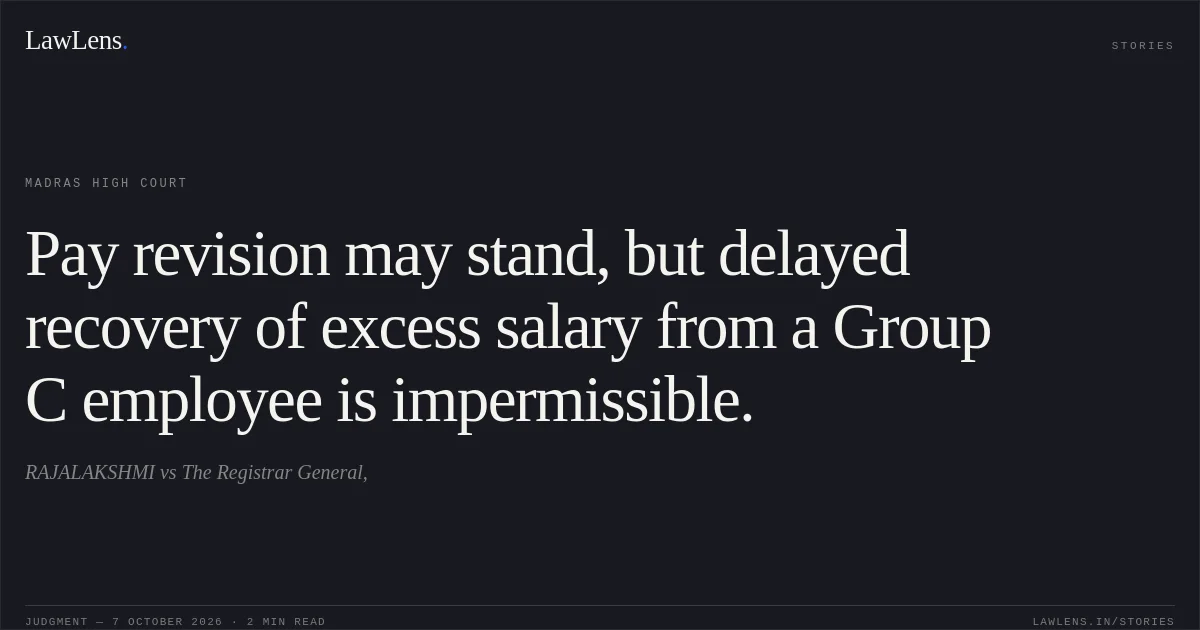
Source reference: pp. 2–3An employer may correct an erroneous pay fixation and grant the pay applicable under the relevant rules, but recovery of excess payments may be impermissible in circumstances identified in *State of Punjab v. Rafiq Masih*, (2015) 4 SCC 334—including recovery from Group C or Group D employees, recovery for payments made more than five years before the recovery order, and recovery that would be iniquitous, harsh, or arbitrary
Source reference: pp. 2–3Reasoning
The Court distinguished correction of pay fixation from recovery of amounts already paid.
Source reference: p. 2; p. 4It upheld the revised fixation made pursuant to the audit objection, observing that the authorities could rectify the error and apply the correct pay rules.
Source reference: p. 2; p. 4However, the respondents had not shown that the petitioner misrepresented any fact; the error was attributable to the establishment, and recovery after many years would cause extreme hardship.
Source reference: p. 2Applying the principles in *Rafiq Masih*, the Court therefore found recovery impermissible while leaving the revised pay fixation undisturbed.
Source reference: pp. 3–4Holding
The writ petition was partly allowed.
The revised pay fixation was confirmed, but the impugned proceedings were set aside insofar as they directed recovery of excess salary.
Source reference: p. 4Any amount already recovered under the impugned order must be repaid to the petitioner within 12 weeks from receipt of a copy of the order.
Source reference: p. 4No costs were awarded, and the connected miscellaneous petition was closed
Source reference: p. 4Original Court PDF
RAJALAKSHMIvsThe Registrar General,
Click to open original judgment
Original judgment, available to read, download and summarize on LawLens.in