Facts
The Revenue appealed under Section 260-A of the Income Tax Act, 1961, against the ITAT’s order for assessment year 2003–04.
Source reference: p. 2The appeal concerned the deletion of additions for bad debts of ₹868 crores, disallowance of ₹10.20 crores in interest on security deposits, commissions and gifts paid to associated entities, royalty expenditure of ₹64.53 lakhs, and overdraft interest of ₹22.73 lakhs relating to interest-free advances
Source reference: pp. 2, 8–10, 20The Court noted that the bad-debt and royalty issues had been addressed in earlier decisions involving the assessee, while the associated-entity expenses had been accepted in other assessment years and the Revenue had not pursued those decisions further
Source reference: pp. 2–8, 9Issues
Whether the ITAT was right in deleting the addition of ₹868 crores claimed as bad debts
Source reference: p. 2Whether the ITAT was right in deleting the disallowance of ₹10.20 crores for interest on security deposits, commission and gifts paid to closely associated companies
Source reference: pp. 8–9Whether the ITAT was right in allowing royalty expenditure of ₹64.53 lakhs
Source reference: p. 10Whether the ITAT was right in allowing overdraft interest of ₹22.73 lakhs despite interest-free advances
Source reference: p. 20Law Applied
Under Sections 36(1)(vii) and 36(2) of the Income Tax Act, following TRF Ltd. v. CIT, a bad debt need not be independently proved irrecoverable if it is written off in the accounts, subject to the statutory requirements; a payment made in the course of business may also qualify as a business loss under Section 28.
Source reference: pp. 3–8Sections 21 and 22 of the Chit Funds Act, 1982 impose duties on a foreman relevant to meeting subscriber defaults.
Source reference: pp. 3–8Royalty for a limited, non-exclusive and non-transferable right to use intellectual property may be revenue expenditure under Section 37(1), rather than capital expenditure qualifying for depreciation under Section 32(1)(ii), as explained in CIT v. Ciba of India Ltd., CIT v. Wavin (India) Ltd. and Honda Siel Cars (India) Ltd. v. CIT.
Source reference: pp. 10–19The Court also applied the principles of consistency where facts and the legal position remain unchanged, and accepted the relevance of sufficient surplus funds in deciding whether interest-bearing borrowings funded interest-free advances
Source reference: pp. 20–21Reasoning
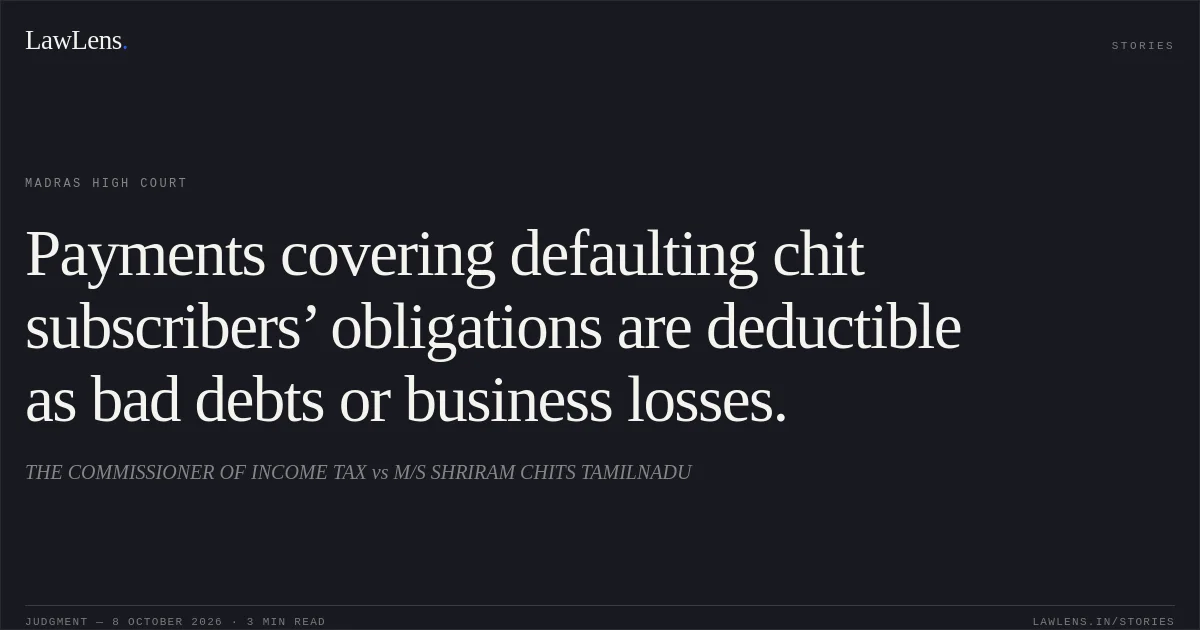
On bad debts, the Court followed its earlier decision in the assessee’s case, which treated the foreman’s statutory obligation to keep the chit operating, and the resulting payments from its own funds, as giving rise to a debtor-creditor relationship and an allowable business loss; the Revenue’s appeal on the issue had also failed to displace that conclusion
Source reference: pp. 2–8For the associated-entity payments, identical claims had been allowed in prior years, the Revenue had not pursued the relevant orders, and the assessee’s operating method had not changed; the Court found no basis to depart from consistency
Source reference: pp. 8–9On royalty, it relied on its earlier ruling that the licence granted only a restricted right to use the logo, without transferring ownership or an enduring asset, and therefore the royalty was revenue expenditure
Source reference: pp. 10–19Finally, the CIT(A) and ITAT had found that the assessee had surplus funds of ₹18.58 crores; the Court considered those funds sufficient to support the interest-free advances and upheld the allowance of overdraft interest
Source reference: pp. 20–21Holding
The Court answered all four substantial questions of law in favour of the assessee.
It upheld the ITAT’s decisions on the bad-debt claim, associated-entity payments, royalty expenditure and overdraft interest, and dismissed the Revenue’s appeal without costs
Source reference: pp. 8–9, 19, 21Acts & Sections Cited
4 provisions across 1 statute referred to in this judgment. Each provision opens on LawLens.
Chit Funds Act, 19824
Original Court PDF
THE COMMISSIONER OF INCOME TAXvsM/S SHRIRAM CHITS TAMILNADU
Click to open original judgment
Original judgment, available to read, download and summarize on LawLens.in