Facts
Respondent No. 3 alleged that he had entered into an Agreement to Sell dated 20 February 2007 with the petitioner for the sale of a building comprising ten shops for ₹27 lakh. The petitioner allegedly paid ₹22 lakh, with the remaining ₹5 lakh payable at the time of registration of the sale deed, and obtained possession of most of the property.
Source reference: p. 2The complainant subsequently alleged that the petitioner avoided payment and, through forgery, impersonation and misrepresentation, procured registration of a sale deed dated 27 June 2007 by presenting an unknown person as the complainant before the Sub-Registrar.
Source reference: pp. 2–3It was further alleged that a second Agreement to Sell dated 22 March 2007, showing a sale consideration of ₹12.50 lakh, had also been fabricated and that the complainant’s signatures had been forged.
Source reference: p. 4The Chief Judicial Magistrate, Jammu, acting under Section 156(3) CrPC, forwarded the complaint to the Crime Branch for investigation by order dated 24 June 2014.
Source reference: p. 4The Revisional Court dismissed the revision on 24 September 2014, relying on Father Thomas v. State of U.P., and holding that an order under Section 156(3) CrPC was interlocutory and not revisable.
Source reference: p. 4The Crime Branch initially closed the preliminary verification as “not proved” because a civil suit concerning the property was pending, but the matter was subsequently reopened, found to disclose offences, and connected with FIR No. 48/2016.
Source reference: pp. 5–7Further investigation remained stayed pursuant to an order of the High Court dated 21 September 2021.
Source reference: p. 7Issues
Whether the complaint disclosed prima facie offences of cheating, forgery, impersonation and criminal conspiracy warranting investigation under Section 156(3) CrPC, notwithstanding the pendency of a civil suit concerning the same property?
Source reference: pp. 12–14; paras. 20–24Whether the order dated 24 June 2014 directing investigation under Section 156(3) CrPC, and the Revisional Court’s order upholding it, were liable to be quashed in the exercise of the High Court’s inherent jurisdiction under Section 482 CrPC?
Source reference: pp. 12–13; paras. 19–20, 24–26Whether the pendency of civil proceedings rendered the criminal proceedings an abuse of the process of court?
Source reference: p. 13; paras. 21–24Law Applied
The Court applied Section 156(3) CrPC, which empowers a Magistrate to direct the police to investigate a cognizable offence disclosed in a complaint, and Section 482 CrPC, which preserves the High Court’s inherent jurisdiction to prevent abuse of process and secure the ends of justice.
Source reference: pp. 4, 12–13The Court recognised that allegations involving cheating, forgery, use of forged documents, impersonation and criminal conspiracy may constitute criminal offences even when they arise out of a property or contractual transaction; the relevant offences identified during the preliminary verification were Sections 420, 467, 468, 471 and 120-B RPC.
Source reference: p. 7Relying on S.N. Vijayalakshmi v. State of Karnataka, 2025 SCC OnLine SC 1575, particularly paragraph 42, the Court held that civil and criminal proceedings can proceed simultaneously on the same facts where the allegations disclose an overwhelming element of criminality; however, criminal proceedings may be quashed where such criminality is absent and their continuation would amount to abuse of process.
Source reference: pp. 13–14The Revisional Court had also relied on Father Thomas v. State of U.P., 2011 Cri LJ 2278, for the proposition that an order directing investigation under Section 156(3) CrPC is interlocutory and not amenable to criminal revision.
Source reference: p. 12; para. 19Reasoning
The Court found that the complaint, and the allegations reiterated during the investigation, went beyond a mere dispute over performance of an Agreement to Sell.
Source reference: pp. 12–14; paras. 20–21The allegations specifically asserted that the petitioner had forged the complainant’s signatures, fabricated an additional Agreement to Sell and procured registration of the sale deed by impersonation through an unknown person before the Sub-Registrar.
Source reference: pp. 12–14; paras. 20–21These allegations prima facie disclosed an overwhelming criminal element involving forgery, impersonation, cheating and conspiracy.
Source reference: pp. 13–14; paras. 22–24Applying S.N. Vijayalakshmi, the Court held that the pending civil suit seeking declaration that the sale deed was void did not bar investigation of the distinct criminal conduct alleged in obtaining that deed.
Source reference: pp. 13–14; paras. 22–24The Court further noted that the Crime Branch’s preliminary verification had found the allegations substantiated and that the matter required investigation to determine the truth regarding the alleged impersonation and forgery.
Source reference: pp. 6–7, 14Since the impugned order under Section 156(3) CrPC was supported by prima facie allegations of cognizable offences, the Court found no ground to exercise its inherent jurisdiction to quash either the Magistrate’s order or the Revisional Court’s order.
Source reference: p. 14; paras. 24–25Holding
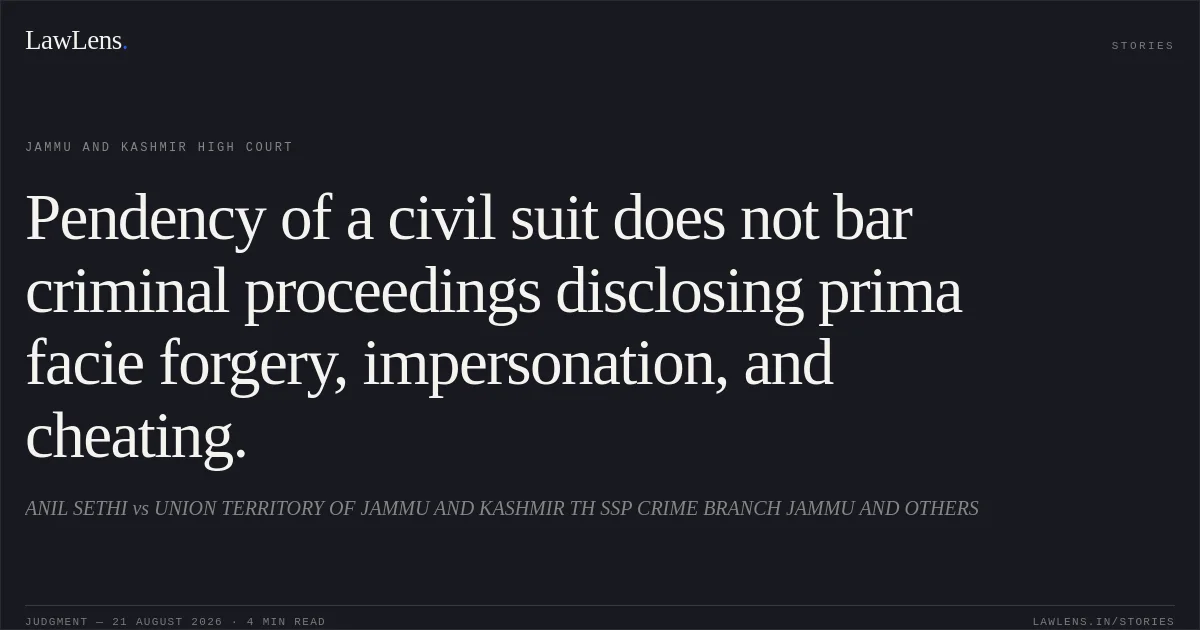
It held that the pendency of the civil suit did not prevent simultaneous criminal investigation because the allegations prima facie disclosed forgery, impersonation, cheating and criminal conspiracy.
The High Court dismissed the petition under Section 482 CrPC, upheld the Chief Judicial Magistrate’s order dated 24 June 2014 directing investigation by the Crime Branch, and affirmed the Revisional Court’s order dated 24 September 2014.
Source reference: p. 15; para. 25All connected applications were also dismissed, any interim direction was vacated, and the investigating agency was directed to expedite and conclude the investigation at the earliest, the matter having originated in 2014.
Source reference: p. 15; para. 26Acts & Sections Cited
2 provisions across 1 statute referred to in this judgment. Each provision opens on LawLens.
Code of Criminal Procedure, 19732
Original Court PDF
ANIL SETHIvsUNION TERRITORY OF JAMMU AND KASHMIR TH SSP CRIME BRANCH JAMMU AND OTHERS
Click to open original judgment
Original judgment, available to read, download and summarize on LawLens.in