Facts
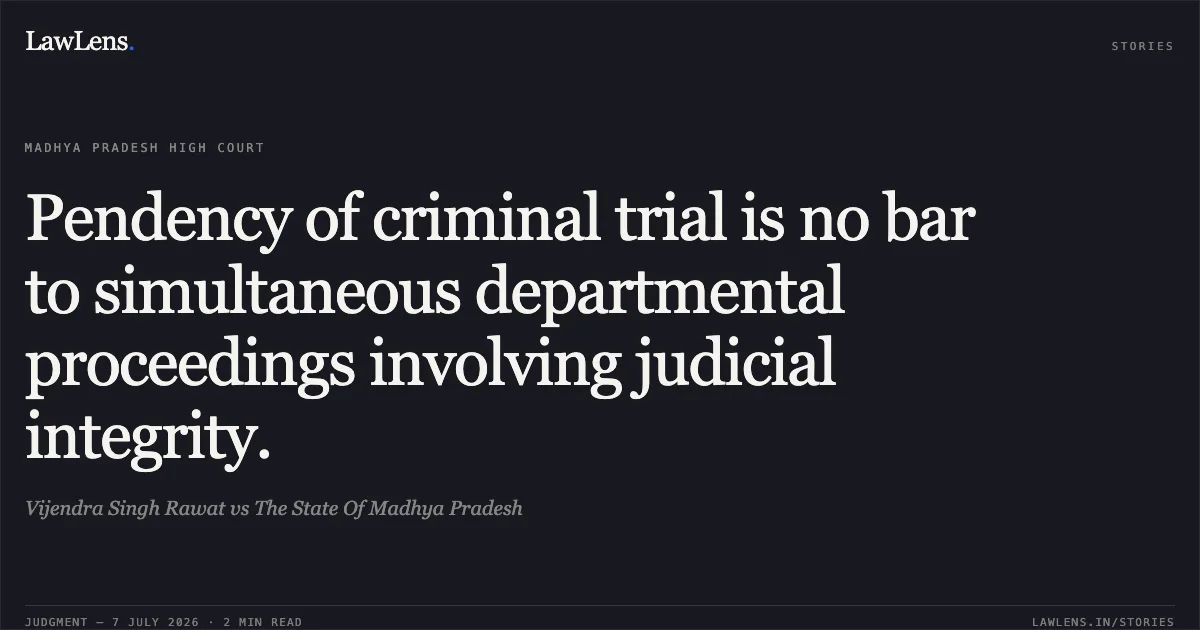
The petitioner, a judicial officer (V Civil Judge, Senior Division, Indore), challenged a charge-sheet dated 19.12.2025 issued under Rule 14 of the M.P. Civil Services (CCA) Rules, 1966
Source reference: para. 1, 2The disciplinary action stemmed from allegations that the petitioner prepared a forged judgment of acquittal in State v. Santosh Verma (2020) while the trial was still pending, allegedly to assist the accused in obtaining an IAS award
Source reference: para. 2The petitioner was placed under suspension following a vigilance scrutiny
Source reference: para. 3He moved the High Court seeking quashment of the proceedings on grounds of gross delay and the simultaneous pendency of a criminal trial based on the same facts
Source reference: para. 4, 5Issues
1. Whether disciplinary proceedings can be quashed solely on the ground of delay in issuing the charge-sheet
Source reference: para. 4, 122. Whether departmental proceedings must be stayed or quashed during the pendency of a criminal prosecution arising from the same set of facts
Source reference: para. 5, 133. Whether the High Court should exercise judicial review to interfere with a charge-sheet at a preliminary stage
Source reference: para. 8, 15Law Applied
The Court applied Rule 14 of the Madhya Pradesh Civil Services (Classification, Control and Appeal) Rules, 1966
Source reference: para. 1It relied on Capt. M. Paul Anthony v. Bharat Gold Mines Ltd., which established that while simultaneous proceedings are permissible, departmental actions may be stayed only in "grave" cases involving complex questions of law and fact
Source reference: para. 5, 13The Court further applied the principle from Dinesh Awasthi v. State of M.P., holding that delay does not invalidate proceedings unless "actual prejudice" is established
Source reference: para. 10, 12Finally, it followed Mohinder Singh Kanwar v. State of M.P. and Shailendra Pasari v. Coal India Ltd., which mandate that Courts should not stifle disciplinary actions at the threshold unless there is a total lack of jurisdiction
Source reference: para. 9, 15Reasoning
The Court reasoned that interference at the charge-sheet stage is only permissible in exceptional cases of patent arbitrariness or lack of jurisdiction, neither of which were present here
Source reference: para. 12Regarding delay, the Court noted the gravity of the charges—forgery of a judicial record—required extensive vigilance scrutiny, and the petitioner failed to demonstrate any specific prejudice caused by the 5-year gap
Source reference: para. 12Addressing the criminal trial, the Court held that the standard of proof in departmental inquiries (preponderance of probability) differs from criminal trials (beyond reasonable doubt), and public confidence in judicial integrity necessitates a swift internal inquiry
Source reference: para. 9, 14The Court clarified that Capt. M. Paul Anthony does not mandate an "inflexible rule" to stay proceedings; administrative authorities remain entitled to proceed if the institutional interest warrants it
Source reference: para. 13Holding
The Court answered all issues in the negative and dismissed the writ petition
It held that the charge-sheet was not vague and the disciplinary authority has the jurisdiction to investigate allegations of judicial misconduct despite pending criminal cases
Source reference: para. 14, 15The Court granted the disciplinary authority liberty to proceed with the inquiry in accordance with the law, while clarifying that its observations should not influence the final merit-based decision of the Inquiry Officer
Source reference: para. 16Original Court PDF
Vijendra Singh RawatvsThe State Of Madhya Pradesh
Click to open original judgment
Original judgment, available to read, download and summarize on LawLens.in