Facts
The petitioner approached the High Court under Article 226 of the Constitution seeking, inter alia, registration of an FIR on the basis of his complaint dated 11.07.2026, departmental proceedings against respondent Nos. 5 and 6, investigation by superior police officers, and a status report regarding action taken on his complaints.
Source reference: para. 1The petitioner alleged that, during a traffic-checking drive on 11.07.2026, respondent Nos. 5 and 6 abused, assaulted, and criminally intimidated him, despite which the police authorities had taken no effective action.
Source reference: para. 2The State submitted that the petitioner and two others were travelling on a motorcycle in breach of the Motor Vehicles Act, as three persons were riding the motorcycle and none was wearing a helmet; the dispute allegedly arose while the traffic challan was being issued.
Source reference: para. 3It was further submitted that the petitioner’s complaint was already under inquiry before the competent superior authority and that statements of the concerned officials had been sought.
Source reference: para. 3Issues
Whether the High Court should direct registration of an FIR or prescribe the manner of investigation when the petitioner’s complaint was already under consideration and an inquiry had commenced before the competent police authority.
Source reference: para. 4Whether the Superintendent of Police, Jabalpur, should be directed to decide the petitioner’s representation dated 13.07.2026 in accordance with law.
Source reference: para. 5Law Applied
The Court exercised its jurisdiction under Article 226 of the Constitution in considering the petitioner’s grievance regarding alleged police inaction.
Source reference: para. 1It referred to the principle in Lalita Kumari v. Government of Uttar Pradesh, (2014) 2 SCC 1, concerning the legal obligations of the police upon receipt of information disclosing a cognizable offence.
Source reference: para. 2However, the Court applied the restraint that disputed questions of fact should not ordinarily be adjudicated in writ proceedings, particularly where the competent authority is already seized of the complaint and an inquiry is pending.
Source reference: para. 4The Court also emphasised that the authority deciding the complaint must act independently, objectively, and uninfluenced by the Court’s observations or the allegations of either party.
Source reference: para. 5Reasoning
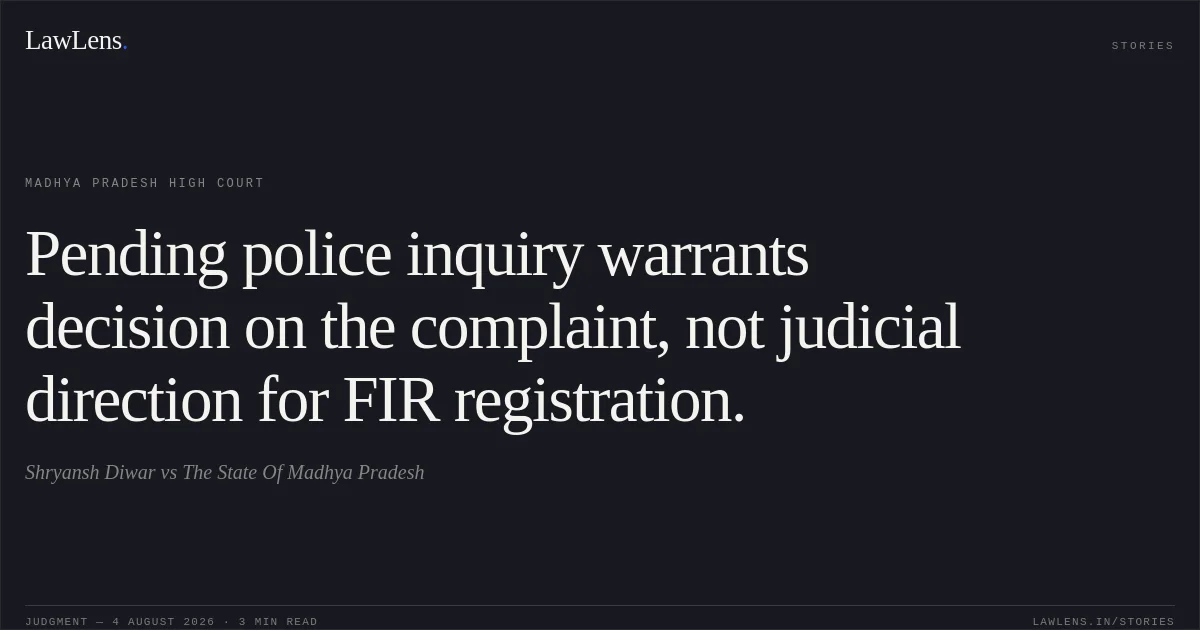
The Court found that the petitioner’s primary grievance was the alleged inaction on his complaint, but noted that the complaint had not been ignored: an inquiry had already commenced, statements of the concerned officials had been sought, and the matter remained under consideration.
Source reference: paras. 3–4In view of the pending inquiry and the disputed factual allegations concerning the traffic incident, the Court declined to direct registration of an FIR or interfere with the manner of investigation at that stage.
Source reference: para. 4Instead, it considered it appropriate to require the competent superior police authority to decide the petitioner’s pending representation in accordance with law, while preserving the authority’s independent assessment of the allegations.
Source reference: para. 5Holding
The Court did not issue a direction for immediate registration of an FIR, departmental proceedings, or transfer of investigation.
It disposed of the writ petition with a direction to respondent No. 3 to consider and decide the petitioner’s representation dated 13.07.2026 strictly in accordance with law.
Source reference: para. 5The decision was to be taken independently and objectively, without being influenced by the Court’s observations or by the allegations made by either party.
Source reference: para. 5The petition was accordingly disposed of.
Source reference: para. 9Original Court PDF
Shryansh DiwarvsThe State Of Madhya Pradesh
Click to open original judgment
Original judgment, available to read, download and summarize on LawLens.in