Facts
A complaint alleged that Panchayat records for a property registered in Gangappa’s name were changed to Mahalingappa’s name without Gangappa’s knowledge or consent.
Source reference: p. 3–5Following a departmental inquiry, the Lokayukta initially recommended withholding two increments, but, after being informed that Kumaraswamy had retired, modified its recommendation to withholding 10% of his pension for three years.
Source reference: p. 3–5The State imposed that penalty after issuing a further show-cause notice.
Source reference: p. 3–5Kumaraswamy’s challenge to the penalty was dismissed by the Karnataka State Administrative Tribunal in Application No. 165/2024.
Source reference: p. 2–5He then filed this writ petition seeking to set aside the Tribunal’s order and the penalty.
Source reference: p. 2–5Issues
1. Whether the Tribunal’s dismissal of Kumaraswamy’s challenge to the pension penalty warranted interference under Articles 226 and 227 of the Constitution.
Source reference: p. 2, 5–72. Whether the disciplinary authority’s penalty was sustainable in light of the evidence concerning Kumaraswamy’s role in changing the katha records and the grounds raised against the inquiry.
Source reference: p. 5–7Law Applied
The Government imposed the penalty of withholding 10% of Kumaraswamy’s pension for three years under Rule 214(1)(A) of the Karnataka Civil Services (Classification, Control and Appeal) Rules, 1957.
Source reference: p. 3The petition invoked the High Court’s jurisdiction under Articles 226 and 227 of the Constitution to challenge the Tribunal’s order.
Source reference: p. 2The judgment cited no precedents and did not set out a separate legal test governing review of the disciplinary findings.
Source reference: no citationReasoning
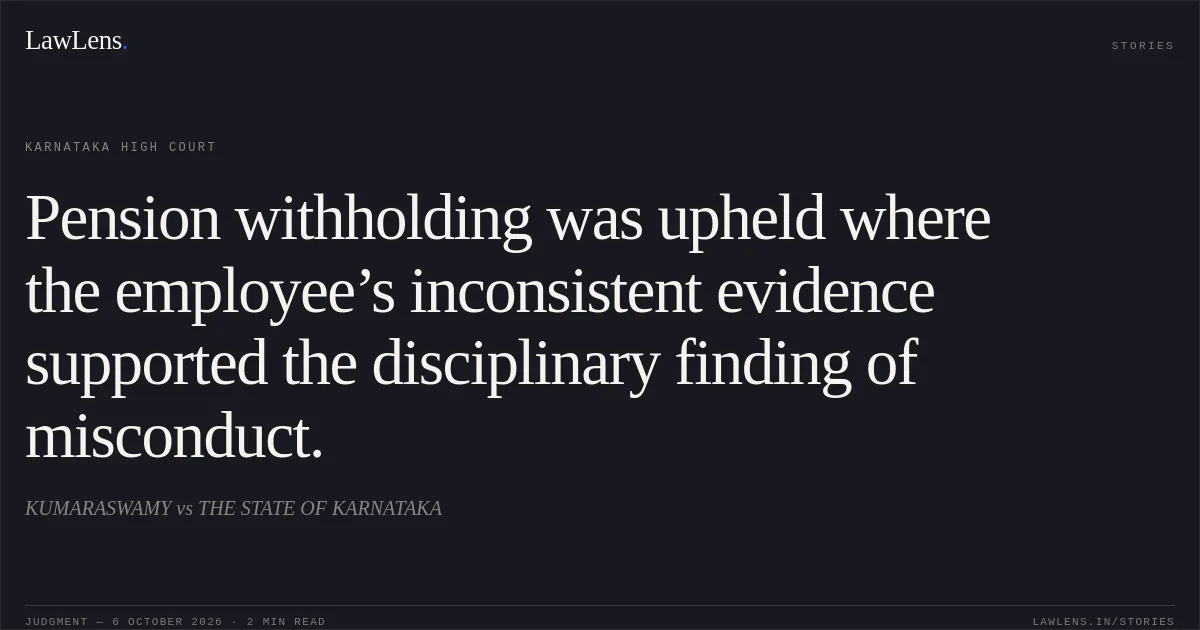
The Court considered Kumaraswamy’s contention that the inquiry was improper and that he had not tampered with or changed the records.
Source reference: p. 5It found that his evidence was inconsistent: although he denied transferring the katha in his chief-examination, he admitted in cross-examination that his written objection stated he had effected the change after Gangappa orally approached him.
Source reference: p. 6–7The Court also noted his admission that the family arrangement on which he relied was made after the complaint was filed.
Source reference: p. 6–7In view of these inconsistencies, the Court declined to accept his defence and held that the disciplinary authority had imposed an appropriate penalty; it found no ground to interfere with the Tribunal’s decision.
Source reference: p. 7Holding
The Court answered against Kumaraswamy, finding no ground to set aside either the Tribunal’s order or the penalty.
It dismissed the writ petition.
Source reference: p. 7Original Court PDF
KUMARASWAMYvsTHE STATE OF KARNATAKA
Click to open original judgment
Original judgment, available to read, download and summarize on LawLens.in