Facts
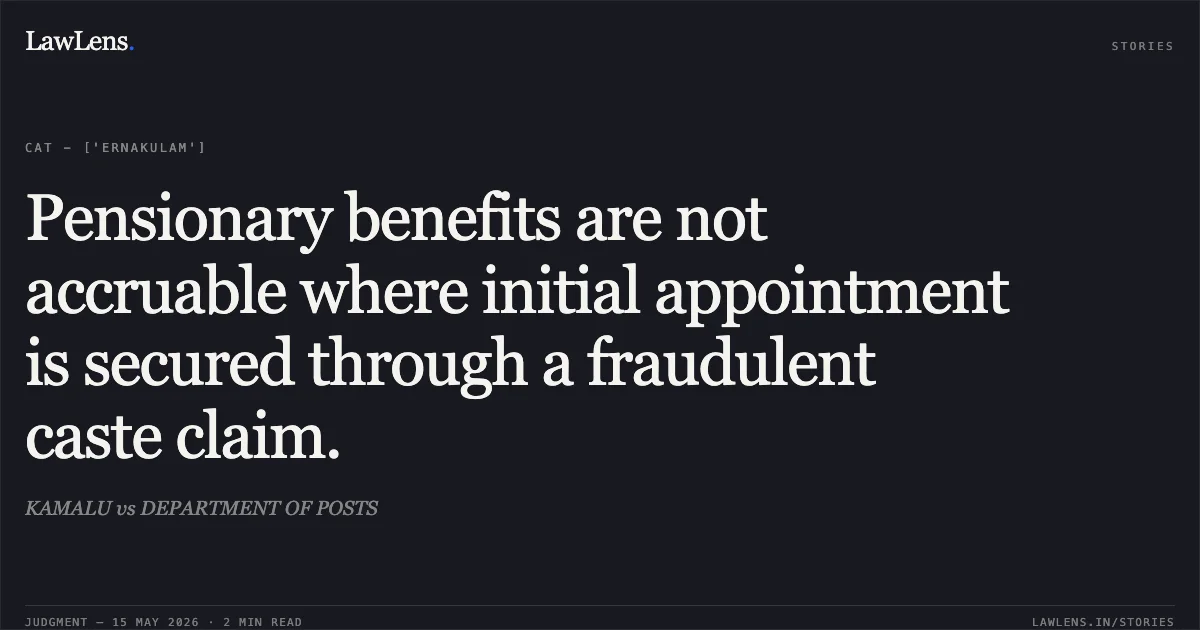
The Applicant entered service in the Department of Posts in 1973 under the Scheduled Tribe (ST) quota
Source reference: p. 3On 26.03.1981, following a verification, her caste status was reclassified from "ST" to "Other Category" (OC) because she actually belonged to the "Pandaram" community
Source reference: p. 7Despite this, she continued in service and retired as a Postmaster on 31.03.2007
Source reference: p. 3Post-retirement, she was granted only a provisional pension because a dispute regarding the ST status of her family members was pending before the Scrutiny Committee and the High Court
Source reference: p. 3The Scrutiny Committee officially cancelled her ST status in 2005
Source reference: para. 9While the High Court of Kerala in MFA No. 125/2005 later ordered terminal benefits for several of her relatives despite their cancelled caste status, the Respondents denied the Applicant similar benefits, arguing she was not a party to that litigation and had admitted her non-ST status as early as 1981
Source reference: p. 4, p. 9-10Issues
1. Whether a retired employee is entitled to full retirement benefits and DCRG when their initial appointment was secured under a reserved category (ST) which was subsequently found and admitted to be incorrect
Source reference: p. 10 / para. 102. Whether the Applicant can claim parity with the judgment in MFA No. 125/2005 even though her caste status was reclassified several decades prior to retirement without challenge
Source reference: p. 10 / para. 10Law Applied
The Tribunal primarily applied the principle that an appointment secured through a false or incorrect caste certificate is void ab initio and non-est in the eyes of the law.
Source reference: p. 12-14It relied heavily on the Supreme Court precedent in R. Vishwanatha Pillai v. State of Kerala, as cited in CA No. 8928/2015, which establishes that rights to salary and pension flow only from a valid legal appointment and cannot be claimed if the appointment was obtained by practicing fraud or deceit
Source reference: p. 12-14The Tribunal also considered the "legitimate expectation" doctrine and the burdens of post-retirement verification discussed in M. Gunasekaran v. The State Level Scrutiny Committee-II others
Source reference: p. 14, 16Reasoning
The Tribunal reasoned that the Applicant's situation was distinct from the relatives who succeeded in the High Court. Specifically, the Applicant's caste status was formally reclassified as "OC" (Other Category) by the Department as early as 1981, following a verification that revealed she belonged to the "Pandaram" community
Source reference: p. 15The Applicant did not challenge this reclassification during her remaining 26 years of service
Source reference: p. 16The Tribunal found that because the Applicant joined under the ST quota—a benefit she was not entitled to—the very basis of her appointment was invalidated
Source reference: p. 16Unlike those who faced verification only after retirement, the Applicant had been put on notice of the discrepancy decades prior
Source reference: p. 16-17Following the Supreme Court's mandate, the Tribunal held that equity cannot be invoked to protect benefits derived from an inherently void appointment
Source reference: p. 14, 17Holding
The Tribunal held that the Applicant is not entitled to the release of regular pension, DCRG, or commuted value of pension because her initial appointment was based on an incorrect caste claim that was discovered and recorded as early as 1981
The Original Application was dismissed, and no costs were awarded
Source reference: p. 17Acts & Sections Cited
1 provisions across 1 statute referred to in this judgment. Linked provisions open on LawLens.
Kerala (Scheduled Castes and Scheduled Tribes) Regulation of Issue of Community Certificates Act, 19961
Original Court PDF
KAMALUvsDEPARTMENT OF POSTS
Click to open original judgment
Original judgment, available to read, download and summarize on LawLens.in