Facts
Kanhaya Lal was serving as Officer Incharge (Training) and was additionally assigned charge of the Stores Section of National Bal Bhawan (“NBB”). Disciplinary proceedings were initiated against him in 2004 concerning procurement from NAFED during 2001–2002 and inadequate scrutiny of NCCF bills in 2003. The Inquiry Officer found five of the seven constituent charges proved, including fraudulent procurement and use of document S-2, disregard of procurement procedures, alteration of Bill No. 1804, and deficient scrutiny of NCCF bills.
Source reference: p. 2, para. 2; p. 4, para. 9Although Kanhaya Lal retired on 31 July 2004, the proceedings continued under Rule 9 of the CCS (Pension) Rules, 1972. The Board of Management of NBB thereafter permanently reduced his pension by 50% and withheld his gratuity in full by order dated 9 April 2005. His appeal was initially rejected as time-barred, but, following directions of the High Court, a fresh appeal was considered and rejected on merits on 8 April 2015. During the writ proceedings, Kanhaya Lal died and his legal representatives were substituted. They challenged the inquiry findings, alleged bias, and the proportionality and legality of the pensionary penalty.
Source reference: p. 1, para. 1; p. 2–3, paras. 3–7Issues
Whether the findings of misconduct, particularly those relating to document S-2, NAFED procurement, alteration of Bill No. 1804, and scrutiny of NCCF bills, were based on sufficient evidence or were perverse and unsustainable in judicial review?
Source reference: p. 3–7, paras. 6–8, 10–16Whether the disciplinary proceedings or penalty were vitiated by alleged bias on the part of Dr. Madhu Pant?
Source reference: p. 10–11, paras. 25–29Whether the Board had jurisdiction under Rule 9 of the CCS (Pension) Rules, 1972 to continue the proceedings after retirement and withhold or reduce pension and gratuity?
Source reference: p. 12–13, 31–35; p. 16–17, paras. 44–45Whether the permanent 50% reduction in pension together with complete withholding of gratuity was disproportionate, inadequately reasoned, or otherwise contrary to Rule 9?
Source reference: p. 13–16, paras. 36–41Whether the absence of UPSC consultation, non-supply of second-stage CVC advice, or alleged disparity with the penalties imposed on other officers invalidated the impugned orders?
Source reference: p. 15–18, paras. 42–46Law Applied
The Court applied the principle of limited judicial review in disciplinary matters: a writ court does not reappreciate evidence, but may interfere where a finding is based on no evidence, is perverse, or is unsupported by the record, as recognised in B.C. Chaturvedi v. Union of India, (1995) 6 SCC 749.
Source reference: p. 4, para. 8Departmental findings are assessed on the preponderance of probabilities rather than proof beyond reasonable doubt.
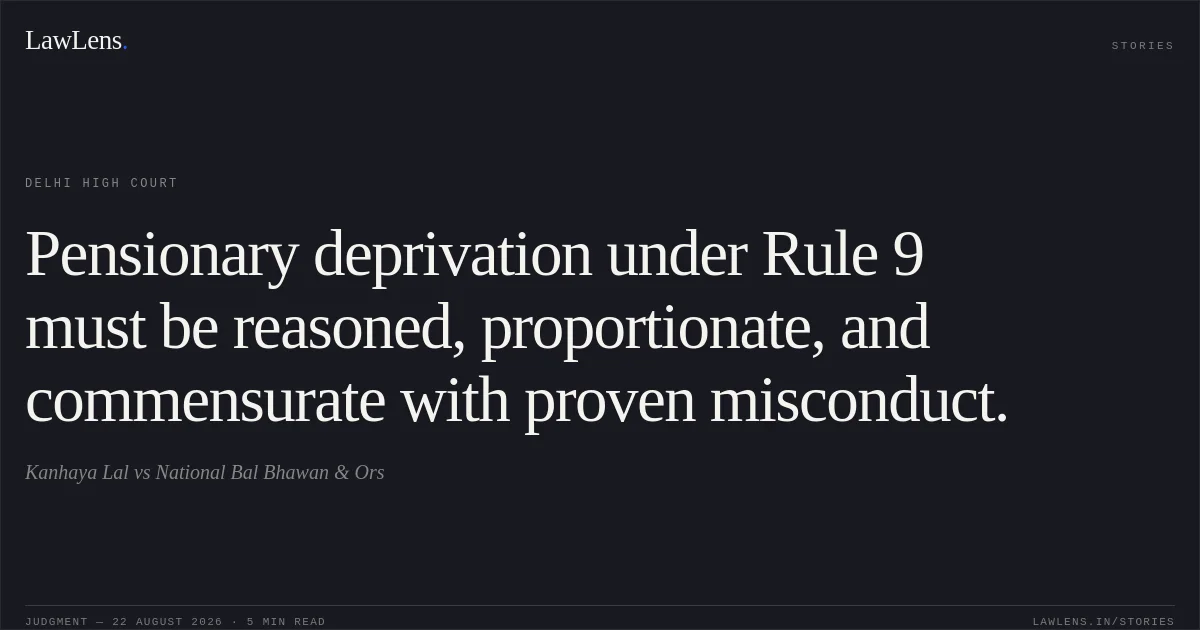
Source reference: p. 6, paras. 14–15Under Rule 9 of the CCS (Pension) Rules, 1972, pension or gratuity may be withheld or withdrawn after retirement where the pensioner is found guilty of grave misconduct or negligence, but the deprivation must be correlative to and commensurate with the gravity of the misconduct, as held in D.V. Kapoor v. Union of India, (1990) 4 SCC 314.
Source reference: p. 12, paras. 31–33Pandit D. Aher v. State of Maharashtra, (2007) 1 SCC 445, establishes that the substance of grave misconduct or negligence is determinative and exact repetition of the statutory phrase is unnecessary.
Source reference: p. 12–13, para. 33The substituted Rule 9(1) authorised withholding pension, gratuity, or both, in whole or in part.
Source reference: p. 13, para. 35The Court also applied the principle that punishment ordinarily lies within the disciplinary authority’s discretion, but an inadequately reasoned or disproportionate penalty may be remitted for reconsideration rather than judicially substituted, subject to B.C. Chaturvedi and State of Orissa v. Bidyabhushan Mohapatra, 1962 SCC OnLine SC 106.
Source reference: p. 15–16, paras. 39–41Allegations of bias were considered in light of National Bal Bhawan & Anr. v. Khazan Chand & Ors., Civil Appeal No. 4216/2026, and parity among co-delinquents was considered with reference to Rajendra Yadav v. State of Madhya Pradesh, (2013) 3 SCC 73.
Source reference: p. 10–11, para. 27; p. 16, paras. 42–43Reasoning
The Court held that the findings on the principal charges were not based on “no evidence.” Although no witness directly saw Kanhaya Lal fabricate or procure document S-2, the document’s appearance in the Stores Section, his note upon it, his role in obtaining approval and processing subsequent NAFED purchases, and the concentration of approximately 80.5% of procurement with NAFED constituted sufficient circumstantial material under the preponderance-of-probabilities standard.
Source reference: p. 5–7, paras. 11–15The findings concerning disregard of procurement procedures, alteration of Bill No. 1804 resulting in an additional payment of INR 12,000, and deficient scrutiny of NCCF bills were also sustainable; however, the Court rejected unsupported assumptions of personal financial gain, collusion, ulterior motive, or quantified loss.
Source reference: p. 7–9, paras. 17–22The alleged bias did not invalidate the proceedings because the penalty was recorded as a decision of the Board of Management, with Dr. Pant signing only as Member Secretary on behalf of the Board, and no material established that the collective decision was merely a device to implement her personal decision.
Source reference: p. 10–11, paras. 28–29Continuation after retirement was permissible under Rule 9, and, by virtue of the NBB Service Bye-laws, the Board validly exercised the powers otherwise vested in the President; UPSC consultation was therefore unnecessary. However, the penalty order failed to explain why the proved misconduct warranted a permanent 50% pension cut and complete denial of gratuity. It also treated the aggregate value of NAFED purchases as “sizeable financial loss” without identifying or quantifying the actual loss. This failure to separately assess the nature, extent, and duration of each pensionary consequence rendered the penalty decision legally deficient and required reconsideration.
Source reference: p. 13–17, paras. 36–45Holding
The writ petition was partly allowed. The Court left undisturbed the findings that Articles I(i), I(ii), I(iii), I(v), and II(i) were proved, subject to the clarification that the volume of procurement could not itself establish pecuniary loss, personal gain, collusion, or ulterior motive; Articles I(iv) and II(ii) remained not proved.
The penalty order dated 9 April 2005 and appellate order dated 8 April 2015 were set aside only insofar as they permanently reduced pension by 50% and completely withheld gratuity. The matter was remitted to the Appellate Authority for a fresh, reasoned decision confined to the nature, extent, and duration of any pensionary consequence. The legal representatives were permitted to submit a concise representation limited to penalty, without reopening the findings or conducting a fresh inquiry.
Source reference: p. 18–19, para. 48(ii)–(vi)Any amount found payable was directed to be released within six weeks of the fresh decision.
Source reference: p. 19, para. 48(vii)Original Court PDF
Kanhaya LalvsNational Bal Bhawan & Ors
Click to open original judgment
Original judgment, available to read, download and summarize on LawLens.in