Facts
The parties married on 17 February 2016 according to Hindu rites and customs and had a daughter. They cohabited for approximately six to seven days before the husband left for government service and the wife continued her nursing education.
Source reference: p.2The husband subsequently filed Civil Suit No. 290A/2021 before the Family Court, Ambikapur, seeking divorce principally on the ground of cruelty, alleging that the wife quarrelled with him and his family, frequently left the matrimonial home, neglected domestic responsibilities and their child, made false complaints against him, and maintained an illicit relationship with another man.
Source reference: pp.3–4The wife denied the allegations and alleged dowry-related harassment, physical mistreatment, the husband’s extramarital relationships, coercion concerning her pregnancy, and other matrimonial misconduct. She asserted that she wished to continue the marriage and had also initiated proceedings for restitution of conjugal rights.
Source reference: pp.4–7The Family Court framed an issue regarding cruelty, answered it in the husband’s favour, and granted divorce by judgment and decree dated 11 November 2024.
Source reference: p.7The wife appealed under Section 19(1) of the Family Courts Act, 1984, challenging the finding of cruelty and contending that the Family Court had failed to award permanent alimony for her and the minor daughter.
Source reference: pp.1, 7–9During the appeal, she filed an application under Section 25 of the Hindu Marriage Act, 1955, but had not made a specific alimony claim or led evidence on that issue before the Family Court.
Source reference: pp.16–18Issues
Whether the Family Court was justified in granting the husband a decree of divorce on the ground of cruelty?
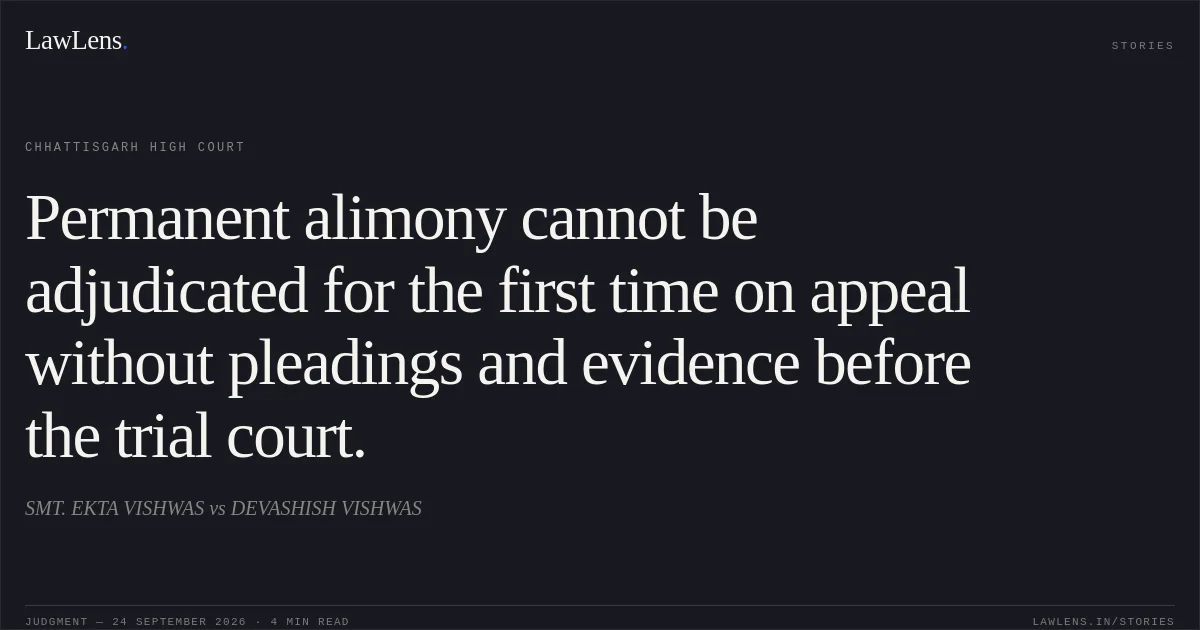
Source reference: para. 14(i); pp.9, 12–16Whether the wife was entitled to permanent alimony under Section 25 of the Hindu Marriage Act, 1955, and whether such claim could be adjudicated for the first time in the appeal?
Source reference: para. 14(ii); pp.9, 16–18Law Applied
The Court applied Section 13(1)(ia) of the Hindu Marriage Act, 1955, under which mental or physical cruelty constitutes a ground for divorce.
Source reference: no citationIt held, relying on Ravi Kumar v. Julmidevi, (2010) 4 SCC 476, that cruelty has no precise or exhaustive definition and must be assessed cumulatively from the parties’ conduct, including acts, omissions, words, gestures and silence.
Source reference: para. 30It further relied on Roopa Soni v. Kamalnarayan Soni, 2023 SCC OnLine SC 1127, which states that cruelty must be determined contextually and from person to person.
Source reference: para. 31Section 25 of the Hindu Marriage Act permits permanent alimony upon application by either spouse, after considering the parties’ income, property, needs, conduct and other circumstances.
Source reference: para. 36Applying Vinny Parmvir Parmar v. Parmvir Parmar, (2011) 13 SCC 112, U. Sree v. U. Srinivas, (2013) 2 SCC 114, and Rajnesh v. Neha, (2021) 2 SCC 324, the Court held that permanent alimony requires relevant financial and other evidence, including income, expenditure, standard of living and capacity to pay.
Source reference: paras. 37–38Reasoning
The Court found that the matrimonial relationship had been abnormal from the beginning and that both parties had levelled allegations concerning each other’s character.
Source reference: para. 22Although the husband did not produce the alleged CD or independent eyewitness evidence concerning the wife’s relationship with Afsar Khan, the wife’s suggestions during cross-examination that she had apologised to the husband regarding that incident were treated as indicating that the incident had occurred.
Source reference: paras. 23–24The non-examination of the wife’s mother, who had filed an affidavit but did not enter the witness box, also permitted an adverse inference against the wife.
Source reference: para. 25The Court considered that the wife’s alleged closeness with another person, as well as unsupported allegations by her against the husband’s character, could constitute mental cruelty.
Source reference: paras. 26–32On an overall assessment of the evidence and the cumulative matrimonial conduct, it held that the wife’s conduct amounted to cruelty under Section 13(1)(ia).
Source reference: paras. 26–32The Court also noted circumstances suggesting that the wife was not genuinely seeking resumption of cohabitation and had not clarified the outcome of her restitution proceedings.
Source reference: para. 33Regarding alimony, the Court held that the wife had neither sought permanent alimony before the Family Court nor produced evidence regarding the parties’ income, needs, property, expenditure or standard of living.
Source reference: paras. 35, 38–39Consequently, the appellate court could not properly determine the Section 25 claim for the first time without factual findings by the court of first instance.
Source reference: paras. 35, 38–39Holding
The appeal was dismissed, and the Family Court’s judgment and decree dated 11 November 2024 granting divorce to the husband on the ground of cruelty were affirmed.
The Court declined to decide the wife’s claim for permanent alimony in the appeal because it had not been raised or supported by evidence before the Family Court.
Source reference: paras. 39, 42However, the wife was granted liberty to file an appropriate application under Section 25 of the Hindu Marriage Act, 1955, which was directed to be considered by the competent court in accordance with law.
Source reference: para. 42Acts & Sections Cited
4 provisions across 2 statutes referred to in this judgment. Each provision opens on LawLens.
Family Courts Act, 19841
Hindu Marriage Act, 19553
Original Court PDF
SMT. EKTA VISHWASvsDEVASHISH VISHWAS
Click to open original judgment
Original judgment, available to read, download and summarize on LawLens.in