Facts
The parties, both advocates, married on 3 March 2014 and had a daughter, Kavya, born on 7 September 2015. They began living separately on 19 April 2016. The respondent-husband filed a petition under Section 13(1)(i-a) of the Hindu Marriage Act, 1955, alleging mental cruelty and desertion.
Source reference: paras. 1–4The proceedings remained pending before the Family Court, the High Court and the Supreme Court, with several unsuccessful mediation attempts and transfer proceedings.
Source reference: paras. 5–6, 23–24During the litigation, the High Court directed payment of maintenance pendente lite of ₹50,000 per month and travelling expenses, while the Supreme Court permitted the matrimonial proceedings to continue subject to compliance with maintenance-related directions.
Source reference: paras. 5–6, 23–24The Family Court, Dehradun, by judgment and decree dated 5 April 2024, dissolved the marriage on the ground of cruelty. The wife challenged that decree in the present appeal.
Source reference: paras. 7–13, 20–29The respondent examined himself, his parents and an independent advocate, while the appellant examined only herself.
Source reference: paras. 7–13, 20–29Issues
Whether the respondent-husband proved that the appellant-wife had subjected him to mental cruelty within the meaning of Section 13(1)(i-a) of the Hindu Marriage Act, 1955?
Source reference: para. 9(i)Whether the Family Court’s finding granting divorce was based on proper appreciation of the pleadings and evidence, or was perverse?
Source reference: para. 9(ii)Whether the appellant was entitled to permanent alimony and, if so, to what extent?
Source reference: para. 9(iii)Whether the respondent’s proposed parenting plan was consistent with the welfare of the minor child?
Source reference: para. 9(iv)Law Applied
The Court applied Section 13(1)(i-a) of the Hindu Marriage Act, 1955, under which a marriage may be dissolved where one spouse has treated the other with cruelty.
Source reference: paras. 1, 9Relying principally on Samar Ghosh v. Jaya Ghosh, (2007) 4 SCC 511, the Court held that mental cruelty has no fixed or exhaustive definition and must be assessed from the cumulative effect of the parties’ conduct, considering their social circumstances, education, profession, background and the impact of the conduct on the affected spouse.
Source reference: paras. 15–16The Court also relied on Naveen Kohli v. Neelu Kohli, (2006) 4 SCC 558, recognising that prolonged separation and a marriage irretrievably broken down may support a finding that continuation of the marital tie has become harmful and unrealistic.
Source reference: para. 17Nayan Bhowmick v. Aparna Chakraborty, 2025 SCC OnLine SC 2798 was cited for the principle that persistent refusal by spouses to accommodate each other may constitute cruelty, without the Court determining which spouse was morally or factually “correct”.
Source reference: para. 18Sonal Talpada v. Veerbhan Singh, 2026 SCC OnLine SC 1063 was relied upon for the proposition that prolonged separation, emotional alienation and absence of genuine reconciliation efforts may be considered by an appellate court in assessing mental cruelty.
Source reference: para. 22For financial relief, the Court considered the parties’ assets, income, qualifications and earning capacity in light of Rajnesh v. Neha, and exercised its jurisdiction to award permanent alimony under Section 25 of the Hindu Marriage Act.
Source reference: paras. 25–28Reasoning
The Court held that the allegations could not be examined as isolated matrimonial disagreements.
Source reference: paras. 12–14, 19The respondent’s evidence, substantially supported by his parents and an independent advocate, disclosed a continuing course of alleged humiliation before relatives, friends and professional colleagues; sustained pressure to abandon or alter his corporate legal practice and relocate to Chandigarh; repeated medical examinations; and attempts to distance him from his parents and the child.
Source reference: paras. 12–14, 19Although the appellant argued that material witnesses such as the photographer and doctors had not been examined, the Court held that mental cruelty may be proved through the overall evidence and need not be established by direct or independent testimony in the manner required in a criminal trial.
Source reference: para. 14The Court also accepted the restaurant incident referred to in the respondent’s replica because the appellant had been permitted to file an additional written statement and had cross-examined the relevant witnesses.
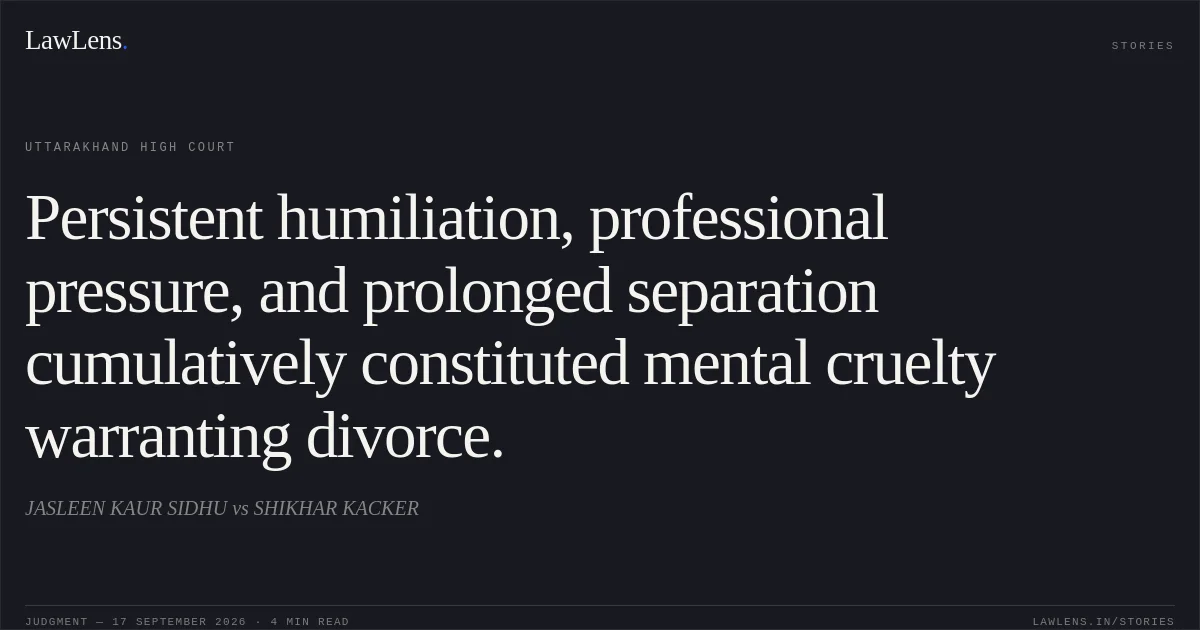
Source reference: para. 13Considering the parties’ professional context, the repeated public humiliation, the prolonged separation of more than a decade and the failure of numerous mediation efforts, the Court concluded that the conduct exceeded ordinary matrimonial wear and tear and satisfied the test of mental cruelty under Samar Ghosh.
Source reference: paras. 19–22The pending maintenance proceedings did not prevent adjudication of the divorce petition because the Supreme Court had expressly permitted the matrimonial proceedings to continue, subject to maintenance compliance.
Source reference: paras. 23–24On the child-related issues, the Court found that the child’s custody should remain with the appellant, while preserving the respondent’s visitation and parental participation rights.
Source reference: para. 26Having regard to the appellant’s professional qualifications and earning capacity, but also the overall circumstances, it awarded permanent alimony of ₹40 lakhs and directed a separate one-time contribution of ₹70 lakhs for the child’s welfare and education.
Source reference: paras. 25–28Holding
The appeal was disposed of and the Family Court’s decree dissolving the marriage on the ground of cruelty was upheld.
The Court held that the respondent had proved mental cruelty and that the Family Court’s findings were neither perverse nor unsupported by evidence.
Source reference: paras. 19, 24Custody of the minor daughter was continued with the appellant, subject to visitation and parental participation rights of the respondent.
Source reference: para. 26The respondent was directed to pay ₹70 lakhs as a one-time amount exclusively for the welfare and education of the minor daughter and ₹40 lakhs as permanent alimony to the appellant.
Source reference: paras. 26, 28–29(ii)–(iii)Acts & Sections Cited
4 provisions across 2 statutes referred to in this judgment. Each provision opens on LawLens.
Hindu Marriage Act, 19553
Code of Civil Procedure, 19081
Original Court PDF
JASLEEN KAUR SIDHUvsSHIKHAR KACKER
Click to open original judgment
Original judgment, available to read, download and summarize on LawLens.in