Facts
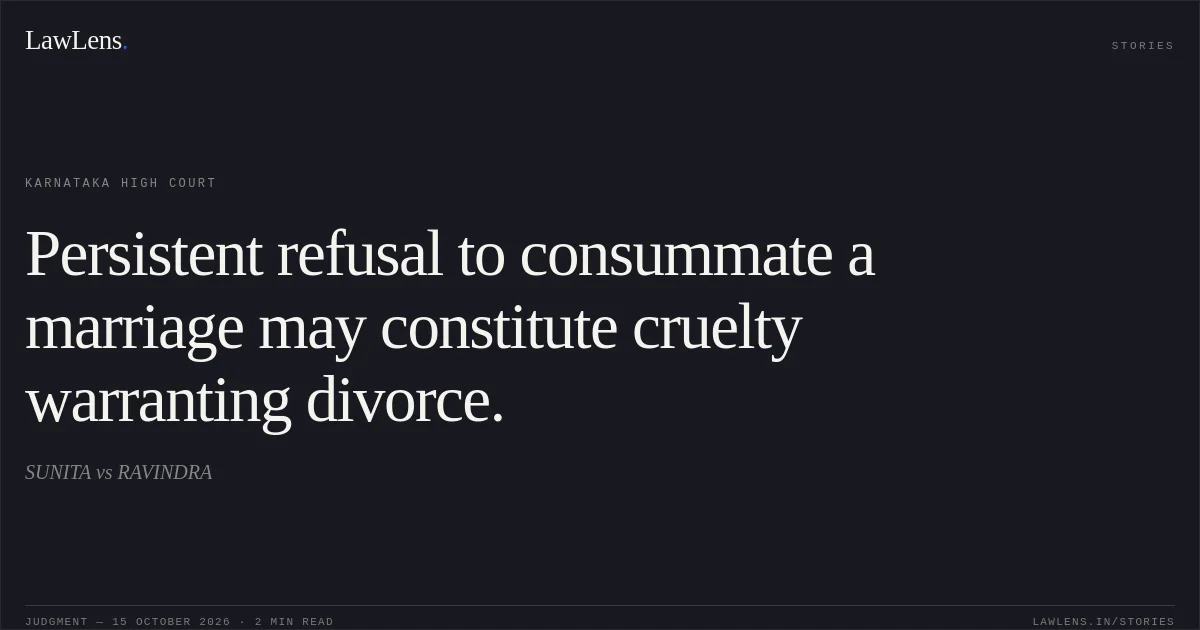
The parties married on 19 February 2022. The husband alleged that the marriage was never consummated because the wife refused physical relations, and that she had lived separately since March 2022. He sought divorce under Sections 13(1)(i-a) and 13(1)(i-b) of the Hindu Marriage Act, 1955. The wife denied the allegations and asserted that she wished to continue the marriage.
Source reference: paras. 3.1–3.2, pp. 3–5The Family Court allowed the petition on cruelty but rejected desertion; the wife appealed, arguing that cruelty and desertion were not proved and that she had not received sufficient opportunity to lead evidence.
Source reference: paras. 3.3–3.5, pp. 5–6; para. 6, p. 6Issues
Whether the wife proved that the Family Court failed to provide her sufficient opportunity to lead evidence.
Source reference: para. 9, p. 8Whether the Family Court’s judgment and decree granting divorce were arbitrary or erroneous.
Source reference: para. 9, p. 8Law Applied
The husband’s petition invoked Section 13(1)(i-a) and (i-b) of the Hindu Marriage Act, 1955, concerning divorce on the grounds of cruelty and desertion, respectively.
Source reference: para. 3.1, p. 3The Court also reproduced Section 13(1A), which provides grounds for divorce following a decree for judicial separation or restitution of conjugal rights.
Source reference: para. 12, pp. 10–11It referred to Savitri Pandey v. Prem Chandra Pandey, (2002) 2 SCC 73, as authority relied on by the Family Court, but did not set out a distinct legal proposition from that decision.
Source reference: para. 15, p. 11Reasoning
The Court found that the wife had been given sufficient opportunity to lead evidence but had not done so.
Source reference: para. 13, p. 11The husband testified that the marriage was not consummated because the wife refused physical relations; three other witnesses gave evidence in support, while the wife did not enter the witness box to rebut the allegation.
Source reference: paras. 10–11, pp. 9–10The Court also noted that the parties had lived separately since 2022, mediation had failed, and there appeared to be no prospect of reunion.
Source reference: paras. 14–15, p. 11On that record, it found no error in the Family Court’s decision to grant divorce on cruelty, notwithstanding that the Family Court had rejected desertion.
Source reference: paras. 3.5, p. 6; 15, p. 11Holding
The Court answered both issues in the negative, holding that the wife had received sufficient opportunity to present evidence and that the impugned decree disclosed no error warranting appellate interference.
It dismissed the appeal and confirmed the Family Court’s judgment and decree dated 24 January 2025 dissolving the marriage; pending applications, if any, were disposed of.
Source reference: para. 16, p. 12Acts & Sections Cited
2 provisions across 2 statutes referred to in this judgment. Each provision opens on LawLens.
Family Courts Act, 19841
Hindu Marriage Act, 19551
Original Court PDF
SUNITAvsRAVINDRA
Click to open original judgment
Original judgment, available to read, download and summarize on LawLens.in