Facts
Ramesh Kumar Yadav, aged 46 years, died from injuries sustained in a motor vehicle accident on 8 April 2021 involving an SUV driven by Respondent No. 1, owned by Respondent No. 2, and insured by Respondent No. 3. His legal representatives filed a claim petition.
Source reference: para. 4The Motor Accident Claims Tribunal, Korba, assessed his monthly income at ₹12,000 on the basis of his pay slip and entry pass, and awarded total compensation of ₹20,31,000 by deducting one-fourth of his income towards personal and living expenses.
Source reference: para. 4; para. 7The Tribunal found the deceased’s father, Appellant No. 4, to be non-dependent because the household expenses were being met from his pension, and treated the remaining four claimants as dependants.
Source reference: para. 7After condoning a delay of 127 days, the High Court considered the claimants’ appeal seeking enhancement of compensation.
Source reference: paras. 1–3Issues
Whether the Tribunal erred in deducting one-fourth, instead of one-fifth, of the deceased’s income towards personal and living expenses while calculating compensation
Source reference: para. 5Whether the award required interference or enhancement on the ground that the deduction should have been based on the total number of claimants being five
Source reference: paras. 8–9Law Applied
The Court applied the principles laid down in Sarla Verma v. Delhi Transport Corporation, (2009) 6 SCC 121, and National Insurance Co. Ltd. v. Pranay Sethi, (2017) 16 SCC 680, concerning deductions for the deceased’s personal and living expenses in fatal motor accident claims.
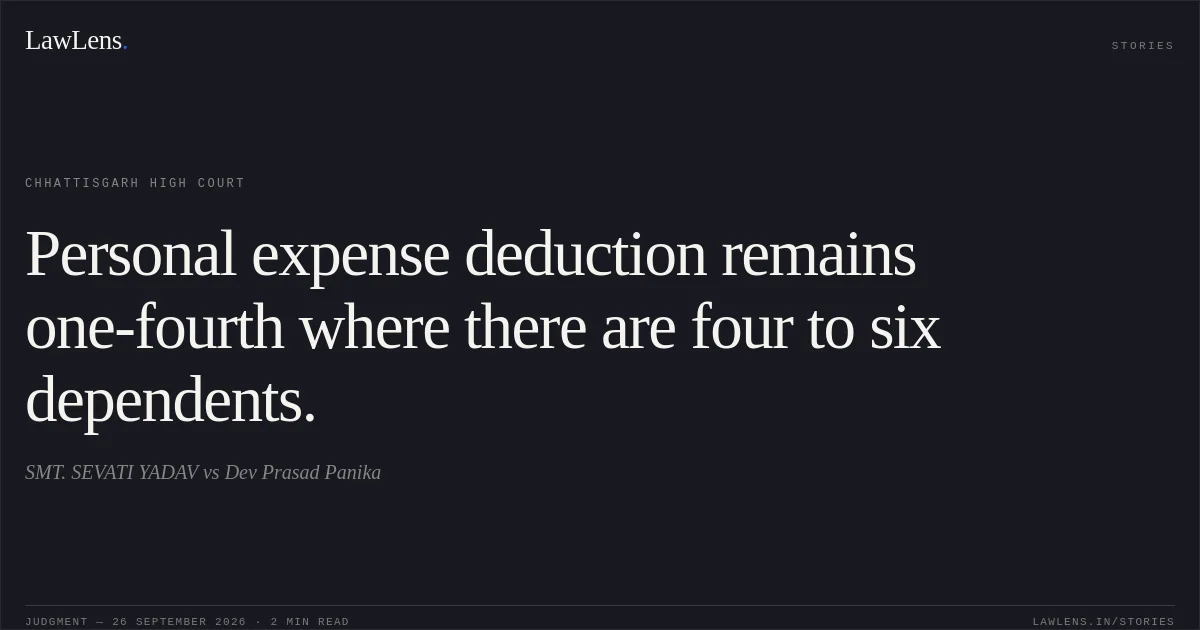
Source reference: para. 8Where the number of dependants is between four and six, the standard deduction is one-fourth of the deceased’s income; a one-fifth deduction is applicable only where the number of dependants exceeds six.
Source reference: para. 8The relevant assessment is based on dependants, not merely the number of claimants, and a non-dependent claimant is not counted for this purpose.
Source reference: para. 7Reasoning
The Tribunal had found that only four of the claimants were financially dependent on the deceased because his father was maintained from his pension and did not receive financial support from the deceased.
Source reference: para. 7Even if all five claimants were considered, the applicable legal category would remain four to six dependants, for which Sarla Verma and Pranay Sethi prescribe a one-fourth deduction.
Source reference: para. 8The proposed one-fifth deduction was therefore legally unavailable, as it applies only where the number of dependants exceeds six.
Source reference: para. 8The High Court consequently found no illegality, perversity, or material infirmity in the Tribunal’s computation.
Source reference: para. 9Holding
The Court answered the issues against the appellants. It held that the one-fourth deduction towards personal and living expenses was correctly applied and that the appellants were not entitled to enhancement on that ground.
The appeal was dismissed at the admission stage, while the application for condonation of the 127-day delay was allowed.
Source reference: paras. 1–3, 10Original Court PDF
SMT. SEVATI YADAVvsDev Prasad Panika
Click to open original judgment
Original judgment, available to read, download and summarize on LawLens.in