Facts
M/s. Taha Wires Pvt. Ltd. manufactured copper wires by drawing copper wire rods and availed CENVAT credit on copper ingots/wire bars, including imported goods allegedly cleared through ICD Tughlakabad.
Source reference: p.1Following investigation and searches conducted by DGCEI, the Department alleged that the imported inputs were not actually transported to Taha Wires’ factory at Daman, that the inputs were diverted elsewhere, and that non-duty-paid scrap was substituted in their place.
Source reference: pp.1–2A show cause notice dated 3 October 2007 proposed recovery of CENVAT credit of ₹3,93,98,286, along with penalties on Taha Wires, its Director Shri Kamilbhai Z. Vashi, and the transporters Shri Rajesh Sharma, Shri Navrattan Lal Sharma and Shri Satish B. Agrawal.
Source reference: pp.1–2The original adjudication order dated 20 April 2011 confirmed the demand and imposed penalties. On appeal, the Tribunal set aside that order and remanded the matter for de novo adjudication.
Source reference: p.2In the remand proceedings, the Principal Commissioner dropped the proceedings by order dated 16 July 2019. The Department filed a separate appeal against Taha Wires and the present appeals against the co-noticees.
Source reference: pp.2–3The Department’s appeal against Taha Wires was dismissed by the Tribunal in Final Order No. A/10092/2022 dated 11 February 2022.
Source reference: p.3Issues
Whether the Department established, by cogent and corroborative evidence, that the disputed copper inputs were not received by Taha Wires at Daman and that the CENVAT credit availed on those inputs was inadmissible.
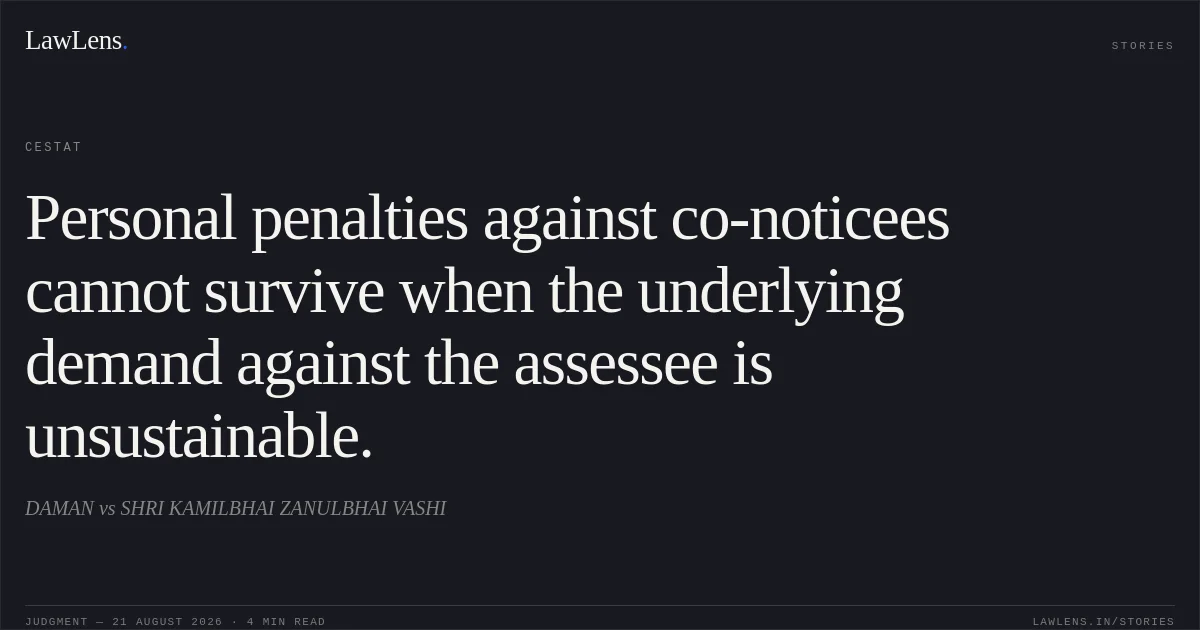
Source reference: pp.4–8Whether personal penalties could be sustained against the Director and the transporters when the substantive demand against Taha Wires had already been dropped and the Department’s appeal against that finding had been dismissed.
Source reference: p.4; para. 6.2Law Applied
The Tribunal applied the CENVAT Credit Rules, 2004, particularly the requirement that credit can be availed only on inputs actually received and used in the manufacture of final products, and the provisions authorising recovery and penalty for wrongly availed credit under Rule 15(2).
Source reference: pp.1–2It also considered Rule 4(5)(a) of the CENVAT Credit Rules, 2004 and Notification No. 214/86-CE concerning movement of inputs to job workers and return of processed goods.
Source reference: pp.4–5Penalties against the individuals were proposed under Rule 26 of the Central Excise Rules, 2002 and the corresponding CENVAT provisions.
Source reference: pp.2–3The governing evidentiary principle was that denial of credit and imposition of penalty cannot rest merely on uncorroborated third-party statements, transport records, RTO reports or alleged irregular vehicle numbers; the Department must establish non-receipt or diversion through reliable and corroborative evidence.
Source reference: pp.6–8The Tribunal relied on Nissan Copper Pvt. Ltd. v. CCE, 2014 (313) ELT 449 (Tri. Ahmd.); Akshay LPG Valves v. CCE, 2016 (337) ELT 129 (Tri. Hyd.); STI Industries v. CCE, 2015 (325) ELT 910 (Tri. Ahmd.); and the Gujarat High Court decision in Commissioner v. Dhanlaxmi Tubes & Metal Industries, 2012 (282) ELT 206 (Guj.), which recognised the evidentiary relevance of job-work records in cases alleging non-receipt of copper inputs.
Source reference: pp.7–8Reasoning
The Tribunal adopted the findings recorded in its earlier decision concerning Taha Wires.
Source reference: p.4The Department relied principally on RTO and check-post records, statements of a few transporters and other third parties to allege that the goods had not travelled from Delhi to Daman. However, it did not identify any alleged buyers, establish the clandestine disposal of approximately 1,670 MT of inputs, prove any financial flow-back, or identify suppliers or transportation arrangements for the allegedly substituted scrap.
Source reference: pp.4–6In contrast, the statutory records, including RG-23A Part I and II, purchase and payment records, job-work challans, Annexure IV and V registers, and records maintained by the job workers, supported actual receipt and utilisation of the inputs.
Source reference: pp.4–5The factory and job-worker premises were inspected without any discrepancy being found in the stock of inputs or finished goods, and the finished goods were cleared on payment of duty.
Source reference: pp.5–7The statements of certain transporters were either retracted, contradicted in cross-examination or insufficiently corroborated; moreover, the investigation covered only a small number of consignments and did not discredit the records relating to the remaining consignments.
Source reference: pp.5–7Since the Department failed to prove the substantive allegation of non-receipt or diversion, and its appeal against Taha Wires had already been dismissed, no independent basis remained for imposing penalties on the co-noticees.
Source reference: p.4; para. 6.2Holding
The Tribunal held that the Department failed to establish that the disputed inputs were diverted, not received at Daman, or substituted with non-duty-paid scrap.
The dropping of the demand against Taha Wires was therefore upheld.
Source reference: para. 6.2As the substantive demand did not survive and no separate or new grounds existed for imposing penalties on the Director and transporters, the personal penalties also could not be sustained.
Source reference: para. 6.2Accordingly, Revenue’s Appeals Nos. 12575–12578 of 2019 were dismissed.
Source reference: para. 7Original Court PDF
DAMANvsSHRI KAMILBHAI ZANULBHAI VASHI
Click to open original judgment
Original judgment, available to read, download and summarize on LawLens.in