Facts
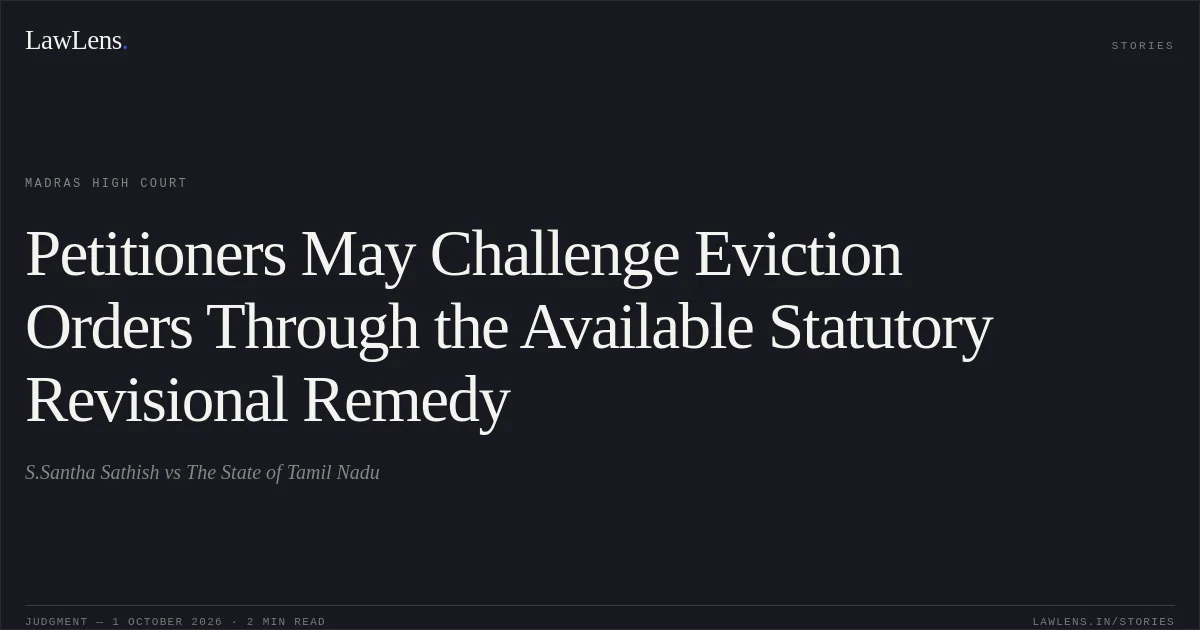
The petitioners claimed to occupy parcels in Survey No. 67, originally classified as “Arasu Poramboke” and later reclassified as “Assessed Waste.”
Source reference: p. 5, paras 3–5They relied on pattas allegedly issued in their favour; the State disputed their authenticity, asserting that they were forged.
Source reference: p. 5, paras 3–5After the authorities issued eviction notices under Section 6 of the Tamil Nadu Land Encroachment Act, 1905, the petitioners’ appeals under Section 10 were rejected.
Source reference: pp. 4–5, paras 2–3They challenged the resulting orders in these writ petitions.
Source reference: pp. 4–5, paras 2–3The State also submitted that a revision under Section 10-A was available before the Commissioner of Land Administration.
Source reference: p. 6, para 5Issues
Whether the petitioners should be permitted to pursue the statutory revisional remedy under Section 10-A of the Tamil Nadu Land Encroachment Act, 1905, instead of having the merits of their challenges determined in the writ petitions
Source reference: p. 7, paras 7–8Whether coercive action against the petitioners should be withheld while those revisions are pending
Source reference: p. 8, para 9Law Applied
Section 6 of the Tamil Nadu Land Encroachment Act, 1905, provides for action concerning encroachments; Section 10 provides an appeal against the relevant orders; and Section 10-A provides a revisional remedy before the Commissioner of Land Administration.
Source reference: pp. 6–8, paras 5, 7–9The Court relied on the availability of that statutory revision and directed that it be considered on the merits, without expressing a view on the parties’ rival claims.
Source reference: pp. 6–8, paras 5, 7–9Reasoning
The Court noted the dispute over the petitioners’ pattas and the State’s assertion that they were forged, but did not decide that factual or substantive dispute.
Source reference: pp. 5–7, paras 5–7Given the nature of the controversy and the available revisional remedy under the Act, it considered it appropriate for the petitioners to approach the competent Revisional Authority.
Source reference: pp. 5–7, paras 5–7To preserve the position pending that process, the Court directed that the respondents take no coercive steps concerning the properties until the revisions were disposed of.
Source reference: p. 8, para 9Holding
The Court disposed of the writ petitions without expressing any opinion on the merits.
It granted the petitioners four weeks from receipt of the order to file revisions before the Commissioner of Land Administration, who was directed to decide them on the merits, in accordance with law, and after hearing all concerned, within six weeks thereafter.
Source reference: pp. 7–8, paras 7–9The respondents were restrained from taking coercive steps concerning the properties until the revisions were decided.
Source reference: pp. 7–8, paras 7–9No order as to costs; connected miscellaneous petitions were closed.
Source reference: pp. 7–8, paras 7–9Acts & Sections Cited
2 provisions across 1 statute referred to in this judgment. Each provision opens on LawLens.
Tamil Nadu Land Encroachment Act, 19052
Original Court PDF
S.Santha SathishvsThe State of Tamil Nadu
Click to open original judgment
Original judgment, available to read, download and summarize on LawLens.in