01Facts
The petitioner, a practising advocate appearing in person, filed a writ petition under Article 226 of the Constitution styled as a Public Interest Litigation
p. 2 · ¶ 1He sought a writ of mandamus directing the State to consider his representation dated 27.08.2026 and to constitute an inquiry committee headed by a retired High Court judge to investigate alleged illegal extraction of minerals, quantify the loss to the State Exchequer, identify perpetrators, and initiate action
p. 1 · p. 2 · ¶ 1The foundation of the petition was a statement by the Minister for Natural Resources (Mines and Minerals) on the floor of the Tamil Nadu Legislative Assembly that substantial mineral resources had gone missing during the previous Government's tenure, supported by photographs
p. 2 · ¶ 2The petitioner had no material beyond that statement. He admittedly conducted no preliminary inquiry, field verification, or fact-finding before approaching the Court.
p. 3 · ¶ 4The petition identified no location, survey number, leaseholder, or specific instance of illegal mining under the MMDR Act, 1957 or the Tamil Nadu Minor Mineral Concession Rules, 1959
p. 3 · ¶ 4The Government Advocate appeared for the respondent
p. 3 · ¶ 302Issues
i.1. Whether a PIL can be maintained on the sole basis of a statement made on the floor of the Legislative Assembly, without independent verification or foundational facts.
p. 3 · ¶ 4 · pp. 3–4 · ¶ 5ii.2. Whether statements made within the Legislative Assembly can, by themselves, constitute conclusive proof or the sole cause of action for invoking writ jurisdiction.
pp. 3–4 · ¶ 5iii.3. Whether the Court should constitute a parallel inquiry committee when the State Government has already taken cognizance and the matter is under active consideration.
p. 4 · ¶ 6iv.4. Whether a petitioner who is a practising advocate, filing a petition lacking material particulars, abuses the PIL jurisdiction.
p. 4 · ¶ 703Law Applied
Article 226 of the Constitution, which confers writ jurisdiction, and the settled principle that a PIL cannot rest merely on newspaper reports or Assembly statements without independent verification and foundational facts.
pp. 3–4 · ¶ 5Article 194(2) of the Constitution, which protects statements made inside the Legislative Assembly, and the principle that such statements cannot by themselves be conclusive proof or the sole cause of action without corroborative material.
pp. 3–4 · ¶ 5The principle that courts cannot usurp executive functions or order a "roving and fishing inquiry" at a litigant's instance, particularly where the executive has already taken cognizance.
p. 4 · ¶ 6The principle that PIL is a remedy for the voiceless and the rule of law, not "Publicity Interest Litigation," and that a higher standard of diligence is expected of an advocate invoking PIL jurisdiction. The order refers to Supreme Court holdings for these propositions but cites no specific authority.
p. 4 · ¶ 7The MMDR Act, 1957 and the Tamil Nadu Minor Mineral Concession Rules, 1959 are identified as the governing statutory framework.
p. 3 · ¶ 404Reasoning
The Court first examined the petition's factual basis and found it wholly dependent on a legislative statement, supported by no tangible material, independent evidence, or preliminary inquiry.
p. 3 · ¶ 4It declined to treat the Assembly statement as sufficient foundation, since Article 194(2) protects the statement but does not convert it into proof or a cause of action.
pp. 3–4 · ¶ 5The absence of any specific location, lease, or instance of contravention meant the petition could not identify a justiciable violation.
p. 3 · ¶ 4The Court held that the State had already taken cognizance and the matter was under active consideration. A parallel committee ordered at the petitioner's request would therefore be premature and would intrude on executive functions, amounting to a fishing inquiry.
p. 4 · ¶ 6The Court treated the petitioner's status as an advocate as aggravating, because it heightened the expected standard of diligence before invoking PIL jurisdiction. Filing a petition without material particulars wasted judicial time and constituted an abuse of process.
p. 4 · ¶ 7A petition lacking foundational facts does not serve the PIL purpose.
p. 4 · ¶ 705Holding
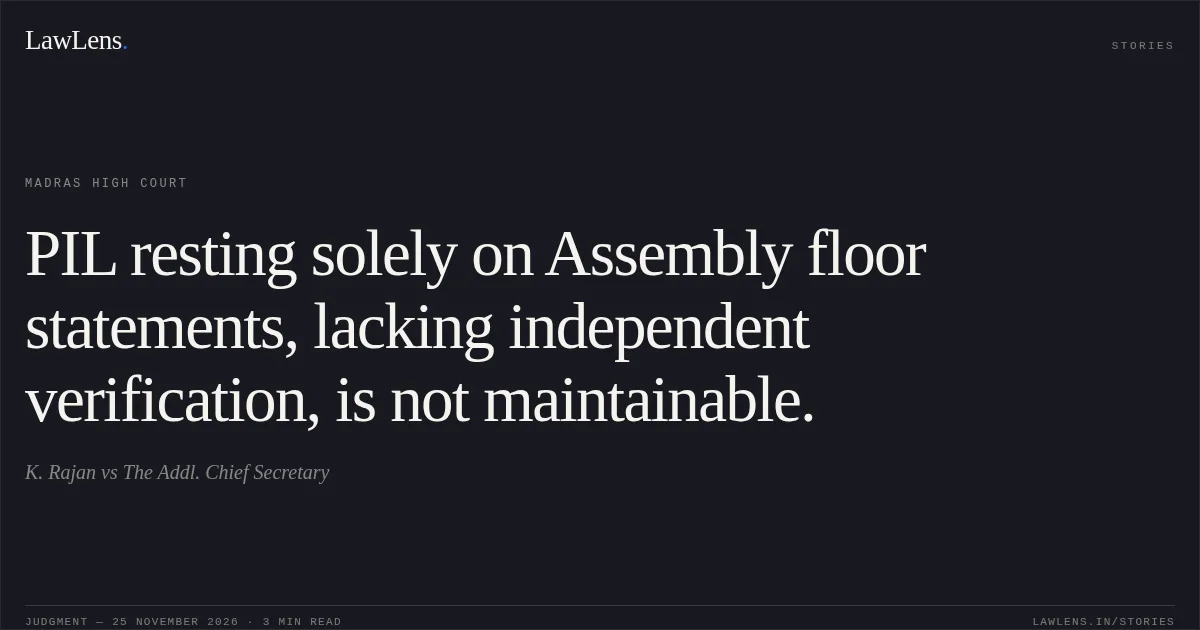
A PIL cannot rest solely on an Assembly statement without foundational facts and independent verification.
pp. 3–4 · ¶ 5Such a statement, protected under Article 194(2), cannot itself be the sole cause of action.
pp. 3–4 · ¶ 5Constituting a parallel inquiry committee was unwarranted and premature where the State had already taken cognizance.
p. 4 · ¶ 6The petition, filed by an advocate without material particulars, was an abuse of process.
p. 4 · ¶ 7The writ petition was found devoid of merit, premature, and lacking foundational facts, and was dismissed at the admission stage without costs.
pp. 4–5 · ¶ 8The Court did not direct the State to consider the representation on the merits, and it made no findings on the alleged mineral losses.
Original Court PDF
K. RajanvsThe Addl. Chief Secretary
Click to open original judgment
Original judgment, available to read, download and summarize on LawLens.in