01Facts
The petitioners (defendant nos. 5 to 10) challenged Order No. 18 dated 11 September 2024, by which the Trial Court rejected their application under Order VII Rule 11(d), CPC, in Title Suit No. 25 of 2022.
¶ 2The application argued that (1) the appointment of plaintiff Gopal Das as sole selling agent was illegal under the Companies (Amendment) Act, 1960; (2) the appointment violated Section 294 of that Act; and (3) a resolution dated 31.03.2014, passed by a board meeting attended by ten members, was valid, so the "B" Schedule deeds were valid.
¶ 2At the hearing, the petitioners' counsel abandoned points (1) and (2) and sought liberty to raise point (3) and other legal points as a preliminary issue before the Trial Court.
¶ 3The opposite parties contended that only plaint averments may be considered under Order VII Rule 11, that the plaintiff failed to show a bar on the face of the plaint, and that the 1960 Act amendment did not apply to suits pending when instituted; the 1960 Act was later replaced by the Companies Act, 2013.
¶ 4–5The Trial Court held that a plaint may be rejected only if its pleadings reveal a legal bar; that the petitioners' case of voidness under Section 249 of the Companies Act and the question of ratification required evidence and could not be decided at the threshold.
¶ 602Issues
i.1. Whether a plaint may be rejected under Order VII Rule 11(d), CPC, on the ground of a statutory bar where the bar is not disclosed on the face of the plaint averments.
¶ 6 · ¶ 8ii.2. Whether the Trial Court was justified in refusing to decide, at the threshold, the question of the plaintiff's appointment's validity and ratification, which required evidence.
¶ 6 · ¶ 8iii.3. Whether the petitioners may agitate the maintainability of the suit by a fresh application to be decided as a preliminary issue.
¶ 3 · ¶ 1003Law Applied
Order VII Rule 11(d), CPC, under which a plaint is rejected where the suit appears from the plaint's statements to be barred by any law.
¶ 6The bar is determinable only on the plaint averments, so the petitioners had to show the bar from the pleadings.
¶ 8Section 294 of the Companies (Amendment) Act, 1960, on sole selling agents, which the petitioners abandoned; and Section 249 of the Companies Act, relied on for the claim that the appointment was void ab initio.
¶ 2–3 · ¶ 6Under the principle applied by the Trial Court, whether a void appointment was ratified is a question of fact for trial, not for threshold rejection.
¶ 6Provisions in the judgment · 1 · Linked ones open on LawLens
Companies Act, 2013 Section 249
04Reasoning
The petitioners abandoned their statutory challenges under Section 294 and the 1960 Act amendment, leaving only the validity of the 2014 resolution and the "B" Schedule deeds as a ground.
¶ 2–3The Court held that the Trial Court correctly limited the Order VII Rule 11(d) inquiry to the plaint averments and that the petitioners did not show, from those averments, a bar by law.
¶ 8Because the claimed invalidity of the plaintiff's appointment depended on ratification and evidence, the Trial Court was right to defer it to trial. The Court did not decide the applicability of the amendment or the effect of the 2013 Act, so those questions remain open for the Trial Court.
¶ 5–6 · ¶ 8Since no merit was found in the revision, the Court preserved the petitioners' right to raise maintainability as a preliminary issue, which the Trial Court must decide in accordance with law.
¶ 9–1005Holding
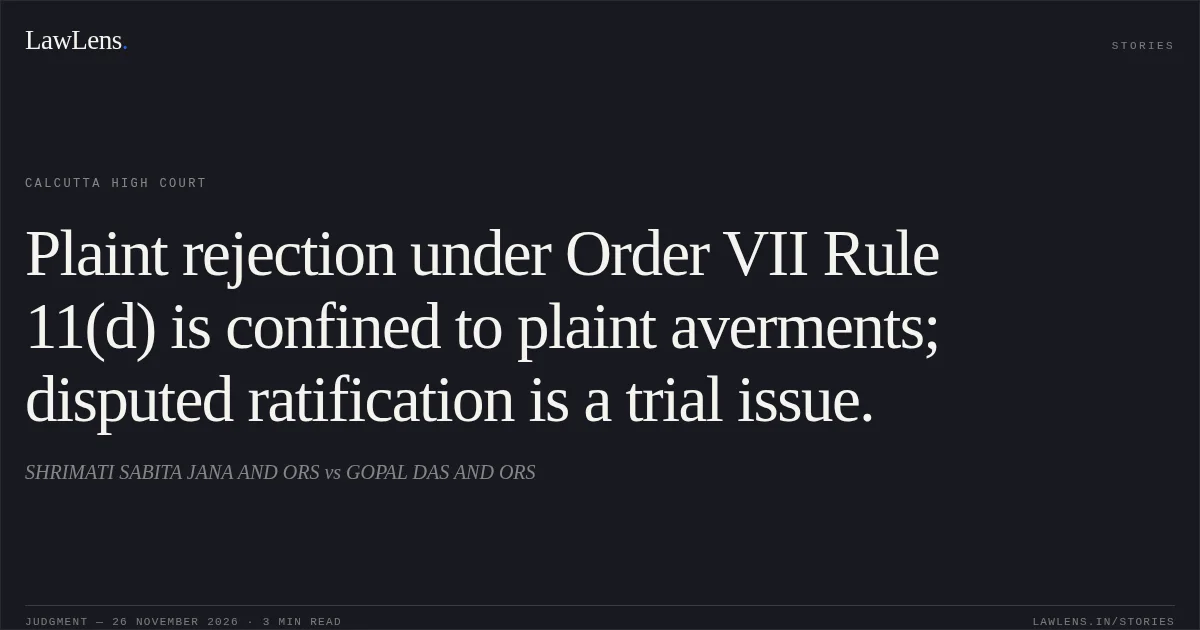
The petitioners failed to establish, on the plaint's averments, a bar under Order VII Rule 11(d), CPC, and the Trial Court properly deferred the ratification question to trial.
¶ 8–9The revisional application is disposed of with no merit. The petitioners are granted liberty to file an application on the suit's maintainability, which the Trial Court shall decide as a matter of law, and the certified copy is to be supplied on compliance with formalities.
¶ 9–12Original Court PDF
SHRIMATI SABITA JANA AND ORSvsGOPAL DAS AND ORS
Click to open original judgment
Original judgment, available to read, download and summarize on LawLens.in