01Facts
The predecessor of the opposite parties (plaintiffs) instituted Title Suit No. 520 of 2022 for declaration of title and permanent injunction over a plot of land. After the original plaintiff died, his heirs were substituted.
¶ 2The petitioner (defendant) filed a written statement denying the plaint's allegations and a counter-claim for adverse possession.
¶ 2After arguments concluded and the matter was fixed for orders, the plaintiffs applied under Order VI Rule 17 CPC to amend the plaint, contending that the suit property had been wrongly described through typographical errors. The defendant objected.
¶ 3The schedule as originally filed recorded R.S. Khatian Nos. 69 and 16 and R.S. Plot Nos. 339 and 717.
¶ 12The plaintiffs' application dated 20.12.2023, which was produced before the Court, sought no amendment of the schedule.
¶ 8, 13Yet the amended plaint described the land under R.S. Khatian No. 217 and R.S. Plot Nos. 69 and 16, with added boundaries.
¶ 13The proposed amendment restored the Khatian and Plot numbers and added boundaries, including East and West.
¶ 15–16The trial court allowed the amendment, finding it necessary, non-prejudicial, and not altering the property in dispute.
¶ 4The petitioner challenged that order in revision.
¶ 402Issues
i.1. Whether the change in the schedule of the amended plaint, made without any prayer for amendment of the schedule, was impermissible, such that the original schedule must be deemed correct.
¶ 13–14ii.2. Whether the plaintiffs' amendment to correct the schedule's typographical/clerical errors may be allowed at the post-hearing stage despite the absence of due diligence under the proviso to Order VI Rule 17 CPC.
¶ 5–6, 22iii.3. Whether the amendment alters the identity of the suit property or causes prejudice to the defendant.
¶ 19iv.4. Whether the mismatch between the amended schedule and the PW1 affidavit-in-chief, which repeats the incorrect numbers, creates confusion warranting interference.
¶ 5, 2703Law Applied
The proviso to Order VI Rule 17 CPC requires due diligence for amendments after trial commences, but the bar applies chiefly to substantive amendments, not bona fide typographical or clerical corrections.
¶ 22Misdescription of property should be liberally corrected, as stated in Sajjan Kumar v. Ram Kishan (2005) 13 SCC 89, which allowed correction of the description of premises at a late stage to avoid needless complications at execution.
¶ 17–18Under Peethani Suryanarayana v. Repaka Venkata Ramana Kishore (2009) 11 SCC 308, the power to amend is circumscribed by three conditions: bona fides, no injustice to the other side, and no infringement of accrued rights of defendants.
¶ 20–21Section 153 CPC, as explained in Purushottam Umedbhai & Co. v. Manilal & Sons (1960 SCC OnLine SC 126), permits correction of clerical errors even where Order VI Rule 17 is not strictly applicable.
¶ 23In J. Samuel v. Gattu Mahesh (2012) 2 SCC 300, omission of a mandatory pleading under Section 16(c) of the Specific Relief Act was held to be a substantive lapse, not a typographical error, and is distinguishable.
¶ 24–25Provisions in the judgment · 3 · Linked ones open on LawLens
Code of Civil Procedure, 1908 Section 115Section 153
Specific Relief Act, 1963 Section 16
04Reasoning
The Court first observed that the schedule was changed without any prayer, which was impermissible, so the original schedule should be treated as correct.
¶ 13–14Even otherwise, the proposed amendment was held to be a bona fide correction of clerical errors. The plaintiffs' affidavit showed that the Khatian and Plot numbers had been transposed.
¶ 16Because both parties claimed under the same patta and the property was undisputed, the amendment neither changed the property nor caused surprise or prejudice.
¶ 19Since the defendant had never disputed that the suit land was the land covered by the patta, the Peethani conditions were satisfied.
¶ 20–21The due diligence bar, applied strictly to substantive amendments in J. Samuel, did not extend to such clerical corrections. Avijit Mukherjee was held inapplicable for the same reasons.
¶ 22, 24–26The inconsistency between PW1's affidavit-in-chief and the amended schedule was not fatal, since evidence is assessed as a whole against the documents of title, which both sides relied upon.
¶ 2705Holding
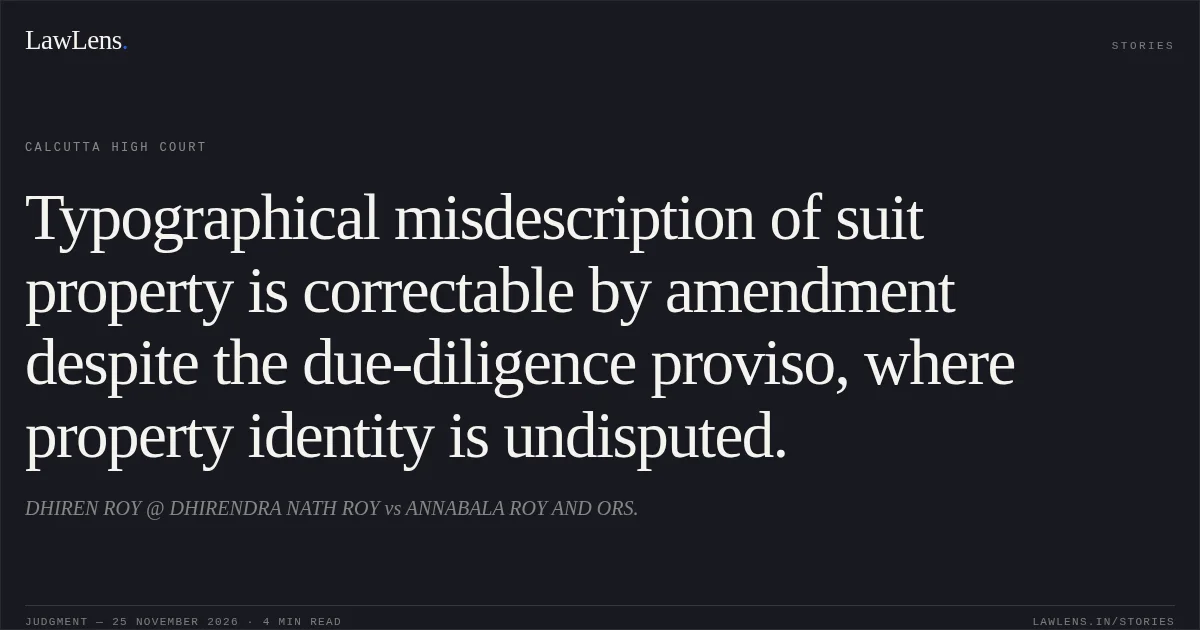
The trial court's order allowing the amendment under Order VI Rule 17 CPC was correct. The amendment was a bona fide correction of typographical/clerical errors that did not alter the property in dispute and caused no prejudice, so the due diligence bar did not apply.
¶ 19, 22The order did not call for interference.
¶ 28C.O. 181 of 2026 was dismissed without costs. The Court directed that a certified copy of the judgment be supplied to the parties on application, subject to formalities.
¶ 28–29Original Court PDF
DHIREN ROY @ DHIRENDRA NATH ROYvsANNABALA ROY AND ORS.
Click to open original judgment
Original judgment, available to read, download and summarize on LawLens.in