01Facts
The appellant-plaintiff (Hemanna) sued his brothers (defendant Nos. 1–3) and sister (defendant No. 4) in O.S. No. 113/2012 for partition and separate possession of a 1/5th share in 14 items of properties left by their father, K. Shivalingaiah, who died on 13.08.1990.
¶ 2 · FAC para. 13The mother, Manchamma, died on 21.03.2004.
¶ 2 · FAC para. 13The plaintiff alleged that the properties were joint family properties, that the khatha stood mutated in the mother's name after the father's death, and that no partition had taken place.
¶ 2 · Trial Court · ¶ 2Defendant Nos. 1–3 contended that a partition had taken place on 05.01.1998 under an unregistered partition deed, under which the plaintiff received specified lands, and that Survey No. 204 (defendant No. 4's share) was mutated in her name under MR No. 6/2003-04.
Trial Court · ¶ 3 · FAC paras. 20, 28Defendant No. 4 supported the plaintiff.
Trial Court · ¶ 4The defendants did not produce the partition deed before the Trial Court, and the Trial Court found the plea unproved.
¶ 8(e) · Trial Court · ¶ 8(e)The Trial Court decreed the suit for a 1/5th share by metes and bounds.
Trial Court, Order paras. 1–5The First Appellate Court (FAC) reversed the Trial Court, holding partition proved and dismissing the suit.
FAC paras. 36–39The plaintiff appealed under Section 100 CPC.
¶ 102Issues
i.1. Whether the Appellate Court erred in holding that a partition dated 05.01.1998 existed, without considering whether such a deed was proved on the facts and evidence.
¶ 1, Q(i)ii.2. Whether the FAC's judgment is sustainable when the Trial Court found no earlier partition and the defendants never sought production of the alleged deed in the Trial Court.
¶ 1, Q(ii)iii.3. Whether the FAC's judgment is perverse, arbitrary, unreasonable or illegal in view of the pleadings and evidence on record.
¶ 1, Q(iii)iv.4. Whether the FAC erred in holding that mutation entries constituted proof of partition.
¶ 1, Q(iv)03Law Applied
The appeal was heard under Section 100 CPC, which permits second appeal only on substantial questions of law.
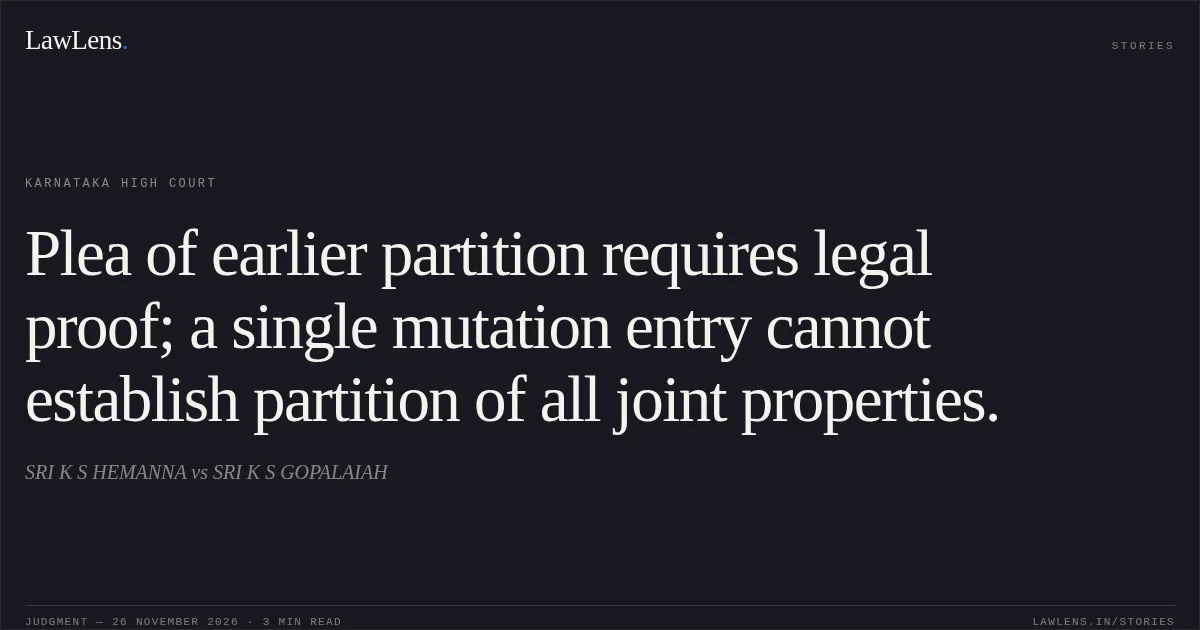
cause title · ¶ 1A party asserting an earlier partition must prove it by legal and acceptable evidence; a bare plea is insufficient.
¶ 9–10Mutation or revenue entries are relevant but not conclusive proof of partition, and they must be read with other evidence showing that the shares were actually divided.
¶ 9–10The FAC relied on Digambar Adhar Patil v. Devram Girdhar Patil (AIR 1995 SC 1728) for the propositions that revenue records are relevant evidence of partition and that partition under Hindu law need not be by registered deed. The High Court did not overrule this proposition but held that the revenue entries in this case did not establish partition.
FAC paras. 34–35, 38 · ¶ 9–10The parties were governed by Hindu law and the Hindu Succession Act, 1956.
FAC paras. 35, 38Provisions in the judgment · 2 · Linked ones open on LawLens
Code of Civil Procedure, 1908 Section 100Section 96
04Reasoning
The High Court held that the FAC misdirected itself by treating the alleged partition as proved without any legal or acceptable evidence. The unregistered partition deed was never produced, and the defendants did not account for its absence.
¶ 10 · ¶ 9 · Trial Court · ¶ 8(e)The only documentary support was the MR No. 6/2003-04 extract (Ex. D-10) and RTC (Ex. D-11), which related solely to Survey No. 204 (2 acres) allotted to defendant No. 4. Those entries did not establish that the remaining items were divided.
¶ 10The revenue records for the remaining properties showed devolution by inheritance to Manchamma, which indicated that the alleged partition was never acted upon by the parties. The High Court therefore rejected the FAC's reliance on mutation entries as conclusive proof.
¶ 10 · Issue 4The oral testimony of DW-1 to DW-5 was assessed as insufficient: the witnesses did not produce the deed, the joint borrowing from the bank in 2004 was consistent with a cordial joint family arrangement, and the partition evidence did not cover all items.
¶ 9 · FAC paras. 23–31Because the partition plea failed, the properties retained their character as ancestral joint family properties, and the plaintiff's claim to a 1/5th share followed.
¶ 10 · Trial Court, Order para. 2The High Court held that the FAC's finding that the plea was proved was perverse, as it rested on an unsupported inference.
¶ 9–11 · Issue 305Holding
The FAC erred in holding that the 05.01.1998 partition was proved, and its reliance on the MR No. 6/2003-04 mutation entry was misplaced.
¶ 9–11 · Issues 1, 2, 4The appeal was allowed. The FAC judgment and decree dated 27.11.2018 in R.A. No. 29/2013 was set aside. The Trial Court judgment and decree dated 13.02.2013 in O.S. No. 113/2012 was restored. The suit was decreed as prayed for, and a decree was to be drawn accordingly.
¶ 12(i)–(v)Original Court PDF
SRI K S HEMANNAvsSRI K S GOPALAIAH
Click to open original judgment
Original judgment, available to read, download and summarize on LawLens.in