01Facts
The respondent-wife (Nasreen Banu) and her minor son filed O.S. No. 10/2013 for maintenance against the appellant-husband, an Assistant Teacher in an Urdu Primary School
¶ 3The parties' marriage on 15.04.2010 and the child's paternity were not disputed
¶ 7The wife alleged ill-treatment and drugging by the husband, which led to termination of a pregnancy; a second child was later born
¶ 7Her legal notice demanding Rs. 10,000 per month was answered by the husband
¶ 7The husband had filed O.S. No. 770/2013 for restitution of conjugal rights, which was disposed of for non-prosecution
¶ 7, 9The husband's witness (DW-2) did not appear for cross-examination and his evidence was excluded; DW-3 deposed that the wife declined to join the husband despite community efforts in 2012
¶ 7In cross-examination, the husband admitted that his wife was caring for her parents
¶ 8He claimed a payment of Rs. 5,00,000 to the wife but produced no documents
¶ 8He stated his 2013 salary as Rs. 20,000 per month but, in cross-examination, admitted Rs. 49,000 per month
¶ 8The Trial Court (21.07.2023) awarded Rs. 6,000 per month to the wife and Rs. 4,000 per month to the son
¶ 3The First Appellate Court (R.A. No. 27/2023, 29.01.2025) dismissed the appeal and affirmed
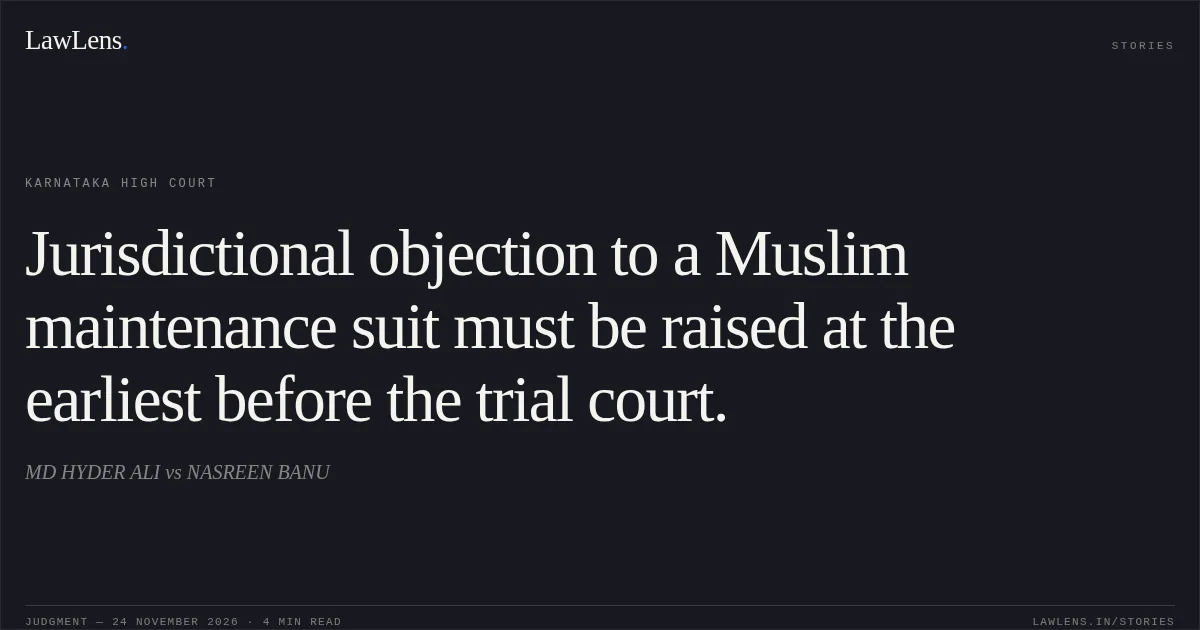
¶ 4The husband did not raise any jurisdictional objection before the Trial Court
¶ 602Issues
i.1. Whether a Civil Court has jurisdiction to entertain a maintenance suit under Muslim Personal Law when the matter falls within the jurisdiction of the Family Court under Section 7 of the Family Courts Act, 1984.
¶ 4 (substantial question no. 1) · ¶ 5ii.2. Whether an award of maintenance can be sustained without proper appreciation of the husband's financial capacity, salary, and obligations, including towards aged parents and minor siblings.
¶ 4 (substantial question no. 2) · ¶ 8iii.3. Whether parallel proceedings (maintenance suit, restitution of conjugal rights petition, and Domestic Violence Act complaint) arising from the same dispute constitute abuse of process and whether courts must prevent multiplicity of proceedings.
¶ 4 (substantial question no. 3) · ¶ 903Law Applied
Section 7(1) of the Family Courts Act, 1984, which vests Family Courts with the jurisdiction of district or subordinate civil courts over the proceedings described in its Explanation
¶ 5An objection to jurisdiction must be raised at the earliest opportunity before the Trial Court, so a party failing to do so cannot later challenge jurisdiction in second appeal
¶ 5 · ¶ 6Concurrent findings of fact of the lower courts are not disturbed in second appeal absent legality or infirmity, and a second appeal under Section 100 CPC requires a substantial question of law
¶ 10A wife is entitled to invoke the maintenance and Domestic Violence Act remedies available under law, and such use is not, by itself, an abuse of process
¶ 9Provisions in the judgment · 2 · Linked ones open on LawLens
Code of Civil Procedure, 1908 Section 100
Family Courts Act, 1984 Section 7
04Reasoning
On Issue 1, the Court did not decide whether Section 7 of the Family Courts Act ousts civil court jurisdiction for Muslim Personal Law maintenance claims. It disposed of the contention on procedural grounds: the husband had not objected before the Trial Court, and the suit had been numbered and tried as a maintenance matter
¶ 5 · ¶ 6On Issue 2, the Court found that the Trial Court had considered the husband's income. The husband's own cross-examination admission of a Rs. 49,000 monthly salary, against his earlier figure of Rs. 20,000, supported the award
¶ 8His claimed Rs. 5,00,000 payment was unsupported by documents, and his admission that the wife cared for her parents did not displace the award. Both lower courts had appreciated these factors, and the contention of improper appreciation was rejected
¶ 8On Issue 3, the Court held that the wife was entitled to pursue the maintenance suit and the DV Act complaint under the statutory scheme, and that the parallel filings did not amount to abuse of process. The Court did not separately discuss the court's duty to prevent multiplicity of proceedings
¶ 9Because the Court found no substantial question of law, it did not reexamine the factual findings
¶ 1005Holding
The Court did not decide the Section 7 jurisdictional question on its merits. It held that the objection was not raised at the earliest opportunity before the Trial Court and therefore could not be entertained in second appeal
¶ 5, 6The maintenance award was properly supported by the husband's salary admissions and the evidentiary record, so the appellant's financial-capacity contention failed
¶ 8The parallel proceedings were not an abuse of process, as the wife was entitled to invoke the available remedies
¶ 9The concurrent findings suffered from no legality or infirmity and no substantial question of law arose
¶ 10The second appeal is dismissed, and the concurrent judgments of the Trial Court (O.S. No. 10/2013, dated 21.07.2023) and the First Appellate Court (R.A. No. 27/2023, dated 29.01.2025), awarding Rs. 6,000 per month to the wife and Rs. 4,000 per month to the minor son, stand affirmed
¶ 3, 4, 10Original Court PDF
MD HYDER ALIvsNASREEN BANU
Click to open original judgment
Original judgment, available to read, download and summarize on LawLens.in