01Facts
The parties married on 04.06.1999 and have a daughter.
¶ 2The wife (appellant) petitioned the Family Court under Section 10(1)(x) of the Divorce Act, 1869, alleging that after an initial period of affection, the husband became addicted to alcohol, quarrelled with and abused her, assaulted her and her family, threatened her life, attempted to strangulate her, took her gold ornaments, and obtained Rs. 2,00,000 from her mother.
¶ 2–3She further alleged an overdose of sleeping tablets caused by his conduct, treatment at Nanjappa Hospital and Kasturba Hospital, Manipal, and the receipt by the husband of 29 cheques aggregating Rs. 25,08,000 that were not properly accounted for.
¶ 3–4The husband denied cruelty, asserted that the money funded a cyber café and his brother-in-law's marriage expenses, denied taking the ornaments, and stated willingness to resume cohabitation.
¶ 5–6The Family Court framed two points on cruelty and entitlement to divorce, answered both in the negative, and dismissed the petition.
¶ 7–8The wife examined herself as PW1 and produced Exs. P1–P20; the husband examined himself as RW1 and produced no documents.
¶ 7, 22In the appeal, the husband was served by publication, was held duly served on 25.10.2024, and did not appear or contest.
¶ 9–10, 45–4602Issues
i.1. Whether the appellant established that the respondent treated her with such cruelty as to cause a reasonable apprehension that it would be harmful or injurious for her to live with him, within Section 10(1)(x) of the Divorce Act, 1869.
¶ 12(i)ii.2. Whether the judgment and decree of the Family Court dismissing the petition warrant interference.
¶ 12(ii)03Law Applied
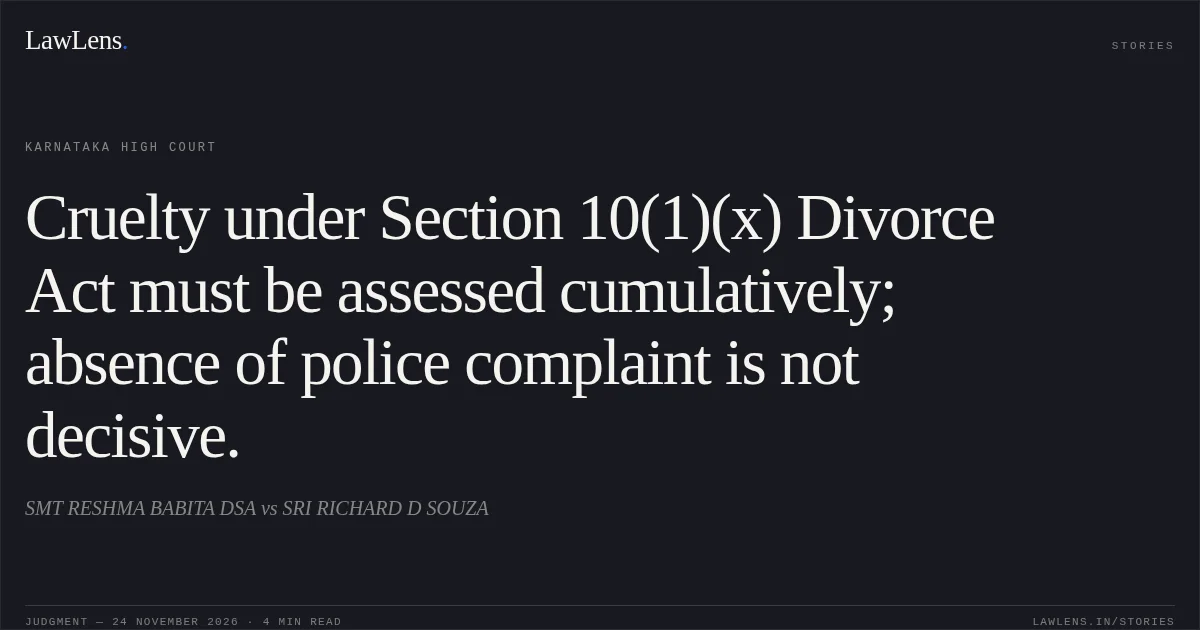
The Court applied Section 10(1)(x) of the Divorce Act, 1869, which permits dissolution where the other spouse has treated the petitioner with cruelty causing a reasonable apprehension of harm in living together, and Section 55 of the Act for the appeal.
¶ 1, 13Cruelty is not confined to physical injury and is assessed cumulatively by nature, gravity, frequency and effect of the conduct.
¶ 13, 15, 18Mental cruelty is a state of mind inferred from cumulative facts, with no rigid formula (V. Bhagat v. D. Bhagat, (1994) 1 SCC 337; Parveen Mehta v. Inderjit Mehta, (2002) 5 SCC 706; Samar Ghosh v. Jaya Ghosh, (2007) 4 SCC 511).
¶ 14–16, 21Matrimonial proceedings are civil, decided on preponderance of probabilities, and incidents within the home may lack independent witnesses (Dastane v. Dastane, (1975) 2 SCC 326).
¶ 17Under this Court's decisions, the expression "harmful or injurious" is not limited to physical harm (J.H. Veronica v. D. Anil Kumar, MFA No. 103466/2017).
¶ 18A decree cannot follow merely from the respondent's non-contest; the grounds must still be proved (Vyshnavee Vikranth v. Vikranth Jagannath, MFA No. 6578/2021).
¶ 20Provisions in the judgment · 2 · Linked ones open on LawLens
Divorce Act, 1869 Section 55Section 10
04Reasoning
The Court held that the Family Court examined the absence of a police complaint, the lack of contemporaneous disclosure to doctors, the non-production of some medical records, the wife's admission regarding alcohol and the cyber café, and the husband's expression of willingness to resume cohabitation largely in isolation.
¶ 24, 32–33, 41, 49, 55Absence of a police complaint is not conclusive, given social reluctance to publicise marital discord.
¶ 24, 54Medical records do not establish causation for each ailment, and the overdose (Ex. P7) cannot by itself be attributed to cruelty, but both remain relevant surrounding circumstances.
¶ 27–30Non-disclosure to a doctor who was jointly consulted affects weight, not admissibility.
¶ 32The adverse inference for non-production of Manipal records is confined to those records.
¶ 33On finances, the Court accepted that the Rs. 25,08,000 transfers were admitted, but found the husband's utilisation explanation unsupported by any oral or documentary evidence.
¶ 36–37, 53The Court rejected the ornament allegation, since the wife admitted the ornaments were sold for house renovation.
¶ 38The husband's absence and unexplained willingness to resume were not treated as proof of cruelty by themselves.
¶ 47–48, 56The Court relied on the cumulative effect of the evidence, the strained relationship, and the husband's conduct since 2017, including no restitution petition, no visits to the daughter for over eight years, and no maintenance of her education.
¶ 51, 53, 5705Holding
The Court answered both points in the affirmative, holding that the wife established cruelty under Section 10(1)(x) on a cumulative appreciation of the evidence and that the Family Court's judgment could not be sustained.
¶ 53, 55, 58The appeal is allowed; the judgment and decree dated 13.12.2019 in M.C. No. 103/2017 are set aside; the petition under Section 10(1)(x) is allowed; and the marriage solemnised on 04.06.1999 is dissolved. No order as to costs is made, and maintenance and permanent alimony were not considered because the appellant did not claim them.
¶ 59–60Original Court PDF
SMT RESHMA BABITA DSAvsSRI RICHARD D SOUZA
Click to open original judgment
Original judgment, available to read, download and summarize on LawLens.in