01Facts
The parties married on 18.05.2022. The husband deserted the wife, and she filed M.C. No. 34/2024 under Section 9 of the Hindu Marriage Act, 1955 for restitution of conjugal rights.
¶ 3A child was born on 10.04.2023, about 10 months and 23 days after the marriage.
¶ 3The wife alleges she was refused entry to the matrimonial home after a visit to her parents' house in October 2022.
¶ 3 · ¶ 7The husband filed M.C. No. 215/2024 seeking dissolution of marriage, alleging adultery by the wife and denying that the child was his.
¶ 4-5The wife filed I.A. No. 3/2024 under Order XXVI Rule 10A CPC read with Section 45 of the Indian Evidence Act, 1872, seeking DNA testing of the husband and the child. The husband opposed it.
¶ 6The Family Court, Hubballi, rejected the application by order dated 04.02.2025. It held that the application was premature because the evidence of the parties was incomplete, that the child was born within a valid marriage (Section 112 of the Evidence Act), and that the adultery allegations were unsubstantiated and the alleged third party was not impleaded. It left the issue open for reconsideration later.
¶ 7-8, 15The wife challenged that order in this writ petition under Articles 226 and 227 of the Constitution. She relied on a co-ordinate bench order in Criminal Petition No. 14726/2025 dated 05.01.2026.
¶ 9-10The husband argued that the rejection was on procedural, not merits, grounds, and that the wife may renew the application after evidence is recorded.
¶ 11-1202Issues
i.1. Whether the Family Court committed an error in rejecting the application for DNA testing of the husband and the child at the present stage of the proceedings.
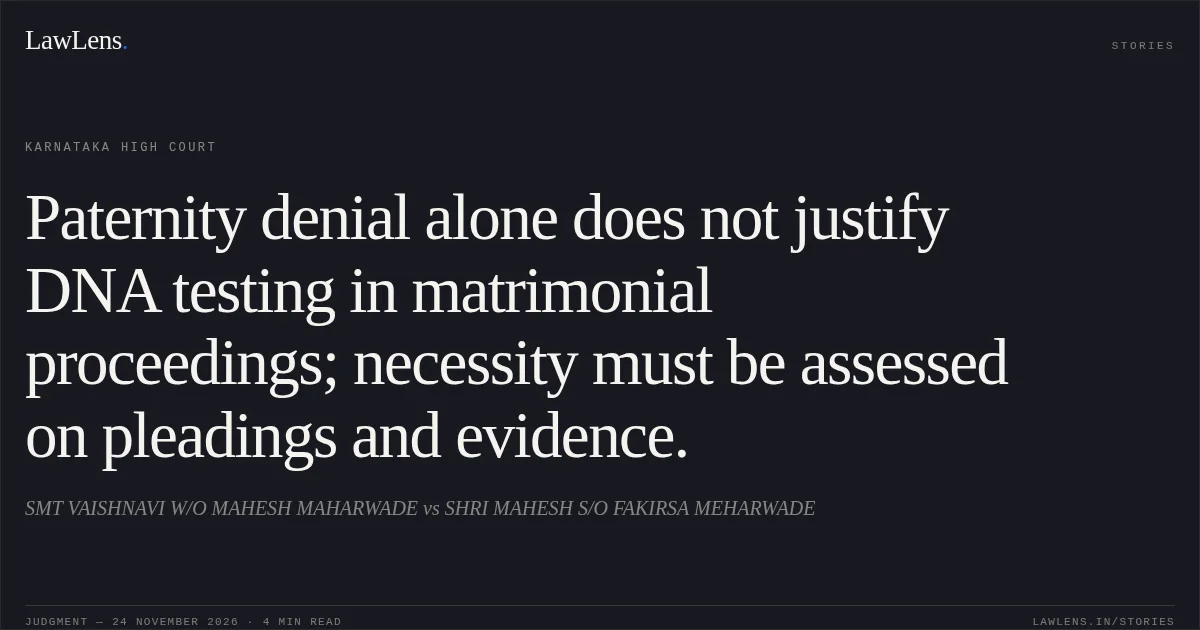
¶ 14ii.2. Whether a DNA test in matrimonial proceedings may be directed merely because one party disputes paternity, or whether it must be assessed on the pleadings, the evidence on record, its necessity, and its consequences.
¶ 1603Law Applied
Order XXVI Rule 10A CPC and Section 45 of the Indian Evidence Act, 1872 govern the court-directed scientific examination and expert evidence sought by the wife.
¶ 1Section 112 of the Indian Evidence Act presumes the legitimacy of a child born during a valid marriage, as considered by the Family Court.
¶ 7A DNA test in matrimonial proceedings is not ordered as a matter of course merely because paternity is disputed. Its necessity and relevance must be assessed against the pleadings, the evidence on record, and the consequences of compelling the parties to undergo the test.
¶ 16The co-ordinate bench order in Criminal Petition No. 14726/2025 was cited by the wife and noted by the court without deciding its applicability.
¶ 10No Supreme Court authority is expressly relied upon in the judgment.
Provisions in the judgment · 1 · Linked ones open on LawLens
Hindu Marriage Act, 1955 Section 9
04Reasoning
The court examined the impugned order and found that the Family Court had not decided the DNA application on its merits. It had held only that the application was premature because the parties' evidence was incomplete.
¶ 15Applying the principle that such directions require assessment of pleadings, evidence, necessity and consequences, the court held that the necessity and relevance of a DNA test could only be determined after both sides had led their evidence.
¶ 16-17The wife's argument that the husband's denial of paternity alone entitled her to a test was rejected, since a direction cannot issue "as a matter of course" on that basis.
¶ 16The court did not discuss the co-ordinate bench order relied on by the wife, and did not decide whether the adultery allegations or the Section 112 presumption would bar the test.
¶ 10Because the impugned order did not foreclose a later application, the court found no jurisdictional error or illegality warranting interference under Articles 226 and 227.
¶ 17-18The court did not explain the choice of remedy, although the order describes the petition as a "revision petition".
¶ 1905Holding
The court held that the Family Court committed no error warranting interference at this stage and rejected the wife's contention that the rejection of the DNA application was erroneous.
¶ 14, 18The writ petition is disposed of, and the order dated 04.02.2025 in I.A. No. 3/2024 is not interfered with. The wife is granted liberty to file a fresh DNA testing application after the parties complete their evidence, if necessary. The Family Court must then decide it on its merits, without being influenced by the observations in the impugned order or in this judgment. All other contentions are kept open.
¶ 18-19Original Court PDF
SMT VAISHNAVI W/O MAHESH MAHARWADEvsSHRI MAHESH S/O FAKIRSA MEHARWADE
Click to open original judgment
Original judgment, available to read, download and summarize on LawLens.in