Facts
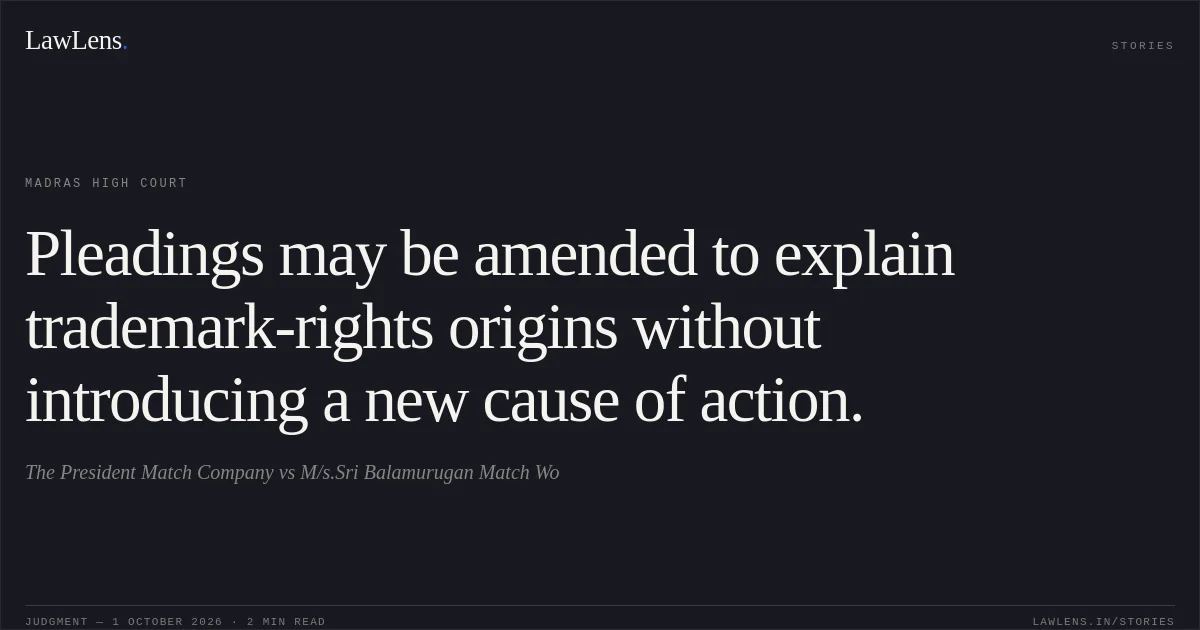
Sri Balamurugan Match Works sued for a permanent injunction alleging infringement of its registered “Acha Dholak” trade mark and related artistic work.
Source reference: para. 2, 13The defendants filed their written statement, and issues were framed.
Source reference: para. 3–4The plaintiff then sought to amend its plaint to plead details about the business’s origin and constitution, its father’s role in establishing the business and obtaining a licence/registration, and the subsequent transfer or continuation of the business with the plaintiff.
Source reference: para. 3–4, 14The defendants opposed the application, arguing that it introduced a new case and cause of action, was not supported by the due diligence required after commencement of trial, and would fill gaps in the plaintiff’s case.
Source reference: para. 6–7The trial court allowed the amendment; the defendants challenged that order under Article 227 of the Constitution.
Source reference: para. 1, 5Issues
1. Whether the proposed amendments introduced a new cause of action or fundamentally changed the nature of the suit.
Source reference: para. 6, 15, 202. Whether the plaintiff satisfied the due-diligence requirement under the proviso to Order VI Rule 17 CPC, and whether the trial court’s order warranted interference under Article 227.
Source reference: para. 7, 16–17, 25Law Applied
Order VI Rule 17 CPC empowers the court to permit amendments necessary to determine the real questions in controversy; after commencement of trial, its proviso requires the applicant to show that, despite due diligence, the matter could not have been raised earlier.
Source reference: para. 16Under Revajeetu Builders and Developers v. Narayanaswamy & Sons, (2009) 10 SCC 84, the court considers whether an amendment is necessary to resolve the real controversy and whether it causes prejudice that cannot be adequately addressed.
Source reference: para. 18Delay alone is not an absolute bar where the amendment is necessary and does not fundamentally alter the suit.
Source reference: para. 19In exercising Article 227 jurisdiction, interference is not warranted absent jurisdictional error or material irregularity in the trial court’s exercise of discretion.
Source reference: para. 25Reasoning
The Court found that the proposed pleadings concerning the business’s origin and continuity were connected to the plaintiff’s existing claim over the registered trade mark and did not introduce an unrelated cause of action.
Source reference: para. 15, 20Although the application followed the framing of issues, the Court noted the plaintiff’s explanation that relevant records had been traced later and that the amendment application followed on legal advice; the framing of issues alone did not establish that trial had substantially commenced.
Source reference: para. 17The defendants could respond to the amended pleadings, and any dispute about the plaintiff’s entitlement, the effect of the licence or registration, or the Trade Marks Act provisions raised by the defendants could be determined on the pleadings and evidence rather than used to reject the amendment.
Source reference: para. 10, 21–24The trial court’s decision therefore disclosed no jurisdictional error or material irregularity.
Source reference: para. 25Holding
The Court dismissed the revision petition and confirmed the order allowing amendment of the plaint.
It directed the trial court to proceed with the suit in accordance with law and permitted the defendants to file an additional written statement, if advised; there was no order as to costs.
Source reference: para. 26Acts & Sections Cited
2 provisions across 1 statute referred to in this judgment. Each provision opens on LawLens.
Trade Marks Act, 19992
Original Court PDF
The President Match CompanyvsM/s.Sri Balamurugan Match Wo
Click to open original judgment
Original judgment, available to read, download and summarize on LawLens.in