Facts
The second respondent, a former MLA and Minister, was prosecuted by the Directorate of Vigilance and Anti-Corruption in a disproportionate-assets case under the Prevention of Corruption Act, 1988.
Source reference: paras. 2.1–2.2The alleged disproportionate assets were approximately ₹2.08 crore, and the case was pending as Spl.C.No.3 of 2019 before the Principal District and Sessions Judge, Thoothukudi.
Source reference: paras. 2.1–2.2By the time of the impugned proceedings, the prosecution had examined 79 witnesses and marked 312 exhibits, while the defence had examined 6 witnesses and marked 74 exhibits; both sides had closed evidence, the prosecution had completed arguments, and the defence had partly argued.
Source reference: para. 2.3Meanwhile, the Enforcement Directorate filed a prosecution complaint under Sections 3 and 4 of the Prevention of Money-Laundering Act, 2002 (PMLA), treating the alleged disproportionate assets as proceeds of crime, before the Special Court at Madurai.
Source reference: para. 2.4The Madurai Special Court had not taken cognizance of the money-laundering complaint and had only issued a pre-cognizance notice under Section 223 of the Bharatiya Nagarik Suraksha Sanhita, 2023 (BNSS).
Source reference: para. 2.5It had also sought production of sanction for prosecuting the second respondent, but the sanction had not been produced.
Source reference: para. 2.5The Enforcement Directorate applied under Section 44(1)(c) of the PMLA before the Thoothukudi Court, seeking committal of the disproportionate-assets case to the Special Court at Madurai so that both matters could be dealt with by the same court.
Source reference: para. 2.6The application was rejected on 11.12.2025 on the grounds, inter alia, that Section 44(1)(c) was not attracted in the absence of cognizance by the Madurai Special Court and that the Thoothukudi Court lacked jurisdiction to transfer the case.
Source reference: para. 2.7The Enforcement Directorate challenged that order under Section 528 of the BNSS read with Section 482 of the Code of Criminal Procedure.
Source reference: para. 1Issues
Whether Section 44(1)(c) of the PMLA permits committal of a scheduled-offence case when the Special Court has not yet taken cognizance of the connected money-laundering complaint?
Source reference: paras. 7, 9–13Whether, having regard to the advanced stage of the disproportionate-assets trial, the absence of sanction, and the circumstances of the case, the Thoothukudi Court ought to have committed the case to the Madurai Special Court?
Source reference: paras. 14–18Law Applied
The Court applied Section 44(1)(a) of the PMLA, under which the money-laundering offence and the connected scheduled offence are triable by the Special Court having territorial jurisdiction.
Source reference: p. 16–18; para. 9Section 44(1)(b), which permits the Special Court to take cognizance of the money-laundering offence without committal; and Section 44(1)(c), which requires committal of the scheduled-offence case only when the Special Court has already taken cognizance of the money-laundering complaint.
Source reference: p. 16–18; para. 9Section 43(2) of the PMLA, requiring the Special Court also to try connected offences, was read in conjunction with Section 44.
Source reference: paras. 10–11, 16–18The Court relied on Rana Ayyub v. Directorate of Enforcement, Vijay Madanlal Choudhary v. Union of India, Deputy Director v. Deputy Superintendent of Police, Ranjit Singh Kothari v. State of West Bengal, and Pankajini Sahu v. Joint Director, Enforcement Directorate for the legislative objective of having one court try connected PMLA and scheduled offences, while recognising that committal is not automatic and must operate within Section 44(1)(c).
Source reference: paras. 10–11, 16–18The Court also relied on Kushal Kumar Agarwal v. Enforcement Directorate concerning the requirement of hearing under Section 223 of the BNSS before cognizance of complaints filed after 1 July 2024.
Source reference: para. 12The Court referred to the requirement of sanction under Section 197(1) CrPC, now corresponding to Section 218 of the BNSS, for prosecuting a public servant.
Source reference: para. 14Reasoning
The Court held that Section 44(1)(c) is triggered only when two conditions coexist: the court trying the scheduled offence has taken cognizance, and the Special Court has taken cognizance of the money-laundering complaint.
Source reference: para. 9Since the Madurai Special Court had merely issued a pre-cognizance notice and had not yet taken cognizance, the statutory precondition for committal was absent, making the Enforcement Directorate’s application premature.
Source reference: paras. 12–13The absence of the requisite sanction further indicated that cognizance against the second respondent could not presently be taken, particularly since the Madurai Court itself had called for the sanction and the Enforcement Directorate had not produced it.
Source reference: para. 14Although the PMLA seeks to avoid conflicting findings by placing connected proceedings before one court, that objective could not justify transferring a nearly concluded trial involving extensive evidence and partly completed arguments.
Source reference: paras. 15, 19–20Committal at that stage would cause substantial delay and prejudice, contrary to the accused persons’ right to a speedy trial under Article 21 and the earlier direction for time-bound disposal.
Source reference: paras. 15, 19–20The Court distinguished the authorities relied on by the Enforcement Directorate because, unlike the present case, they involved proceedings at an earlier stage and, in some instances, a Special Court that had already taken cognizance.
Source reference: paras. 16–17Holding
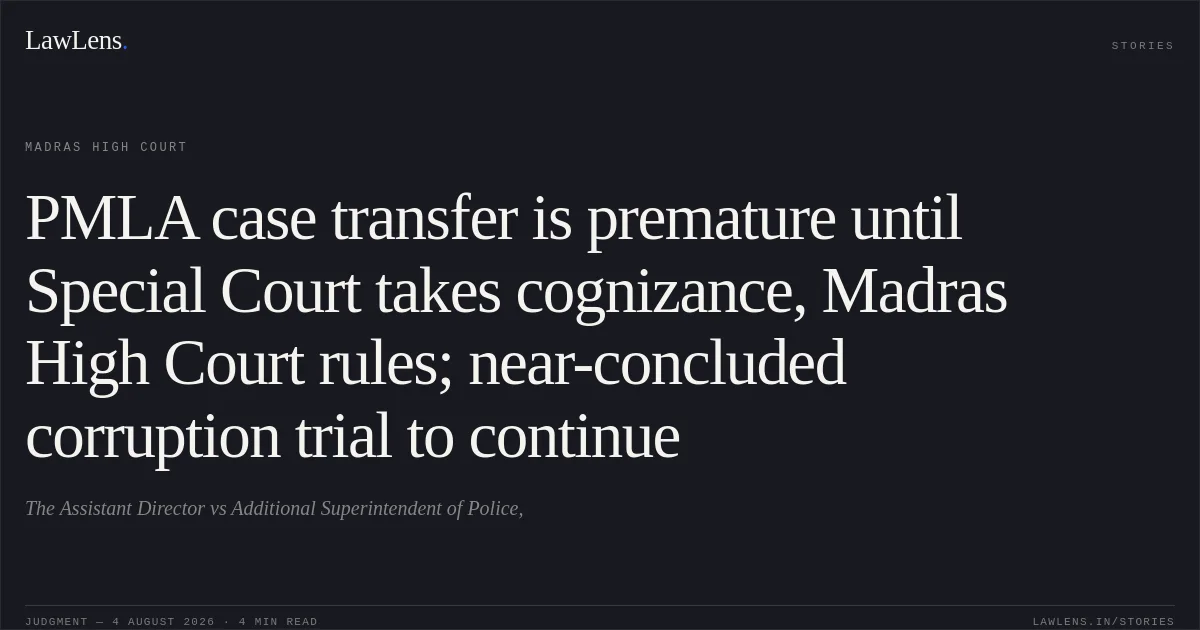
The High Court held that the application under Section 44(1)(c) of the PMLA was premature because the Madurai Special Court had not taken cognizance of the money-laundering complaint and the required sanction had not been produced.
It further held that transferring the disproportionate-assets case after completion of evidence and substantial arguments would defeat the interests of justice and cause avoidable delay.
Source reference: paras. 15, 23The challenge was dismissed, and the order dated 11.12.2025 of the Principal Sessions Judge, Thoothukudi, was upheld.
Source reference: para. 24The interim stay of the disproportionate-assets proceedings was vacated, the accused’s application to vacate the stay was allowed, and the Principal Sessions Judge was directed to resume and expedite the trial.
Source reference: paras. 25–26The Court clarified that it expressed no opinion on the merits of either the disproportionate-assets case or the money-laundering complaint.
Source reference: para. 27Acts & Sections Cited
18 provisions across 4 statutes referred to in this judgment. Each provision opens on LawLens.
Bharatiya Nagarik Suraksha Sanhita, 20235
Code of Criminal Procedure, 19737
Prevention of Money-Laundering Act, 20025
Prevention of Corruption Act, 19881
Original Court PDF
The Assistant DirectorvsAdditional Superintendent of Police,
Click to open original judgment
Original judgment, available to read, download and summarize on LawLens.in