Facts
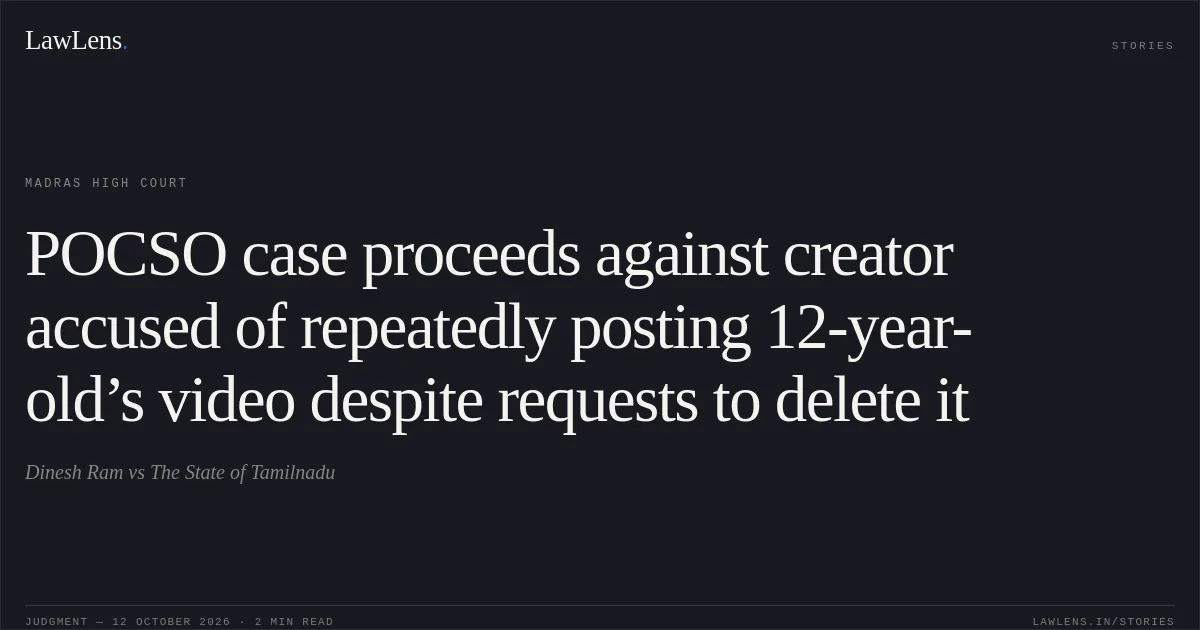
The petitioner, the sole accused in Spl.S.C.No.209 of 2025, sought to quash the final report charging him under Sections 11(1) and 11(2) read with Section 12 of the Protection of Children from Sexual Offences Act, 2012 (POCSO Act), and Section 67 of the Information Technology Act, 2000.
Source reference: para. 1The prosecution alleged that he made an “I Love You” challenge during a video call with the 12-year-old victim and her friends, then posted the recording on social-media platforms.
Source reference: para. 2The victim’s statement indicated that she had asked him not to post the video; her mother and the victim also alleged that he repeatedly failed to remove it despite requests and police intervention.
Source reference: paras. 12–16The petitioner denied knowing the victim’s age or having sexual intent, and argued that the case lacked supporting material.
Source reference: paras. 3–7Issues
Whether the materials in the final report disclosed a prima facie case under the POCSO Act sufficient to refuse quashing of the proceedings.
Source reference: paras. 11–16, 19Whether the petitioner’s asserted lack of knowledge of the victim’s age and absence of sexual intent could be determined at the quashing stage, having regard to Section 30 of the POCSO Act.
Source reference: paras. 17–19Law Applied
Section 30 of the POCSO Act requires the Special Court to presume a culpable mental state where the offence requires one; the accused may rebut that presumption by proving the absence of that mental state beyond reasonable doubt.
Source reference: para. 17The provision’s explanation includes intention, motive, and knowledge of, or belief about, a fact within “culpable mental state”.
Source reference: para. 17Relying on Just Rights for Children Alliance v. S. Harish, 2024 SCC OnLine SC 2611, the Court held that a defence of absent knowledge or intention is ordinarily a matter for trial once a prima facie case is shown.
Source reference: para. 18The Court considered the allegations under Sections 11(1), 11(4) and 12 of the POCSO Act.
Source reference: para. 19Reasoning
The victim’s statement allegedly showed that she identified the school-based nature of the accounts and asked the petitioner not to publish the video, supporting a prima facie inference that he knew she was a minor.
Source reference: para. 12The allegations that he reposted the video and did not remove it from all platforms despite requests and police instructions further supported the prosecution case at this stage.
Source reference: paras. 13–16The Court also noted the forensic report’s reference to other photographs and videos on the petitioner’s phone, while clarifying that they were not connected with the present case.
Source reference: para. 19Applying Section 30 and the Supreme Court’s guidance, it treated the petitioner’s denial of knowledge and sexual intent as matters for trial rather than grounds for quashing.
Source reference: paras. 17–19Holding
The Court held that sufficient prima facie material existed for the petitioner to face trial for the alleged POCSO offences and declined to quash the proceedings.
The criminal original petition was dismissed, and the connected miscellaneous petitions were closed.
Source reference: para. 20The petitioner’s personal appearance before the trial court was dispensed with unless that court specifically directed otherwise.
Source reference: para. 22Acts & Sections Cited
7 provisions across 3 statutes referred to in this judgment. Each provision opens on LawLens.
Bharatiya Nagarik Suraksha Sanhita, 20233
Protection of Children from Sexual Offences Act, 20123
Information Technology Act, 20001
Original Court PDF
Dinesh RamvsThe State of Tamilnadu
Click to open original judgment
Original judgment, available to read, download and summarize on LawLens.in