Facts
A police raid was conducted on 22 October 2002 at three establishments—M/s Noble Surgical, M/s Noble Chemical Industries and M/s Noble Chemical Works—in connection with alleged manufacture, packing, repacking and dealing in drugs and chemicals.
Source reference: paras. 2–3; pp. 1–2Siwan Town P.S. Case No. 165 of 2002 was registered against the petitioner and others under Sections 269, 270, 271, 274, 275, 276, 419, 420, 468, 470, 471 and 475 of the IPC and Sections 18(c) and 18A(1) of the Drugs and Cosmetics Act, 1940.
Source reference: paras. 2–3; pp. 1–2The petitioner contended that the establishments were registered with the Directorate of Industries and were operated by Pankaj Kumar and Nirmala Devi, and that no material connected him with their ownership, management or operations.
Source reference: paras. 4–7; pp. 2–4He also challenged the police-initiated prosecution under the Drugs and Cosmetics Act and pointed out that the informant and Investigating Officer were the same police officer.
Source reference: para. 8; p. 4His discharge petition was rejected by the Special Court, Siwan, on 18 December 2018, leading to the present quashing application.
Source reference: para. 2; p. 1Issues
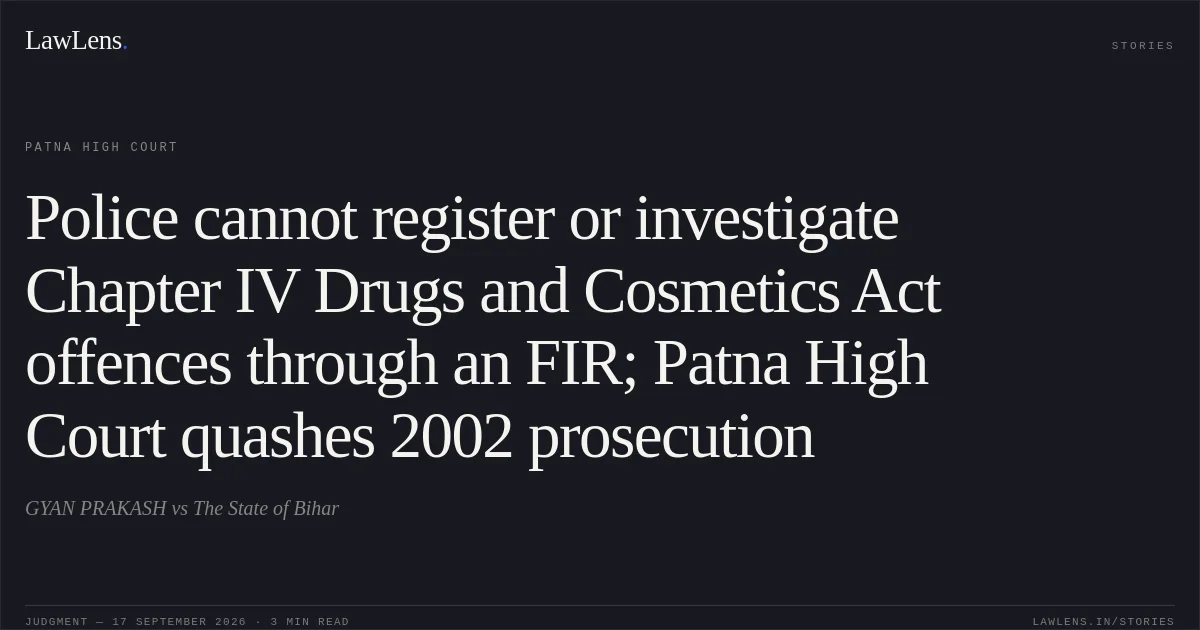
Whether the police could register an FIR and investigate cognizable offences under Chapter IV of the Drugs and Cosmetics Act, 1940, despite Section 32(1) prescribing the persons competent to institute prosecution under that Chapter.
Source reference: paras. 17–18; pp. 8–9Whether the prosecution against the petitioner was sustainable when the materials did not disclose his proprietary, managerial or operational connection with the establishments or specific acts constituting the alleged IPC offences.
Source reference: paras. 26–28; pp. 12–14Whether continuation of the criminal proceedings constituted abuse of process warranting exercise of the High Court’s inherent jurisdiction.
Source reference: paras. 24–25, 29; pp. 11–14Law Applied
Section 32(1) of the Drugs and Cosmetics Act, 1940 provides that prosecution for offences under Chapter IV may be instituted only by the persons specified therein, including an Inspector, an authorised gazetted officer, the person aggrieved or a recognised consumer association.
Source reference: para. 18; p. 8In Union of India v. Ashok Kumar Sharma, (2021) 12 SCC 674, the Supreme Court held that, in respect of cognizable offences under Chapter IV, the police cannot prosecute offenders, register an FIR under Section 154 CrPC or investigate such offences under the CrPC.
Source reference: paras. 19, 21; pp. 9–10The same principle was applied by the Patna High Court in Dr. Sarveshwar Kumar @ Dr. Sharbeshwar Kumar v. State of Bihar and by the Supreme Court in Rakesh Kumar v. State of Bihar, arising from SLP (Crl.) No. 10373 of 2018.
Source reference: paras. 20–22; pp. 9–11The Court also applied the Bhajan Lal principle that inherent jurisdiction may be exercised where an express legal bar prevents institution or continuation of criminal proceedings.
Source reference: para. 25; p. 12Reasoning
The FIR expressly included offences under Sections 18(c) and 18A(1) of the Drugs and Cosmetics Act, which fall within Chapter IV.
Source reference: paras. 23–24, 27; pp. 11–13Applying Section 32(1) and the binding rule in Ashok Kumar Sharma, the Court held that the police lacked jurisdiction to initiate the prosecution through an FIR or investigate the statutory offences under the CrPC; the defect went to the very initiation of the prosecution and was not a curable irregularity.
Source reference: paras. 23–24, 27; pp. 11–13The registration documents further identified Pankaj Kumar and Nirmala Devi as the persons responsible for the concerned establishments, while no material showed that the petitioner was their proprietor, partner, licensee, manager or operator.
Source reference: para. 26; p. 13Additionally, the allegations did not attribute to him specific conduct satisfying the ingredients of the invoked IPC offences, and the mere inclusion of penal provisions in the FIR was insufficient.
Source reference: para. 28; p. 14Accordingly, continuation of the proceedings would amount to abuse of the process of court.
Source reference: para. 29; p. 14Holding
The Court answered the principal issue in the negative: the police could not lawfully register and investigate the Chapter IV Drugs and Cosmetics Act offences in the manner adopted.
It quashed the order dated 18 December 2018 passed by the Special Judge, Siwan, in Trial No. 03 of 2018, along with the consequential criminal proceedings against the petitioner, and discharged him from the liabilities arising from the prosecution.
Source reference: para. 30; p. 14The Court clarified that its order would not prevent the competent authority or Drug Inspector from taking any action otherwise permissible under the Drugs and Cosmetics Act and applicable law, provided such action was independently maintainable and was not treated as a continuation of the quashed police investigation.
Source reference: para. 31; p. 15Acts & Sections Cited
15 provisions across 3 statutes referred to in this judgment. Each provision opens on LawLens.
Indian Penal Code, 1860
Drugs and Cosmetics Act, 19402
Code of Criminal Procedure, 19731
Original Court PDF
GYAN PRAKASHvsThe State of Bihar
Click to open original judgment
Original judgment, available to read, download and summarize on LawLens.in