Facts
The petitioner, proprietor of Riya Pharma, challenged FIR No. CR-II-80 of 2017 registered at Karelibaug Police Station, Vadodara, for alleged offences under Sections 17(B) and 27 of the Drugs and Cosmetics Act, 1940 (“the Act”).
Source reference: p.1A Drug Inspector inspected Pooja Distributors and allegedly seized Azilon-500 tablets bearing the name of a non-existent manufacturer, Infinite Pharmaceuticals Pvt. Ltd., and lacking proper purchase documentation.
Source reference: p.2Inquiry revealed that the petitioner had allegedly obtained the medicines from Shivam Medical Agency, whose proprietor stated that he had purchased them from Rajputana Pharmacy; the latter premises were found closed and its proprietor could not be traced. No incriminating material or spurious medicines were found at the petitioner’s premises.
Source reference: p.2The petitioner therefore invoked Section 482 of the Code of Criminal Procedure, 1973, seeking quashing of the FIR and consequential proceedings.
Source reference: p.1Issues
1. Whether a police officer could register and investigate an FIR concerning cognizable offences under Chapter IV of the Drugs and Cosmetics Act, particularly Sections 17(B) and 27, in view of Section 32 of the Act.
Source reference: pp.3–6, 82. Whether the FIR and consequential proceedings were liable to be quashed qua the petitioner when the prosecution alleged dealing in spurious drugs but did not establish that the petitioner manufactured them or directly supplied them to the principal accused.
Source reference: pp.3–4, 83. Whether the competent authorities under Section 32 of the Act could nevertheless proceed against the petitioner in accordance with law after quashing the police FIR.
Source reference: pp.8–9Law Applied
The Court applied Sections 17(B) and 27 of the Drugs and Cosmetics Act, which concern spurious drugs and their penal consequences, along with Section 32, which specifies the persons competent to institute prosecutions under the Act.
Source reference: no citationSection 36AC was relevant to the classification of the offence under Section 27(a) as cognizable and non-bailable.
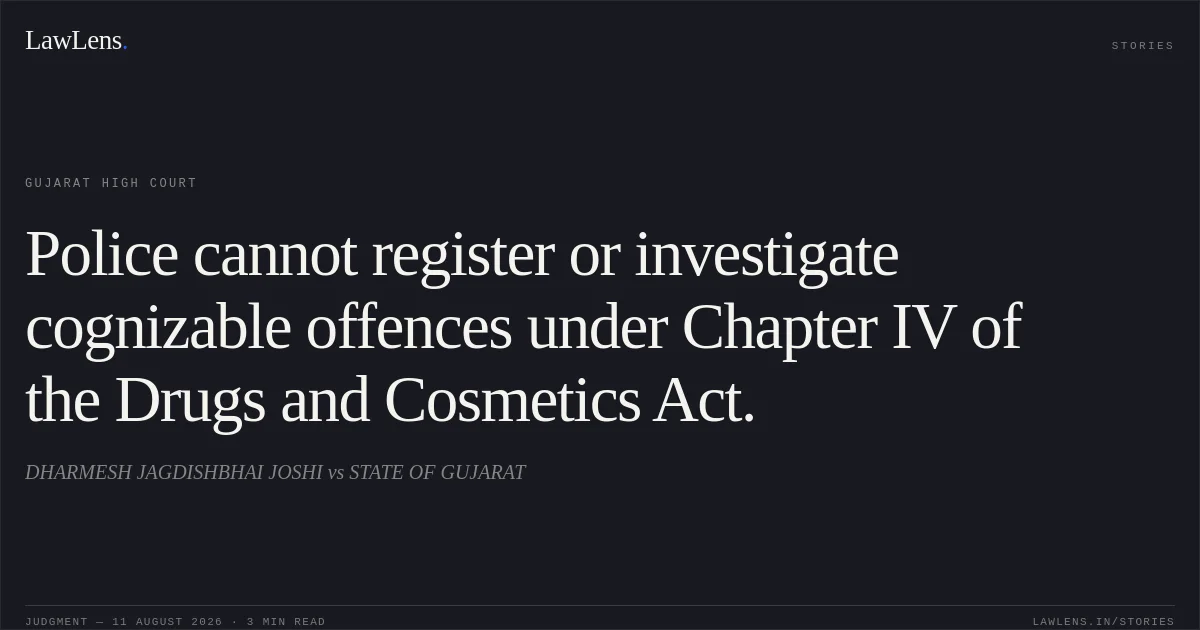
Source reference: p.8Relying on Union of India v. Ashok Kumar Sharma, 2020 LawSuit (SC) 543, the Court held that, having regard to Section 32 and the statutory scheme, a police officer cannot register or investigate offences under Chapter IV of the Act under Section 154 of the CrPC; such proceedings must be initiated by the persons authorised under Section 32.
Source reference: pp.4–6, 8The Supreme Court’s directions concerning police arrest powers were held to operate prospectively from 28 August 2020, but the rule regarding police registration and investigation was applied to the present proceedings.
Source reference: p.8Reasoning
The FIR essentially alleged the sale or distribution of spurious drugs falling within Chapter IV of the Act, including Section 27(a).
Source reference: p.8Although the petitioner’s name emerged during the chain-of-supply inquiry, the material described in the FIR did not allege that he manufactured the medicines, and no incriminating material was recovered from his premises.
Source reference: pp.2–4More importantly, the proceedings had been initiated as a police FIR and investigated under the CrPC, whereas Ashok Kumar Sharma held that police officers lack authority to register and investigate such Chapter IV offences.
Source reference: p.8The Court therefore treated the defect as one concerning the statutory competence and mode of prosecution, notwithstanding that the FIR predated the Supreme Court’s judgment and the directions on police arrest powers were prospective.
Source reference: p.8The Court clarified that its order did not prevent a competent person under Section 32 from taking lawful action independently.
Source reference: pp.8–9Holding
The Court held that the police could not register and investigate the FIR concerning offences under Chapter IV of the Drugs and Cosmetics Act.
Accordingly, FIR No. CR-II-80 of 2017 registered at Karelibaug Police Station, Vadodara, and all consequential proceedings were quashed and set aside qua the petitioner.
Source reference: p.8The competent authority under Section 32 remained at liberty to proceed against the petitioner in accordance with law, uninfluenced by the observations in the judgment.
Source reference: paras. 9–10; pp.8–9The Rule was made absolute to that extent.
Source reference: para. 11; p.9Acts & Sections Cited
6 provisions across 2 statutes referred to in this judgment. Each provision opens on LawLens.
Code of Criminal Procedure, 19733
Drugs and Cosmetics Act, 19403
Original Court PDF
DHARMESH JAGDISHBHAI JOSHIvsSTATE OF GUJARAT
Click to open original judgment
Original judgment, available to read, download and summarize on LawLens.in