Facts
The petitioners, accused Nos. 1 and 2, were charged under Section 78(3) of the Karnataka Police Act after a police raid allegedly found petitioner No. 1 engaging in Matka activity; police also alleged that he supplied Matka lists to petitioner No. 2.
Source reference: pp. 3–6The police registered an initial non-cognizable case and later registered an FIR, stating that Magistrate permission had been obtained.
Source reference: pp. 3–6After the charge sheet was filed and cognizance was taken, the petitioners sought to quash the proceedings under Section 528 of the Bharatiya Nagarik Suraksha Sanhita, 2023 (BNSS), arguing that the offence was non-cognizable and there was no material showing prior Magistrate permission to investigate.
Source reference: pp. 3–6Issues
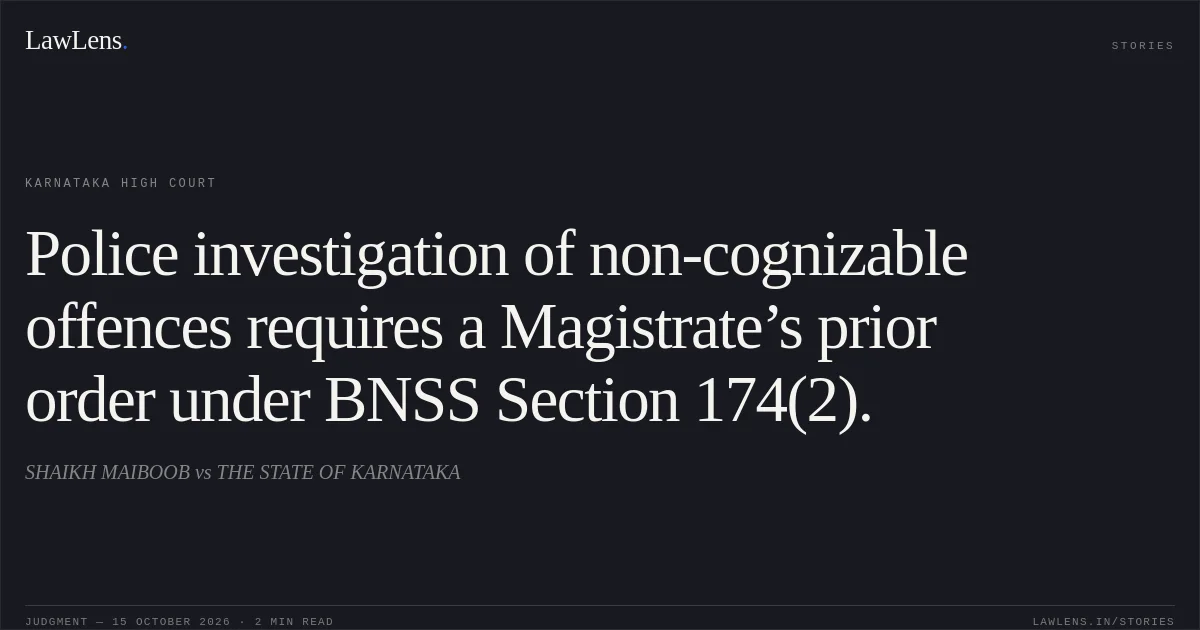
Whether the police could investigate the alleged non-cognizable offence under Section 78(3) of the Karnataka Police Act without an order of a Magistrate under Section 174(2) of the BNSS.
Source reference: pp. 4–7Whether the cognizance and criminal proceedings should be quashed where the record contained no material showing that the Magistrate had granted the required permission.
Source reference: pp. 6–8Law Applied
Section 174(2) of the BNSS provides that a police officer may not investigate a non-cognizable case without an order from a Magistrate empowered to try the case or commit it for trial.
Source reference: p. 5The Court treated the alleged offence under Section 78(3) of the Karnataka Police Act as non-cognizable and applied Section 528 of the BNSS to quash proceedings where the statutory requirement for prior Magistrate permission had not been shown to have been met.
Source reference: pp. 7–8The Court also relied on a coordinate Bench decision dated 10 December 2019 in Criminal Petition No. 101997/2019, which had quashed proceedings in a similar case.
Source reference: p. 7Reasoning
Although the FIR recorded that permission had been received from the Magistrate, the Court found no application or requisition seeking permission and no Magistrate’s order authorising investigation in the materials before it.
Source reference: pp. 5–6Because the alleged offence was non-cognizable, Section 174(2) required such an order before investigation could proceed. In the absence of proof of that statutory prerequisite, the Court held that taking cognizance and continuing the proceedings amounted to an abuse of process; its conclusion was also consistent with the coordinate Bench’s decision in a similar matter.
Source reference: p. 7Holding
The High Court allowed the petition and quashed the order dated 21 July 2026 taking cognizance and issuing process in C.C. No. 1407/2026, arising from Crime No. 128/2026, insofar as it concerned the petitioners.
Any pending interim application was disposed of as not surviving for consideration.
Source reference: p. 8Acts & Sections Cited
4 provisions across 3 statutes referred to in this judgment. Each provision opens on LawLens.
Bharatiya Nagarik Suraksha Sanhita, 20232
KARNATAKA POLICE ACT, 1963.1
Code of Criminal Procedure, 19731
Original Court PDF
SHAIKH MAIBOOBvsTHE STATE OF KARNATAKA
Click to open original judgment
Original judgment, available to read, download and summarize on LawLens.in