01Facts
The petitioner sought police protection to open and run “Angala Eswari Textiles Shop,” relying on a registered sale deed dated 3 June 2024, a patta and his asserted possession of the property
p. 6He alleged that the private respondents obstructed him and threatened him, claiming that they were owed money by the deceased former owner.
pp. 4–5During a police enquiry, the parties allegedly agreed that the private respondents would purchase the shop for Rs. 47 lakhs within 90 days, failing which the petitioner could operate it without obstruction.
pp. 4–5In an earlier writ petition, the Court directed an enquiry under Section 64 of the BNSS, 2023; the police subsequently declined protection on the ground that opening the shop might cause a law-and-order problem.
p. 502Issues
i.1. Whether the police could decline the petitioner’s request for protection solely because permitting him to open the shop might cause a law-and-order problem
pp. 5–6, 7ii.2. Whether police protection could be directed to prevent alleged unlawful interference while leaving disputed civil rights and the private respondents’ alleged debt claims to be resolved through appropriate legal proceedings
pp. 6–703Law Applied
Article 226 of the Constitution provides the High Court’s jurisdiction to issue appropriate writs and directions.
The Court applied the principle that an alleged creditor cannot use force or intimidation to recover a debt or interfere unlawfully with another’s possession; any genuine recovery claim must be pursued through the remedies available before a competent court or other appropriate forum.
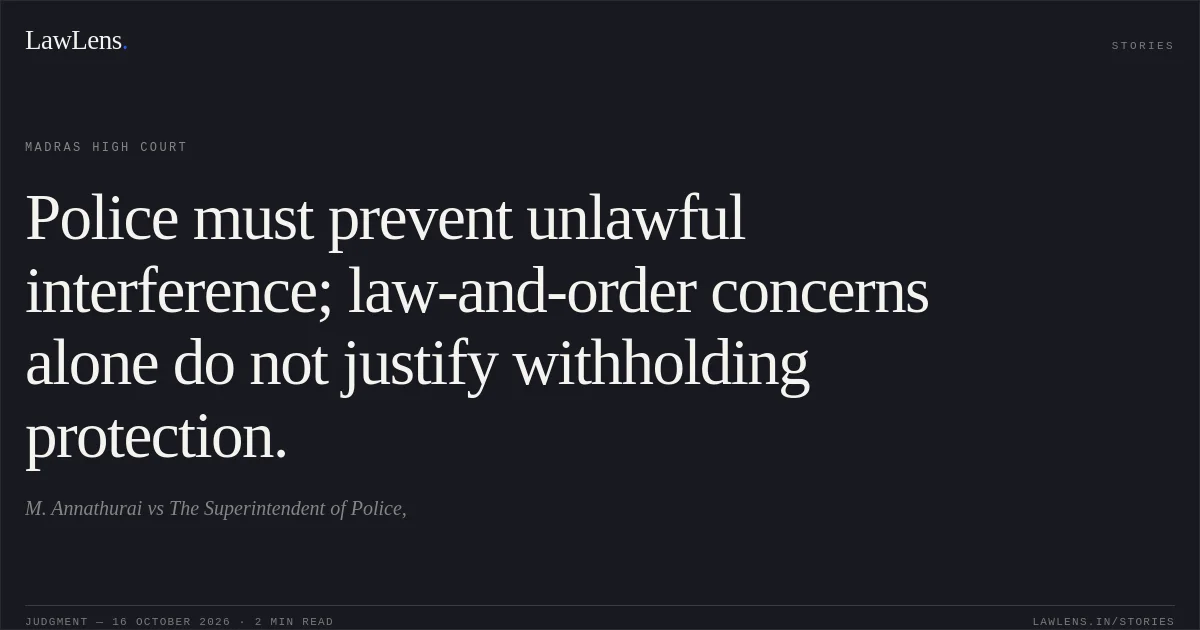
p. 6Where there is a genuine apprehension of obstruction or violence, the police must take preventive measures in accordance with law; a law-and-order concern alone does not justify leaving a person without protection against alleged unlawful acts.
p. 6Protection against unlawful interference does not adjudicate disputed civil rights.
p. 7Section 64 of the BNSS, 2023, was referenced as the basis for the enquiry directed in the earlier proceedings, rather than as a substantive rule governing the present decision.
p. 5Provisions in the judgment · 1 · Linked ones open on LawLens
Bharatiya Nagarik Suraksha Sanhita, 2023 Section 64
04Reasoning
The Court considered the petitioner’s registered sale deed and other documents alongside his allegations of threats and obstruction.
pp. 6–7It held that the private respondents’ claimed loans to the deceased, even if established, did not entitle them to interfere forcibly with the petitioner’s possession or business; they must pursue any recovery claim through lawful channels.
p. 6The police’s stated concern about a possible law-and-order problem did not, by itself, justify refusing protection.
pp. 6–7The Court therefore directed reconsideration of the request and appropriate preventive steps, while making clear that protection would not determine the parties’ civil rights.
pp. 6–705Holding
The writ petition was disposed of with directions that the third respondent police reconsider the request for protection in light of the sale deed and take appropriate steps to prevent unlawful obstruction, threats or violence by the private respondents or persons acting for them.
p. 7The private respondents remained at liberty to pursue any genuine loan-related claim before the competent civil court or other appropriate forum, but were directed not to use force or intimidation or interfere with the petitioner’s lawful possession.
p. 7Original Court PDF
M. AnnathuraivsThe Superintendent of Police,
Click to open original judgment
Original judgment, available to read, download and summarize on LawLens.in