Facts
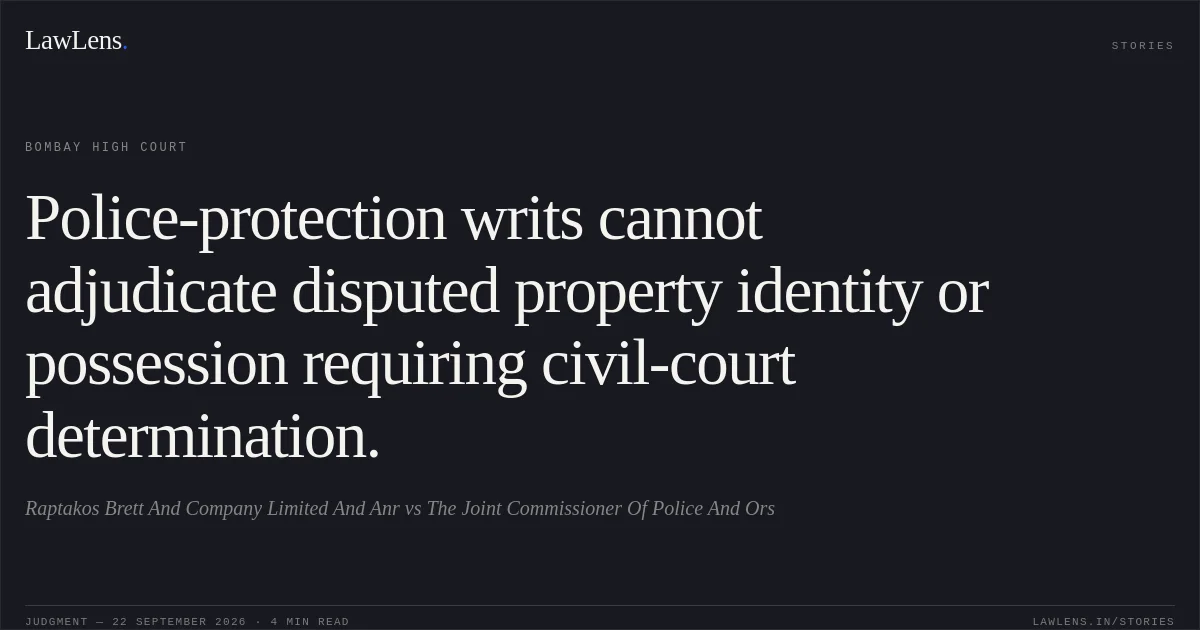
Raptakos, Brett & Company Limited claimed ownership and possession over land forming part of Survey Nos. 217/1 and 217/2, described as the “Suit Property,” adjacent to its factory and hospital at Thane.
Source reference: pp. 5–7; paras. 2–3It alleged that Respondent No. 6 and persons acting through him forcibly entered the property, cut trees, demolished a portion of the compound wall, and subsequently commenced construction thereon.
Source reference: pp. 5–7; paras. 2–3The Company instituted Regular Civil Suit No. 272 of 2024 before the Civil Judge, Senior Division, Thane, seeking declarations and permanent and temporary injunctions.
Source reference: pp. 7–8; para. 3The Civil Court passed orders dated 29 May 2024, 20 July 2024 and 19 August 2024 restraining construction and directing police assistance for implementation of the injunction orders.
Source reference: pp. 8–11; paras. 4–6The interim application was ultimately allowed on 18 February 2025, restraining the defendants and persons claiming through them from entering the Suit Property or obstructing the petitioner’s security and staff.
Source reference: p. 11; para. 7Alleging police inaction, the petitioners invoked Article 226 of the Constitution seeking a writ of mandamus directing police protection and implementation of the Civil Court’s orders.
Source reference: pp. 12–13; para. 8During the writ proceedings, the High Court had passed an interim order dated 30 August 2024 directing that construction on the Suit Property be stopped and construction machinery be removed.
Source reference: p. 13; para. 9The respondents disputed that any construction was taking place on the petitioner’s land and contended that the construction was on their own land pursuant to statutory permissions.
Source reference: p. 14; para. 11Issues
Whether a writ petition under Article 226 seeking police protection and implementation of interim injunction orders is maintainable where the identity, possession and ownership of the disputed property, and the location of the alleged construction, remain seriously disputed?
Source reference: pp. 17–24; paras. 18–30Whether the High Court could direct the police to implement the Civil Court’s injunction orders when the orders and the pleadings did not sufficiently identify the precise land on which the alleged construction was taking place?
Source reference: pp. 18–22; paras. 20–26Whether the dispute should instead be clarified through a local investigation by a court-appointed commissioner under Order XXVI Rules 9 and 10 of the Code of Civil Procedure, 1908?
Source reference: pp. 26–28; paras. 34–36Law Applied
The Court applied Order VII Rule 3 CPC, which requires a plaint concerning immovable property to contain a description sufficient to identify the property, including its boundaries or survey numbers where applicable.
Source reference: p. 19; para. 21It relied on Order XXVI Rules 9 and 10 CPC, under which the Civil Court may appoint a commissioner for local investigation and treat the commissioner’s report and evidence as part of the record.
Source reference: pp. 26–27; paras. 35–36The Court further applied the principle in P. R. Murlidharan v. Swami Dharmananda Theertha Padar, (2006) 4 SCC 501, that a writ for police protection cannot be used to adjudicate disputed civil rights or protect claimed possession that has not been established; police-protection orders ordinarily lie where the right is declared by a decree or an unambiguous civil-court order.
Source reference: pp. 23–24; paras. 28–29The Court also recognised the general principle that Article 226 should not be used to decide private property disputes for which an adequate civil remedy exists, absent violation of a statutory duty by the public authority.
Source reference: pp. 24–26; paras. 30–33Reasoning
The Court held that the central dispute was not merely police non-compliance but whether the alleged construction was actually situated on the petitioner’s land.
Source reference: pp. 18–20; paras. 20–22Although the plaint referred to Survey Nos. 217/1 and 217/2 and included a sketch, the description did not sufficiently identify the precise portion of land allegedly encroached upon or establish that the construction was occurring on land in the petitioner’s possession.
Source reference: pp. 18–20; paras. 20–22The photographs showed construction activity but did not conclusively establish its location or prove encroachment on the petitioner’s property.
Source reference: p. 20; para. 22Because the respondents denied construction on the Suit Property and asserted construction on their own land, the issues of identity, possession and encroachment were disputed questions of fact unsuitable for determination in writ jurisdiction.
Source reference: pp. 20–23; paras. 23–27The Court distinguished cases involving enforcement of a clear civil decree or unambiguous injunction, observing that police protection could not be ordered where the underlying property rights and the location of the alleged violation remained uncertain.
Source reference: pp. 23–24; paras. 28–30It therefore directed that the dispute first be clarified through local investigation under Order XXVI Rule 9 CPC, after which the Civil Court could reconsider the temporary injunction.
Source reference: pp. 26–28; paras. 34–36Holding
The High Court disposed of the writ petition without granting the substantive mandamus sought.
It granted the petitioner liberty to apply in Civil Suit No. 272 of 2024 for appointment of a commissioner under Order XXVI Rule 9 CPC to investigate the alleged encroachment, identify the disputed land and determine the actual site of construction within four weeks.
Source reference: p. 28; para. 37(A)The Civil Court was directed to decide the application preferably within eight weeks, permit both parties to examine the commissioner, and thereafter pass a fresh order on the petitioner’s temporary-injunction application, if necessary modifying the order dated 18 February 2025.
Source reference: p. 29; para. 37(B)–(D)The High Court’s interim order dated 30 August 2024 restraining construction on the Suit Property was directed to continue until completion of that process and passing of a fresh order by the Civil Court.
Source reference: p. 29; para. 37(E)There was no order as to costs.
Source reference: p. 29; para. 37(F)Original Court PDF
Raptakos Brett And Company Limited And AnrvsThe Joint Commissioner Of Police And Ors
Click to open original judgment
Original judgment, available to read, download and summarize on LawLens.in