Facts
Police conducted a trap near Muktidham Gate, Dondilohara, after receiving information that the applicant was selling illicit country-made liquor.
Source reference: paras. 2, 8–9A police constable acting as a dummy purchaser bought a pouch using a marked ₹100 note.
Source reference: paras. 2, 8–9The police then recovered 19 further pouches, totalling 3.420 bulk litres, from the applicant and recovered the marked note from his pocket.
Source reference: paras. 2, 8–9The trial court convicted him under Section 34(1)(b) of the Chhattisgarh Excise Act, 1915, and sentenced him to six months’ rigorous imprisonment and a fine of ₹10,000; the Sessions Court affirmed the conviction and sentence.
Source reference: paras. 1, 4The applicant challenged those concurrent findings in revision under Sections 438 read with 442 of the BNSS, arguing, among other things, that the independent seizure witnesses had turned hostile and the prosecution had not produced the Malkhana Register.
Source reference: paras. 1, 5Issues
1. Whether the evidence, including the testimony of police witnesses and the recovery and testing evidence, sufficiently established the applicant’s guilt despite the independent witnesses turning hostile?
Source reference: paras. 9–162. Whether the concurrent findings of conviction disclosed any perversity, legal error, or jurisdictional illegality warranting interference in revision?
Source reference: paras. 16–173. Whether the sentence imposed required interference?
Source reference: para. 18Law Applied
Section 34(1)(b) of the Chhattisgarh Excise Act, 1915, governed the offence and, as the court stated, prescribed a minimum sentence of six months’ imprisonment and a minimum fine of ₹10,000.
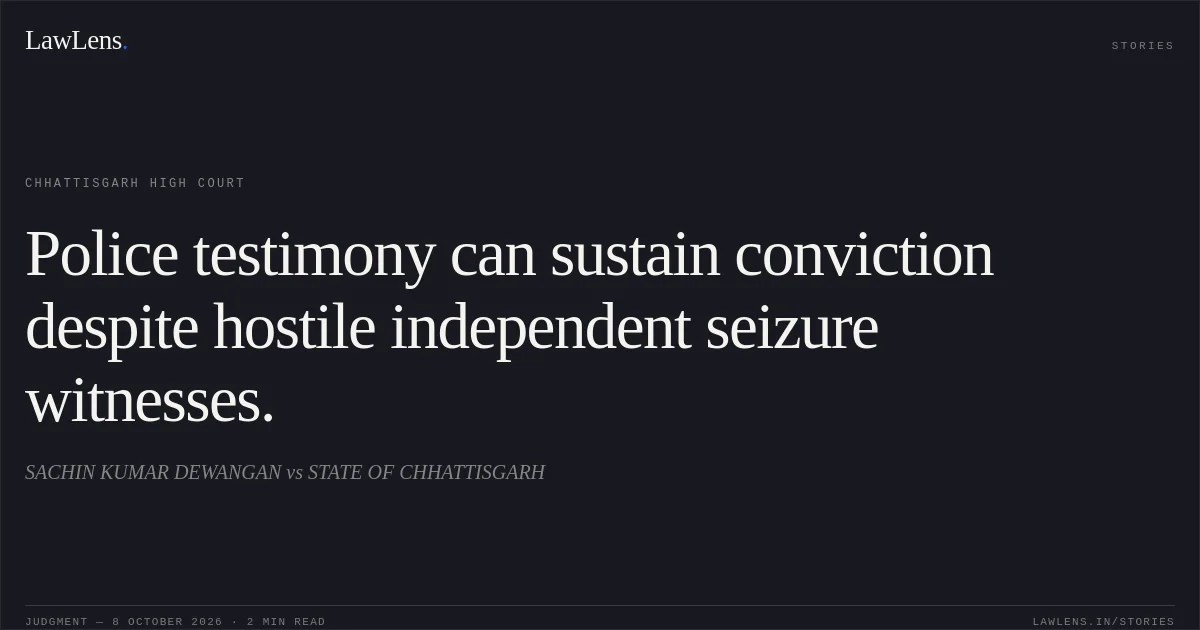
Source reference: paras. 1, 18The court applied the principle that police testimony is not to be rejected merely because independent seizure witnesses have turned hostile, relying on Rizwan Khan v. State of Chhattisgarh, (2020) 9 SCC 627.
Source reference: para. 12In exercising revisional jurisdiction, the court considered whether the concurrent findings suffered from perversity, patent error of law, or jurisdictional illegality.
Source reference: para. 16Reasoning
The court found the evidence of the raiding officer and the dummy purchaser clear and mutually supportive as to the trap, marked-note purchase, and recovery.
Source reference: paras. 9, 15Although the independent witnesses denied knowledge of the incident, they admitted their signatures on the relevant police documents; the court considered their explanation that they had signed numerous documents without knowing their contents unconvincing, and noted that coercion or misrepresentation had not been established.
Source reference: paras. 10–11The liquor’s nature was supported by the Excise Sub-Inspector’s examination and report, while the Investigating Officer’s evidence and produced register records answered the objection concerning the Malkhana Register.
Source reference: paras. 13–14Finding no material in cross-examination to undermine the official witnesses and no basis to disturb the concurrent findings, the court held that revisional interference was unwarranted.
Source reference: paras. 15–17The sentence was the statutory minimum and was therefore upheld.
Source reference: para. 18Holding
The High Court dismissed the revision and affirmed the conviction under Section 34(1)(b) of the Chhattisgarh Excise Act, 1915, and the sentence of six months’ rigorous imprisonment with a fine of ₹10,000.
The applicant, reported to be on bail, was directed to surrender before the trial court within 20 days to undergo the remaining sentence; any period already served in jail was to be adjusted in accordance with law.
Source reference: para. 19Acts & Sections Cited
4 provisions across 1 statute referred to in this judgment. Each provision opens on LawLens.
Bharatiya Nagarik Suraksha Sanhita, 20234
Original Court PDF
SACHIN KUMAR DEWANGANvsSTATE OF CHHATTISGARH
Click to open original judgment
Original judgment, available to read, download and summarize on LawLens.in