Facts
The appellants were convicted by the Additional Sessions Judge, Gwalior, in Sessions Trial No. 71/2011 for offences under Sections 307/149 IPC (three counts), 324/149 IPC (three counts), 323/149 IPC (six counts), and Sections 147 and 148 IPC. They were sentenced to varying terms of imprisonment and fines.
Source reference: para. 2The prosecution alleged that, on 16 April 2010, the appellants, armed with lathis and farsas, assaulted Kamal Singh, Hemant, Bindu Kushwah, and others due to prior enmity; the injured persons included the complainant, his brother, father, and Kallu.
Source reference: para. 3After investigation and trial, the appellants were convicted; the prosecution examined 17 witnesses and the defence examined seven witnesses.
Source reference: paras. 4–7During the appeals, the parties entered into a voluntary compromise, which was verified by the Principal Registrar, although the offences were non-compoundable.
Source reference: para. 8The appellants did not challenge their convictions and sought reduction of their custodial sentences to the periods already undergone, relying on the compromise, the existence of a cross-case, the parties’ relationship, and the prolonged pendency of the proceedings.
Source reference: para. 10Issues
1. Whether the appellants’ convictions under Sections 307/149, 324/149, 323/149, 147 and 148 IPC were sustainable on the evidence on record despite the parties’ compromise.
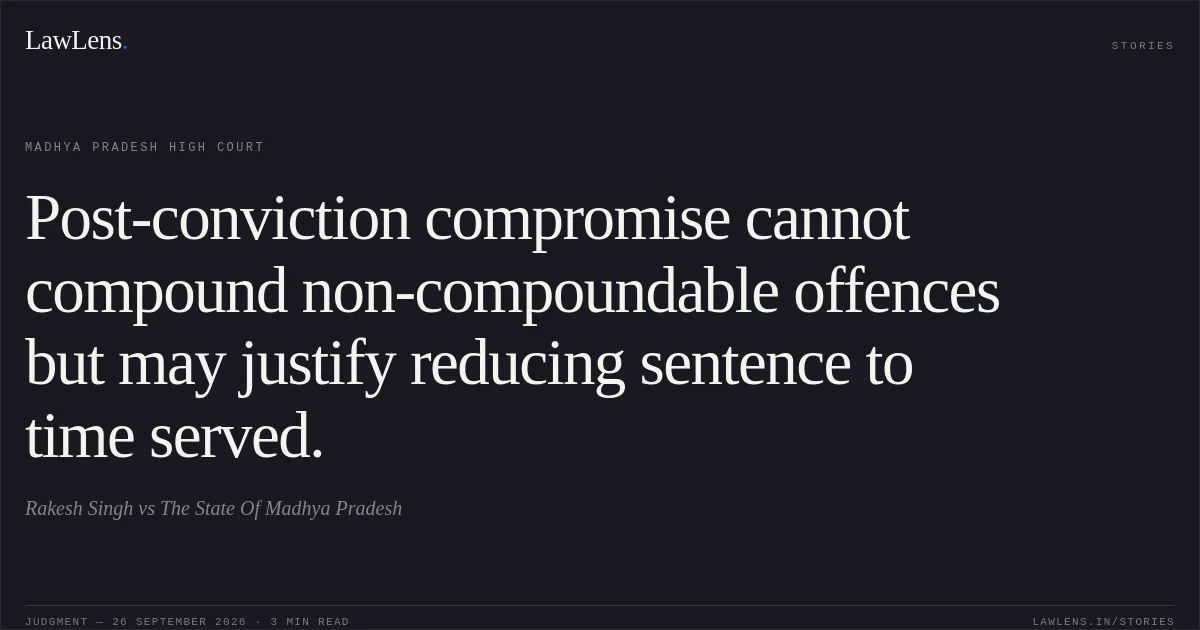
Source reference: para. 112. Whether, although the offences were non-compoundable under Section 320 CrPC, the compromise could be considered as a mitigating circumstance for reducing the appellants’ sentences to the periods already undergone.
Source reference: paras. 9, 12–183. Whether the sentence should be modified by enhancing the fine imposed under Section 307/149 IPC.
Source reference: paras. 19–22Law Applied
The Court applied Sections 147, 148, 149, 307, 323 and 324 IPC concerning rioting, unlawful assembly, attempt to murder and voluntarily causing hurt by dangerous weapons.
Source reference: no citationIt recognised that the offences under Sections 147, 148, 324/149 and 307/149 IPC are non-compoundable under Section 320 CrPC and therefore the compromise could not itself result in compounding or acquittal.
Source reference: para. 18Relying on Narinder Singh v. State of Punjab, the Court noted that, in appropriate cases involving essentially personal disputes, compromise may be relevant to the exercise of judicial discretion.
Source reference: para. 13Under Ishwar Singh v. State of Madhya Pradesh, the fact of compromise may be considered while determining the substantive sentence, even though a non-compoundable offence cannot be formally compounded.
Source reference: para. 14Unnikrishnan alias Unnikuttan v. State of Kerala was relied upon for the principle that a compromise may justify reduction of sentence while maintaining the conviction.
Source reference: para. 15The Court also applied Bhagwan Narayan Gaikwad v. State of Maharashtra, which holds that compromise is only one sentencing factor and must be assessed along with proportionality, deterrence, rehabilitation, and other aggravating or mitigating circumstances.
Source reference: para. 17Reasoning
The Court independently examined the conviction despite the appellants’ limited challenge to sentence. It found that the testimony of the complainant and injured eyewitnesses was corroborated by medical and documentary evidence, and that the trial court’s findings were supported by sound reasoning.
Source reference: para. 11Since the compromise was voluntary and genuine but related to non-compoundable offences, it could not invalidate the convictions or permit formal compounding.
Source reference: paras. 8–9, 18However, the Court treated the compromise as a mitigating sentencing circumstance, particularly because the parties were relatives residing in the same society, had settled their dispute, had lived peacefully for several years, and no criminal antecedents of the appellants were shown.
Source reference: para. 18Considering these factors, the appellants’ periods of incarceration, and the prolonged pendency of the matter, the Court concluded that further imprisonment would serve no useful purpose.
Source reference: para. 19Holding
The appeals were partly allowed on the question of sentence. The convictions under Sections 307/149, 324/149, 323/149, 147 and 148 IPC were affirmed.
The custodial sentences were reduced to the periods already undergone.
Source reference: para. 20The fine under Section 307/149 IPC was enhanced from ₹2,000 to ₹5,000 on each count, with any amount already deposited to be adjusted.
Source reference: para. 20The appellants were directed to deposit the entire fine within 30 days of release; failing such payment, they were required to surrender and undergo the remaining sentence imposed by the trial court, including the default stipulations.
Source reference: para. 22Their bail bonds were discharged, the trial court’s order regarding disposal of property was affirmed, and the appeals were disposed of accordingly.
Source reference: paras. 21–25Acts & Sections Cited
12 provisions across 2 statutes referred to in this judgment. Each provision opens on LawLens.
Indian Penal Code, 1860
Code of Criminal Procedure, 19733
Original Court PDF
Rakesh SinghvsThe State Of Madhya Pradesh
Click to open original judgment
Original judgment, available to read, download and summarize on LawLens.in