Facts
The petitioner entered into a GeM contract with Respondent No. 3 on 10 December 2025 for the supply of goods.
Source reference: p.2The respondents alleged that the supplied goods failed to meet the prescribed standards.
Source reference: p.2On 27 June 2026, Respondent No. 3 debarred the petitioner for six months from participating in bids within the Area of Responsibility of Project Udayak, without issuing a prior show-cause notice and allegedly in breach of natural justice.
Source reference: p.2, paras. 2, 8The petitioner challenged the debarment in W.P.(C) 11990/2026, which was disposed of on 19 August 2026 with a direction to treat the petition as a representation and decide it within one week.
Source reference: p.2–3, para. 3Thereafter, the respondents issued a show-cause notice dated 24 August 2026, followed by a further communication dated 8 September 2026 granting additional time to reply, proposing debarment for six months.
Source reference: p.3, paras. 4, 6The original debarment order was withdrawn on 2 September 2026.
Source reference: p.4, para. 9The petitioner consequently challenged both the withdrawn debarment order and the subsequent show-cause notices, alleging that the respondents were proceeding with a predetermined mind.
Source reference: p.3–4, paras. 5–7, 10Issues
1. Whether the challenge to the debarment order dated 27 June 2026 survived after the order was withdrawn by the respondents and no punitive or consequential action remained operative?
Source reference: p.4, para. 92. Whether the show-cause notices dated 24 August 2026 and 8 September 2026 were liable to be quashed on the ground that they demonstrated a predetermined mind on the part of the respondents?
Source reference: p.4–6, paras. 10–183. Whether the respondents were entitled to initiate fresh debarment proceedings after the earlier debarment order had been passed without notice and subsequently withdrawn?
Source reference: p.4–6, paras. 12–18Law Applied
The Court applied the principles of natural justice, particularly the requirement that a person must be afforded an opportunity to respond before an order of debarment or blacklisting is passed.
Source reference: p.2, para. 2It recognised that blacklisting or debarment has serious civil consequences and that authorities must not proceed with a predetermined mind.
Source reference: p.2, para. 2In this context, the Court considered Techno Prints v. Chhattisgarh Textbook Corporation & Anr., 2025 SCC OnLine SC 343, where the Supreme Court held that blacklisting cannot be founded on allegations absent from the show-cause notice and that, given the grave consequences of blacklisting, the authority must approach the matter without a predetermined conclusion.
Source reference: p.5–6, para. 15The Court further applied the effect of its earlier order directing the respondents to treat the previous writ petition as a representation and decide the matter afresh, thereby requiring the respondents to reconsider the matter after granting an opportunity of hearing.
Source reference: p.4–5, paras. 12–14Reasoning
The Court held that the petitioner’s principal grievance against the original debarment order no longer survived because the order had been withdrawn and the petitioner was no longer debarred.
Source reference: p.4, para. 9The Court treated its earlier direction to decide the petitioner’s writ petition as a representation as placing the original debarment order in abeyance and requiring a fresh decision.
Source reference: p.4–5, paras. 12–14Accordingly, the issuance of the subsequent show-cause notices was viewed not as an implementation of an existing punitive order, but as part of a fresh decision-making process in which the petitioner was given 14 days, followed by an additional 10 days, to respond.
Source reference: p.5, paras. 13–14The Court distinguished Techno Prints, noting that in that case the impugned blacklisting was based on violations not mentioned in the show-cause notice, whereas the present notices set out the alleged violations and were issued pursuant to a direction for fresh consideration.
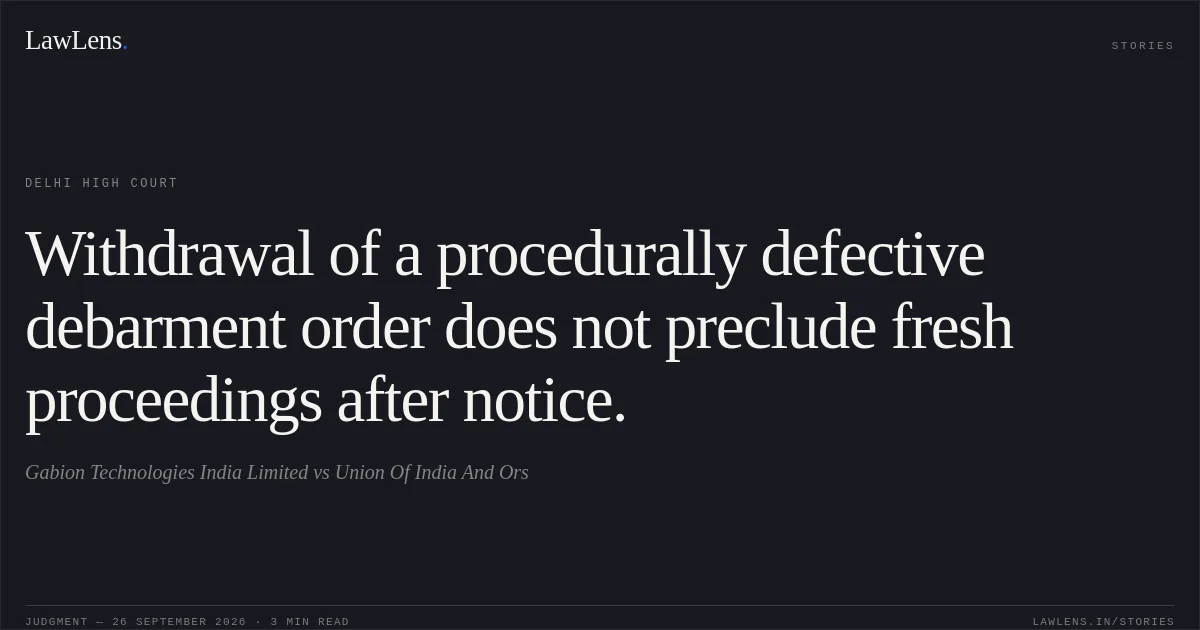
Source reference: p.5–6, para. 15–16It further held that the mere withdrawal of the procedurally defective debarment order did not establish that the respondents had a predetermined mind or preclude them from examining the alleged violations through a lawful process.
Source reference: p.6, paras. 17–18Holding
The High Court dismissed the writ petition, holding that the challenge to the withdrawn debarment order had become infructuous and that the show-cause notices were not liable to be quashed merely because the earlier debarment order had been passed and withdrawn.
The petitioner was granted two weeks to submit a substantive reply to the show-cause notices.
Source reference: p.7, para. 19Respondent No. 3 was directed to consider that reply and pass a fresh order in accordance with law.
Source reference: p.7, paras. 19–20Original Court PDF
Gabion Technologies India LimitedvsUnion Of India And Ors
Click to open original judgment
Original judgment, available to read, download and summarize on LawLens.in