01Facts
The first petitioner, an Agriculture Assistant, and the second petitioner, a retired Assistant Agriculture Officer, faced separate disciplinary charge memos concerning alleged losses to the Government during watershed works.
pp. 3–5The second petitioner retired on 31 May 2011; charges relating to events from 2005–06 to 2009–10 were issued to him on 23 May 2014.
pp. 3–5The Enquiry Officer recorded common evidence and submitted a common report against both petitioners.
pp. 3–5The State imposed compulsory retirement and recovery on the first petitioner, and recovery and withholding of 25% of pension for five years on the second.
pp. 3–5The Karnataka State Administrative Tribunal dismissed their applications challenging the inquiry and penalties; they then petitioned the High Court.
pp. 3–502Issues
i.1. Whether the post-retirement inquiry against the second petitioner was barred by Rule 214(2)(b)(ii) of the Karnataka Civil Services Rules (KCSRs).
pp. 11–13ii.2. Whether the inquiry and resulting penalties were vitiated because no order for common proceedings was made under Rule 13 of the Karnataka Civil Services (Classification, Control and Appeal) Rules, 1957 (KCS (CCA) Rules).
pp. 11, 13–1503Law Applied
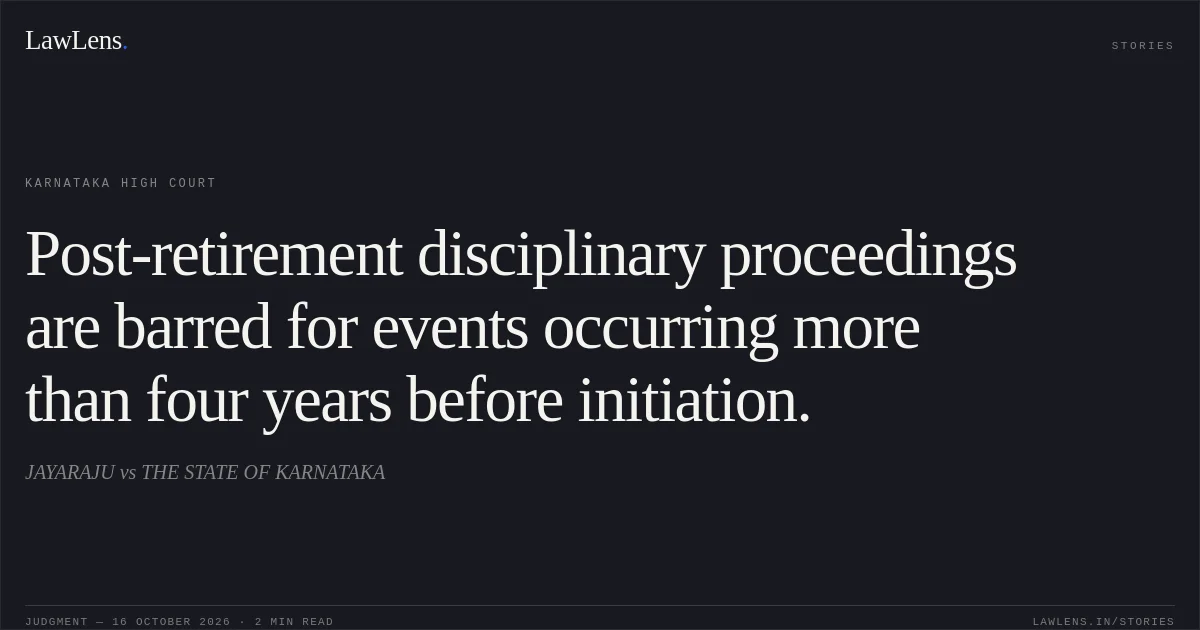
Rule 214(2)(b)(ii) of the KCSRs bars departmental proceedings instituted after a government servant’s retirement in respect of an event that occurred more than four years before institution of the proceedings; the Court treated issuance of the charge memo as the date of institution.
pp. 12–13The Court also held that proceedings against a retired government servant may be initiated only by the State Government under Rule 214(1) of the KCSRs.
p. 13Under Rule 13 of the KCS (CCA) Rules, a common disciplinary proceeding against multiple government servants requires an order by the Government or other authority competent to impose the penalty of dismissal on all of them.
pp. 14–15The Court further stated that non-compliance with the prescribed inquiry procedure vitiates the proceedings.
p. 1504Reasoning
The second petitioner’s charge memo was issued on 23 May 2014, more than four years after the events alleged, and therefore fell within the bar in Rule 214(2)(b)(ii).
pp. 13, 15–16The charge memo was issued by the Zilla Panchayat CEO, whom the Court held was not competent to initiate proceedings against a retired government servant; the cited letter granting “permission” did not constitute a Government order authorising the inquiry.
pp. 13, 15–16As to the first petitioner, although separate charge memos had been issued, the Enquiry Officer combined the inquiries, recorded common evidence, and submitted a common report without an order under Rule 13.
pp. 14–15The Court held that the absence of that order vitiated the inquiry and rejected the Tribunal’s view that the petitioners had to demonstrate prejudice.
pp. 14–1505Holding
The Court answered both issues in the affirmative, allowed the writ petition, set aside the Tribunal’s order, and quashed the penalty order dated 9 June 2017.
p. 16It directed the respondents to reinstate the first petitioner, with consequential benefits but without arrears of salary on the principle of “no work, no pay,” and to settle the second petitioner’s pensionary benefits within three months.
pp. 16–17Original Court PDF
JAYARAJUvsTHE STATE OF KARNATAKA
Click to open original judgment
Original judgment, available to read, download and summarize on LawLens.in