Facts
On June 21, 2012, the claimant, a Head Constable in the Delhi Police, suffered a motorcycle accident involving an offending Maruti Swift car.
Source reference: p. 2The accident resulted in the amputation of one-third of his right lower limb, leaving him with a 60% permanent physical disability.
Source reference: p. 5The Motor Accident Claims Tribunal (MACT) awarded compensation of ₹24,02,832 with 7.5% interest.
Source reference: p. 2Both the Insurance Company and the claimant filed cross-appeals: the former seeking reduction based on alleged lack of evidence for agricultural income and prosthetic costs, and the latter seeking enhancement regarding functional disability and future prospects.
Source reference: p. 2-3Issues
1. Whether the functional disability should be assessed at 70% or 60% based on the nature of the claimant's employment.
Source reference: p. 4-5 / para 5.12. Whether the claimant is entitled to compensation for four prosthetic limbs and increased maintenance costs based on life expectancy.
Source reference: p. 5-6 / para 5.23. Whether future prospects and a multiplier for post-retirement loss of income should be granted to a salaried public sector employee.
Source reference: p. 6-7 / para 5.54. Whether pensionary benefits and specific salary allowances (Transport and Ration money) should be excluded from the computation of income.
Source reference: p. 6-7 / para 5.4, 6Law Applied
The Court applied the principles from Raj Kumar v. Ajay Kumar (2011) regarding the assessment of functional disability versus physical disability.
Source reference: p. 5It relied on Mohd. Sabeer v. U.P. SRTC (2023) for determining the frequency and cost of prosthetic replacements over a lifetime.
Source reference: p. 3, 5Regarding income calculation, it applied Manorma Sinha v. Oriental Insurance (2025) and Meenakshi v. Oriental Insurance (2024), which hold that allowances beneficial to the family form part of "income".
Source reference: p. 6For loss of post-retirement earning capacity, the Court followed Govind Singh Mauni v. Tej Bhan (2026), applying a multiplier of '9' for periods following superannuation.
Source reference: p. 6-7It applied Hanumantharaju B v. M. Akram Pasha (2025), establishing that pension and retirement benefits are statutory rights and cannot be deducted as "pecuniary advantages" from accident compensation.
Source reference: p. 7-9Reasoning
The Court reduced functional disability from 70% to 60%, aligning it with the medical certificate, noting that while mobility is critical for a policeman, the evidence did not support an upward departure.
Source reference: para 5.1The Court rejected the challenge to prosthetic costs, noting that testimony from a reputable company (Endolite India Ltd.) was credible; given the claimant’s age (47) and a 7-8 year prosthetic life, it increased the award from two to four limbs.
Source reference: para 5.2The Court deleted the ₹50,000 agricultural income award due to lack of evidence.
Source reference: para 5.3Critically, the Court recalculated the benchmark income to include Transport and Ration allowances, excluding only washing and convenience allowances.
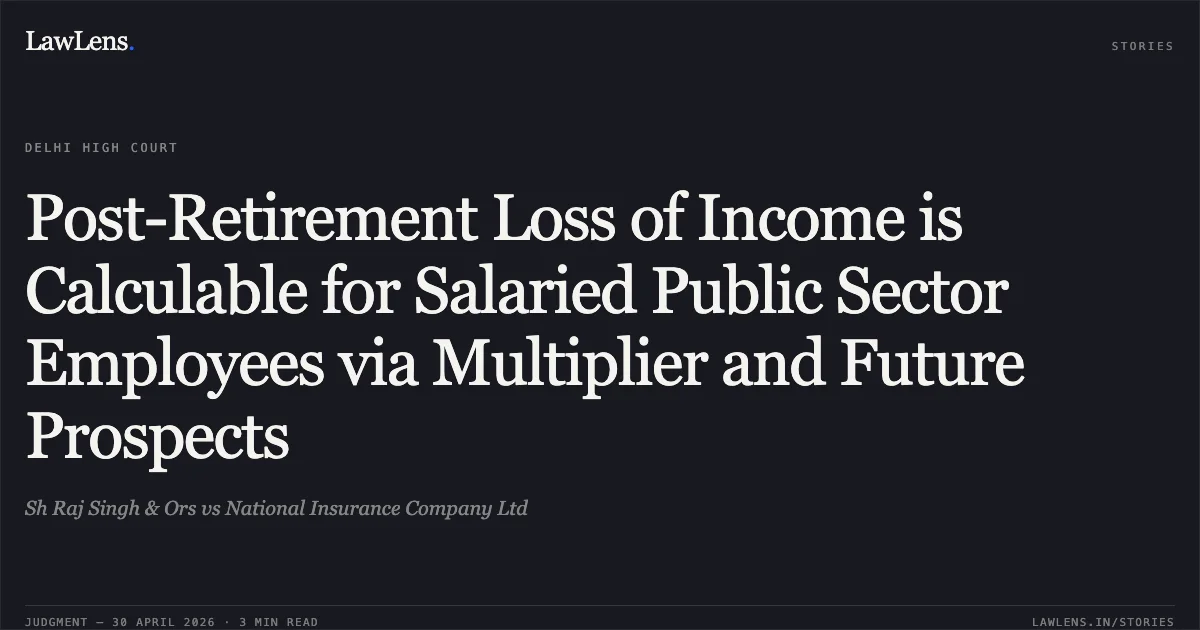
Source reference: para 5.4Since the claimant remained in service, his primary loss would be post-retirement earning potential, necessitating a 30% addition for future prospects and a multiplier of 9 for the post-60 age bracket.
Source reference: para 5.5, 5.6Holding
The Court held that functional disability is 60%, the multiplier for post-retirement loss is 9, and future prospects are 30%.
The Court partially allowed both appeals, enhancing the total compensation by ₹9,42,919 to a revised total of ₹33,51,751 (excluding specific prosthetic deposits).
Source reference: p. 10-11The Court directed the Insurance Company to deposit the enhanced amount with 7.5% interest and further ordered the deposit of ₹3,20,000 for four prosthetic limbs and ₹1,00,000 for maintenance into an interest-bearing account, to be disbursed only upon production of actual purchase invoices.
Source reference: p. 11-12Acts & Sections Cited
3 provisions across 1 statute referred to in this judgment. Each provision opens on LawLens.
Motor Vehicles Act, 19883
Original Court PDF
Sh Raj Singh & OrsvsNational Insurance Company Ltd
Click to open original judgment
Original judgment, available to read, download and summarize on LawLens.in