01Facts
The petitioner was appointed as an Upper Division Teacher in 1988 and subsequently retired as a Lecturer on 30 November 2023.
During scrutiny of his service book by the District Pension Office, an alleged error in pay fixation was detected for the period from 24 November 2012 to 30 November 2023.
¶ 2Based on that objection, the respondents issued an order/Pension Payment Order dated 20 May 2024 directing recovery of ₹5,77,269 from the petitioner’s retiral benefits.
¶ 2The petitioner challenged the recovery on the grounds that it was made after retirement, without notice or hearing, and without any fraud, misrepresentation, or fault on his part.
¶ 3The State contended that the petitioner was a Class-II employee and had furnished an undertaking agreeing to refund any excess payment, thereby permitting recovery.
¶ 402Issues
i.Whether recovery of alleged excess salary payments could be made from the petitioner after his retirement, particularly where the excess payment related to a period exceeding five years?
¶ 7, 11ii.Whether recovery was invalid for having been ordered without issuing a show-cause notice or affording the petitioner an opportunity of hearing?
¶ 3, 8, 11iii.Whether the undertaking relied upon by the State authorised recovery of the alleged excess payment?
¶ 4, 6, 9–1003Law Applied
The Court applied the principles in State of Punjab v. Rafiq Masih (White Washer), (2015) 4 SCC 334, under which recovery is ordinarily impermissible from retired employees and where excess payment has continued for more than five years before the recovery order.
¶ 7It relied on the Full Bench decision in State of Madhya Pradesh v. Jagdish Prasad Dubey, (2024) 2 MPLJ 198, holding that recovery based on an undertaking may be permissible where the undertaking was voluntarily given, but an undertaking obtained as a condition for grant of a financial benefit is generally treated as forced and is unenforceable unless voluntariness is established; procedural safeguards must also be followed.
¶ 6The Court further relied on Central Inland Water Transport Corporation Ltd. v. Brojo Nath Ganguly, (1986) 3 SCC 156, concerning unequal bargaining power and forced undertakings.
¶ 10Jogeswar Sahoo v. District Judge, Cuttack, 2025 (3) MPLJ (SC) 25, held recovery unsustainable where retired employees were not given an opportunity of hearing and the excess payment was not attributable to fraud or misrepresentation.
¶ 8The Court also followed Ravindra Kumar Joshi v. State of Madhya Pradesh, W.P. No. 17831 of 2019, decided on 13 May 2024, which placed the burden on the State to establish that the undertaking was voluntarily furnished.
¶ 904Reasoning
The Court found that the alleged excess payment arose from an erroneous pay fixation made by the department and that there was no allegation of fraud or misrepresentation by the petitioner.
¶ 2–3, 8The recovery was initiated after the petitioner’s retirement and related to payments made over a period of more than eleven years, from 24 November 2012 until 30 November 2023.
¶ 11Consequently, both the retired-employee protection and the five-year limitation principle in Rafiq Masih applied, irrespective of the petitioner’s status as a Class-II employee.
¶ 11The recovery was also made without a show-cause notice or opportunity of hearing, contrary to natural justice.
¶ 3, 8, 11Although the State relied on an undertaking, the Court held that no specific undertaking given at the time of the relevant pay fixation on 24 November 2012 had been produced.
¶ 9–10In any event, the State failed to establish that the undertaking was voluntarily given; therefore, it could not support recovery under Jagdish Prasad Dubey and Ravindra Kumar Joshi.
¶ 9–1005Holding
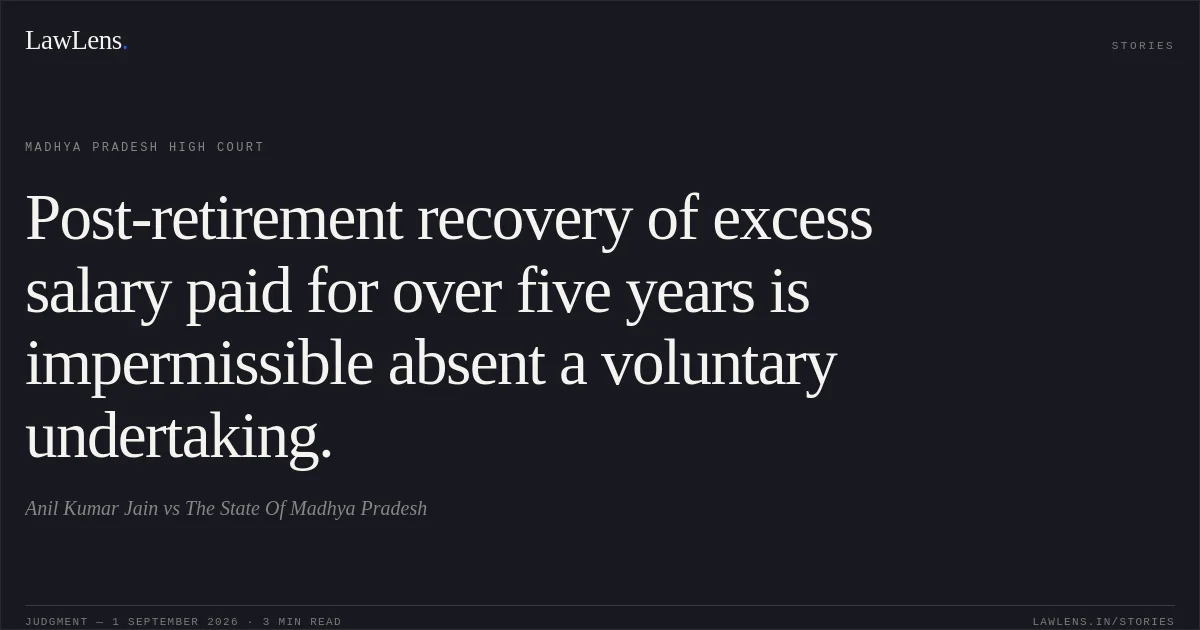
The Court held that recovery of ₹5,77,269 from the petitioner was legally impermissible because it was initiated after retirement, related to excess payments made for more than five years, was ordered without observance of natural justice, and was not supported by a proven voluntary undertaking.
¶ 11The impugned recovery was set aside, and the respondents were directed to refund ₹5,77,269, with interest at 6% per annum from the date of retirement until actual payment, subject to the clarification that no refund would be payable if the amount had not in fact been recovered from the petitioner’s retiral dues.
¶ 11The refund exercise was to be completed within 90 days of submission of the certified copy of the order; failing that, interest would accrue at 12% per annum until actual payment.
¶ 12The petition was accordingly disposed of.
¶ 13Original Court PDF
Anil Kumar JainvsThe State Of Madhya Pradesh
Click to open original judgment
Original judgment, available to read, download and summarize on LawLens.in