Facts
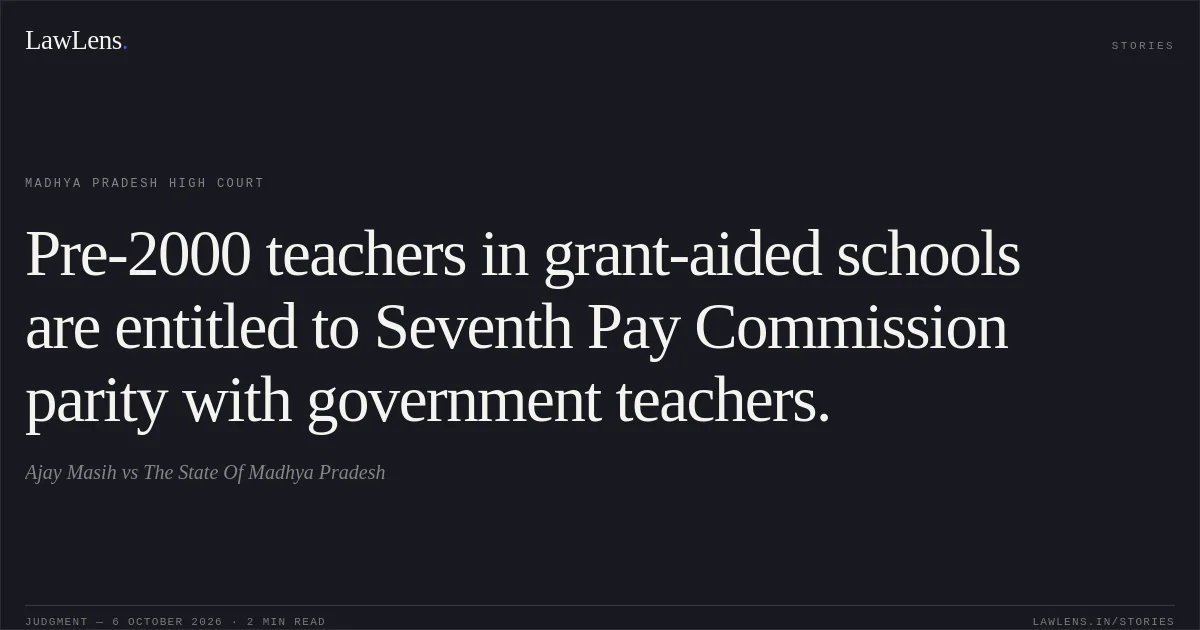
The petitioners, teachers at a grant-in-aid school, sought Seventh Pay Commission benefits from 1 January 2016, including arrears. They claimed entitlement on the basis that they were appointed before 31 March 2000 and that the State had extended the corresponding pay revision to teachers in Government schools.
Source reference: para. 1–2They relied on a Division Bench decision concerning aided-college teachers, which had directed payment of Seventh Pay Commission benefits to pre-amendment appointees. The State opposed the petition but identified no distinguishing feature from that decision.
Source reference: para. 3–4Issues
Whether teachers in the petitioners’ position—appointed before 31 March 2000 in a grant-in-aid institution—were entitled to Seventh Pay Commission benefits from 1 January 2016 on parity with corresponding Government-school teachers.
Source reference: para. 2–3Whether the State could withhold those benefits in the absence of a distinguishing feature from the Division Bench ruling relied upon by the petitioners.
Source reference: para. 3–4Law Applied
The Court applied the Madhya Pradesh Ashaskiya Shikshan Sanstha (Adhyapakon Tatha Anya Karmachariyon Ke Vetano Ka Sandaya) Adhiniyam, 1978, as amended in 2000, and the Revised Rules for Grant-in-aid to Non-Government Educational Institutions in Madhya Pradesh, particularly Rule 33(i). Under Rule 33(i), the pay scales of teachers and other employees of grant-receiving institutions are to correspond to those sanctioned for equivalent categories in Government educational institutions.
Source reference: para. 3The Division Bench decision in W.A. No. 647 of 2025, relying on State of Madhya Pradesh v. Sharique A. Ali, Civil Appeal No. 6364 of 2004 (reported at (2020) 20 SCC 450), treated employees appointed before the 2000 amendment took effect on 1 April 2000 as protected by the unamended Act and Rules. The Division Bench also relied on Suresh Kumar Dwivedi v. State of Madhya Pradesh, 1993 MPLJ 663, concerning parity in revised pay scales for aided-institution employees.
Source reference: para. 3Reasoning
The Court accepted the petitioners’ reliance on the Division Bench ruling and noted that the State could point to no material distinction between that case and the present one.
Source reference: para. 3–4Applying the position stated in that ruling, pre-amendment appointees were governed by the unamended Act and Rules, including Rule 33(i)’s pay-scale parity requirement. Since the Seventh Pay Commission benefits had been extended to corresponding categories of Government-school teachers, the Court directed that the petitioners receive the same pay scale and consequential benefits.
Source reference: para. 3–5Holding
The Court disposed of the petition and directed the competent authority to extend and disburse Seventh Pay Commission benefits to the petitioners from 1 January 2016, on the same pay scale and with the same consequential benefits admissible to corresponding Government-school teachers.
It directed payment of 25% of the arrears within three months and the balance within nine months, with payment to be made directly into the covered employees’ and teachers’ bank accounts.
Source reference: para. 6–7Original Court PDF
Ajay MasihvsThe State Of Madhya Pradesh
Click to open original judgment
Original judgment, available to read, download and summarize on LawLens.in